
Sign In to Your Account
Subscribers have complete access to the archive.
Sign In Not a Subscriber?Join NowRAJPUT PAINTING
And Its Artistic Sisterhood to "Modernist" Art
ANANDA COOMARASWAMY
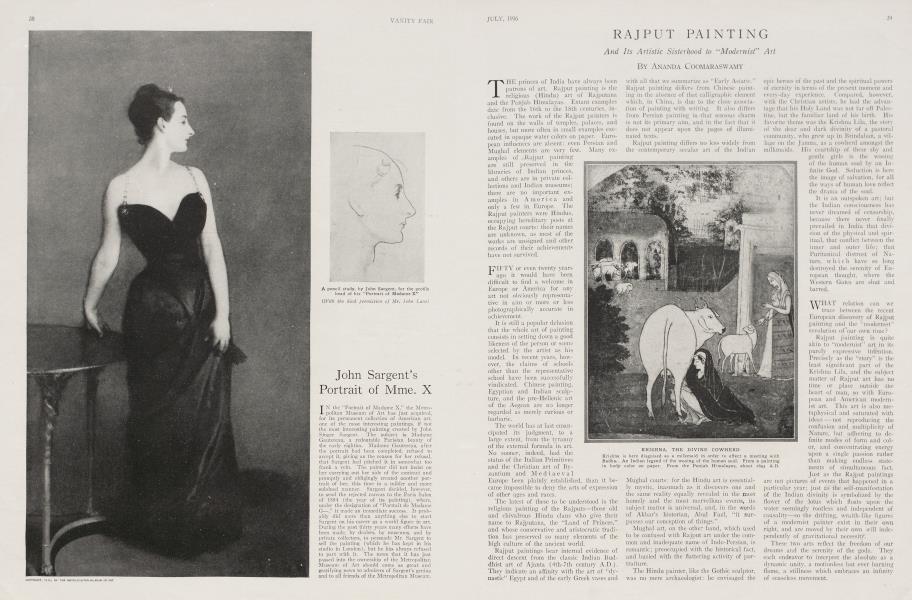
THE princes of India have always been patrons of art. Rajput painting is the religious (Hindu) art of Rajputana and the Panjab Himalayas. Extant examples date from the 16th to the 18th centuries, inclusive. The work of the Rajput painters is found on the walls of temples, palaces, and houses, but more often in small examples executed in opaque water colors on paper. European influences are absent: even Persian and Mughal elements are very few. Many examples of Rajput painting are still preserved in the libraries of Indian princes, and others are in private collections and Indian museums; there are no important examples in America and only a few in Europe. The Rajput painters were Hindus, occupying hereditary posts at the Rajput courts: their names are unknown, as most of the works are unsigned and other records of their achievements have not survived.
FIFTY or even twenty years ago it would have been difficult to find a welcome in Europe or America for any art not obviously representative in aim or more or less photographically accurate in achievement.
It is still a popular delusion that the whole art of painting consists in setting down a good likeness of the person or scene selected by the artist as his model. In recent years, however, the claims of schools other than the representative school have been successfully vindicated. Chinese painting, Egyptian and Indian sculpture, and the pre-Hellenic art of the Aegean are no longer regarded as merely curious or barbaric.
The world has at last emancipated its judgment, to a large extent, from the tyranny of the external formula in art.
No sooner, indeed, had the status of the Italian Primitives and the Christian art of Byzantium and Mediaeval Europe been plainly established, than it became impossible to deny the arts of expression of other ages and races.
The latest of these to be understood is the religious painting of the Rajputs—those old and chivalrous Hindu clans who give their name to Rajputana, the "Land of Princes," and whose conservative and aristocratic tradition has preserved so many elements of the high culture of the ancient world.
Rajput paintings bear internal evidence of direct descent from the classic Indian Buddhist art of Ajanta (4th-7th century A.D.). They indicate an affinity with the art of "dynastic" Egypt and of the early Greek vases and with all that we summarize as "Early Asiatic." Rajput painting differs from Chinese painting in the absence of that calligraphic element which, in China, is due to the close association of painting with writing. It also differs from Persian painting in that sensous charm is not its primary aim, and in the fact that it does not appear upon the pages of illuminated texts.
Rajput painting differs no less widely from the contemporary secular art of the Indian Mughal courts: for the Hindu art is essentially mystic, inasmuch as it discovers one and the same reality equally revealed in the most homely and the most marvellous events, its subject matter is universal, and, in the words of Akbar's historian, Abul Fazl, "it surpasses our conception of things."
Mughal art, on the other hand, which used to be confused with Rajput art under the common and inadequate name of Indo-Persian, is romantic; preoccupied with the historical fact, and busied with the flattering activity of portraiture.
The Hindu painter, like the Gothic sculptor, was no mere archaeologist: he envisaged the epic heroes of the past and the spiritual powers of eternity in terms of the present moment and every-day experience. Compared, however, with the Christian artists, he had the advantage that his Holy Land was not far off Palestine, but the familiar land of his birth. His favorite theme was the Krishna Lila, the story of the dear and dark divinity of a pastoral community, who grew up in Brindaban, a village on the Jamna, as a cowherd amongst the milkmaids. His courtship of these shy and gentle girls is the wooing of the human soul by an Infinite God. Seduction is here the image of salvation, for all the ways of human love reflect the drama of the soul.
It is an outspoken art; but the Indian consciousness has never dreamed of censorship, because there never finally prevailed in India that division of the physical and spiritual, that conflict between the inner and outer life; that Puritanical distrust of Nature, w h i c h have so long destroyed the serenity of European thought, where the Western Gates are shut and barred.
WHAT relation can we trace between the recent European discovery of Rajput painting and the "modernist" revolution of our own time?
Rajput painting is quite akin to "modernist" art in its purely expressive intention. Precisely as the "story" is the least significant part of the Krishna Lila, and the subject matter of Rajput art has no time or place outside the heart of man, so with European and American modernist art. This art is also metaphysical and saturated with ideas — not reproducing the confusion and multiplicity of Nature, but adhering to definite modes of form and color, and concentrating energy upon a single passion rather than making endless statements of simultaneous fact. Just as the Rajput paintings are not pictures of events that happened in a particular year; just as the self-manifestation of the Indian divinity is symbolized by the flower of the lotus which floats upon the water seemingly rootless and independent of causality—so the drifting, wraith-like figures of a modernist painter exist in their own right, and are moved by their own will independently of gravitational necessity.
These two arts reflect the freedom of our dreams and the serenity of the gods. They each endeavor to interpret the absolute as a dynamic unity, a motionless but ever burning flame, a stillness which embraces an infinity of ceaseless movement.
Subscribers have complete access to the archive.
Sign In Not a Subscriber?Join Now