Sign In to Your Account
Subscribers have complete access to the archive.
Sign In Not a Subscriber?Join NowErik Satie: Master of the Rigolo
A French Extremist in Modernist Music
CARL VAN VECHTEN
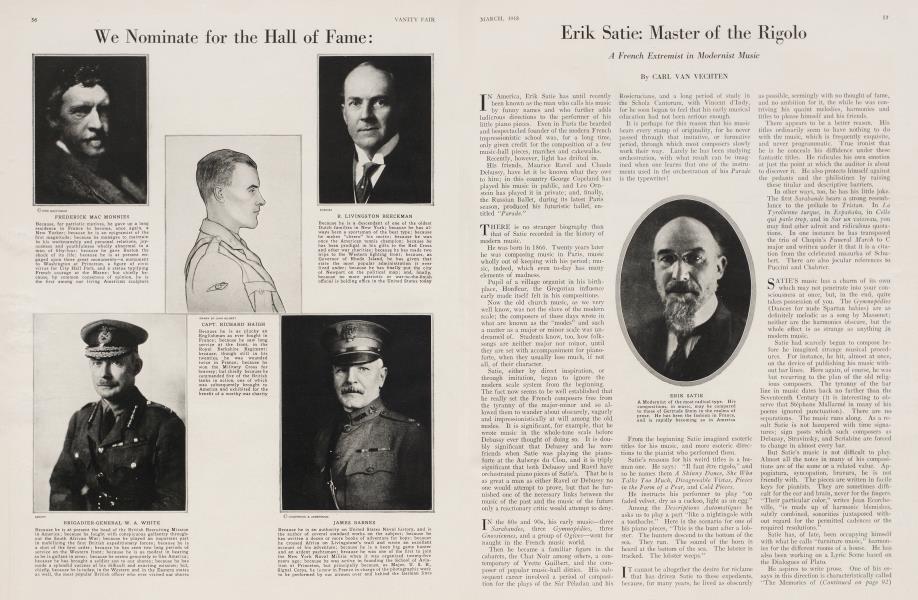
IN America, Erik Satie has until recently been known as the man who calls his music by funny names and who further adds ludicrous directions to the performer of his little piano pieces. Even in Paris the bearded and bespectacled founder of the modern French impressionistic school was, for a long time, only given credit for the composition of a few music-hall pieces, marches and cakewalks. Recently, however, light has drifted in.
His friends, Maurice Ravel and Claude Debussy, have let it be known what they owe to him; in this country George Copeland has played his music in public, and Leo Ornstein has played it in private; and, finally, the Russian Ballet, during its latest Paris season, produced his futuristic ballet, entitled "Parade"
THERE is no stranger biography than that of Satie recorded in the history of modem music.
He was bom in 1866. Twenty years later he was composing music in Paris, music wholly out of keeping with his period; music, indeed, which even to-day has many elements of madness.
Pupil of a village organist in his birthplace, Honfleur, the Gregorian influence early made itself felt in his compositions.
Now the old church music, as we very well know, was not the slave of the modern scale; the composers of those days wrote in what are known as the "modes" and such a matter as a major or minor scale was undreamed of. Students know, too, how folksongs are neither major nor minor, until they are set with accompaniment for pianoforte, when they usually lose much, if not all, of their character.
Satie, either by direct inspiration, or through imitation, began to ignore the modem scale system from the beginning. The fact now seems to be well established that he really set the French composers free from the tyranny of the major-minor and so allowed them to wander about obscurely, vaguely and impressionistically at will among the old modes. It is significant, for example, that he wrote music in the whole-tone scale before Debussy ever thought of doing so. It is doubly significant that Debussy and 'he were friends when Satie was playing the pianoforte at the Auberge du Clou, and it is triply significant that both Debussy and Ravel have orchestrated piano pieces of Satie's. That he is as great a man as either Ravel or Debussy no one would attempt to prove, but that he furnished one of the necessary links between the music of the past and the music of the future only a reactionary critic would attempt to deny.
IN the 80s and 90s, his early music—three Sarabandes, three Gymnopedies, three Gnossiennes, and a group of Ogives—went for naught in the French music world.
Then he became. a familiar figure in the cabarets, the Chat Noir among others, a contemporary of Yvette Guilbert, and the composer of popular music-hall ditties. His subsequent career involved a period of composition for the plays of the Sâr Péladan and his Rosicrucians, and a long period of study in the Schola Cantorum, with Vincent d'Indy, for he soon began to feel that his early musical education had not been serious enough.
It is perhaps for this reason that his music bears every stamp of originality, for he never passed through that imitative, or formative period, through which most composers slowly work their way. Lately he has been studying orchestration, with what result can be imagined when one learns that one of the instruments used in the orchestration of his Parade is the typewriter!
From the beginning Satie imagined esoteric titles for his music, and more esoteric directions to the pianist who performed them.
Satie's reasons for his weird titles is a human one. He says: "Il faut être rigolo," and so he names them A Skinny Dance, She Who Talks Too Much, Disagreeable Vistas, Pieces in the Form of a Pear, and Cold Pieces.
He instructs his performer to play "on faded velvet, dry as a cuckoo, light as an egg."
Among the Descriptions Automatiques he asks us to play a part "like a nightingale with a toothache." Here is the scenario for one of his piano pieces, "This is the hunt after a lobster. The hunters descend to the bottom of the sea. They run. The sound of the horn is heard at the bottom of the sea. The lobster is tracked. The lobster weeps."
IT cannot be altogether the desire for reclame that has driven Satie to these expedients, because, for many years, he lived as obscurely as possible, seemingly with no thought of fame, and no ambition for it, the while he was contriving his quaint melodies, harmonies and titles to please himself and his friends.
There appears to be a better reason. His titles ordinarily seem to have nothing to do with the music, which is frequently exquisite, and never programmatic. True ironist that he is he conceals his diffidence under these fantastic titles. He ridicules his own emotion at just the point at which the auditor is about to discover it. He also protects himself against the pedants and the philistines by raising these titular and descriptive barriers.
In other ways, too, he has his little joke. The first Sarabande bears a strong resemblance to the prelude to Tristan. In La Tyrolienne turque, in Españaña, in Celle qui parle trop, and in Sur un vaisseau, you may find other adroit and ridiculous quotations. In one instance he has transposed the trio of Chopin's Funeral March to C major and written under it that it is a citation from the celebrated mazurka of Schubert. There are also jocular references to Puccini and Chabrier.
SATIE'S music has a charm of its own which may not penetrate into your consciousness at once, but, in the end, quite takes possession of you. The Gymnopedies (Dances for nude Spartan babies) are as definitely melodic as a song by Massenet; neither are the harmonies obscure, but the whole effect is as strange as anything jn modem music.
Satie had scarcely begun to compose before he imagined strange musical procedures. For instance, he hit, almost at once, on the device of publishing his music without bar lines. Here again, of course, he was but recurring to the plan of the old religious composers. The tyranny of the bar line in music dates back no farther than the Seventeenth Century (it is interesting to observe that Stéphane Mallarmé in many of his poems ignored punctuation). There are no separations. The music runs along. As a result Satie is not hampered with time signatures; sign posts which such composers as Debussy, Stravinsky, and Scriabine are forced to change in almost every bar.
But Satie's music is not difficult to play. Almost all the notes in many of his compositions are of the same or a related value. Appogiatura, syncopation, bravura, he is not friendly with. The pieces are written in facile keys for pianists. They are sometimes difficult for the ear and brain, never for the fingers. "Their particular color," writes Jean Ecorcheville, "is made up of harmonic blemishes, subtly combined, sonorities juxtaposed without regard for the permitted cadences or the required resolutions."
Satie has, of late, been occupying himself with what he calls "furniture music," harmonies for the different rooms of a house. He has also been working on a Lyric Scene based on the Dialogues of Plato.
He aspires to write prose. One of his essays in this direction is characteristically called "The Memories of a Man Who Can Remember Nothing," he evidently believes that in his prose, too, "II faut etre rigolo."
Continued on page 92
(Continued from page 57)
For the ballet, Parade, Jean Cocteau, poet, Pablo Picasso, painter, and Leonide Miassine, choreographer, collaborated with Satie. The result has been dubbed by a Parisian critic, "Simultaneity."
The ballet, which has an occult and symbolic significance (probably a Freudian significance as well), concerns figures who, while parading in front of a circus, express the entertainment inside in such a manner as to deceive the public into the belief that they are witnessing the entertainment itself. As a result the combined efforts of performers and showmen is insufficient to induce the public to enter.
SATIE'S music in "Parade" appears to have created as great a disturbance as that provoked by the original production of Stravinsky's Sacre dn Printemps. There was laughing, there was howling, there were cat-calls. Nor were the critics pleased.
This was one of the few occasions on which Satie has been dragged into the light of the theatre or the concert-hall. His real emergence from deep obscurity (an obscurity which had lasted twenty-five years!) occurred on January 16, 1911, when Ravel played three of his compositions, including one of the now famous Sarabandes at a concert of the Societe Musicale Independents.
Since then Riccardo Vines has given many auditions of his works in Paris. London, too, has heard some of his music. New York has not fared so well, although one of his compositions was played, under the direction of Pierre Monteux, at the somewhat extraordinary evening of dance provided by Valentine de Saint Point last Spring at the Metropolitan Opera House.
SATIE, as a man, is extremely shy. He seldom goes, out. He is not a familiar boulevard figure. Aside from a few intimate friends, he sees very few people. Even in Paris his music is not as yet widely known. He is more of a musician's musician than a musician to the crowd. However, he is rapidly beginning to have his disciples. More and more his music sells; more and more it is published. Indeed the list of his published works is already extensive.
Subscribers have complete access to the archive.
Sign In Not a Subscriber?Join Now
