Sign In to Your Account
Subscribers have complete access to the archive.
Sign In Not a Subscriber?Join NowCOUNTÉE CULLEN
Carl Van Vechten
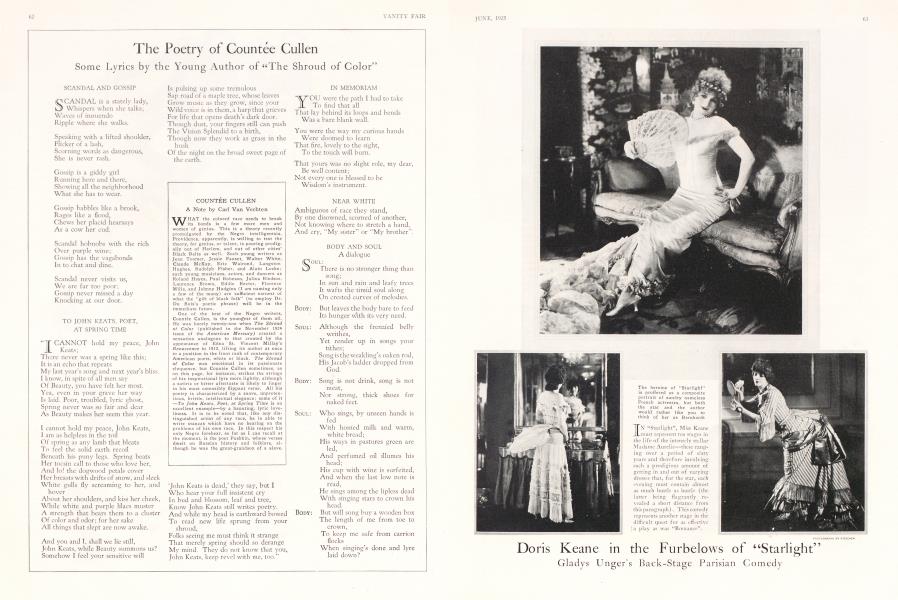
WHAT the colored race needs to break its bonds is a few more men and women of genius. This is a theory recently promulgated by the Negro intelligentsia. Providence, apparently, is willing to test the theory, for genius, or talent, is pouring prodigally out of Harlem, and out of other cities' Black Belts as well. Such young writers as Jean Toomer, Jessie Fauset, Walter White, Claude McKay, Eric Walrond, Langston Hughes, Rudolph Fisher, and Alain Locke; such young musicians, actors, and dancers as Roland Hayes, Paul Robeson, Julius Bledsoe, Laurence Brown, Eddie Rector, Florence Mills, and Johnny Hudgins (I am naming only a few of the many) are sufficient earnest of what the "gift of black folk" (to employ Dr. Du Bois's poetic phrase) will be in the immediate future.
One of the best of the Negro writers, Countee Cullen, is the youngest of them all. He was barely twenty-one when The Shroud of Color (published in the November 1924 issue of the American Mercury) created a sensation analogous to that created by the appearance of Edna St. Vincent Millay's Renascence in 1912, lifting its author at once to a position in the front rank of contemporary American poets, white or black. The Shroud of Color was emotional in its passionate eloquence, but Count6e Cullen sometimes, as on this page, for instance, strikes the strings of his inspirational lyre more lightly, although a satiric or bitter aftertaste is likely to linger in his most ostensibly flippant verse. All his poetry is characterized by a suave, unpretentious, brittle, intellectual elegance; some of it —To John Keats, Poet, at Spring Time is an excellent example—by a haunting, lyric loveliness. It is to be noted that, like any distinguished artist of any race, he is able to write stanzas which have no bearing on the problems of his own race. In this respect his only Negro forebear, so far as I can recall at the moment, is the poet Pushkin, whose verses dwelt on Russian history and folklore, although he was the great-grandson of a slave.
Subscribers have complete access to the archive.
Sign In Not a Subscriber?Join Now