Sign In to Your Account
Subscribers have complete access to the archive.
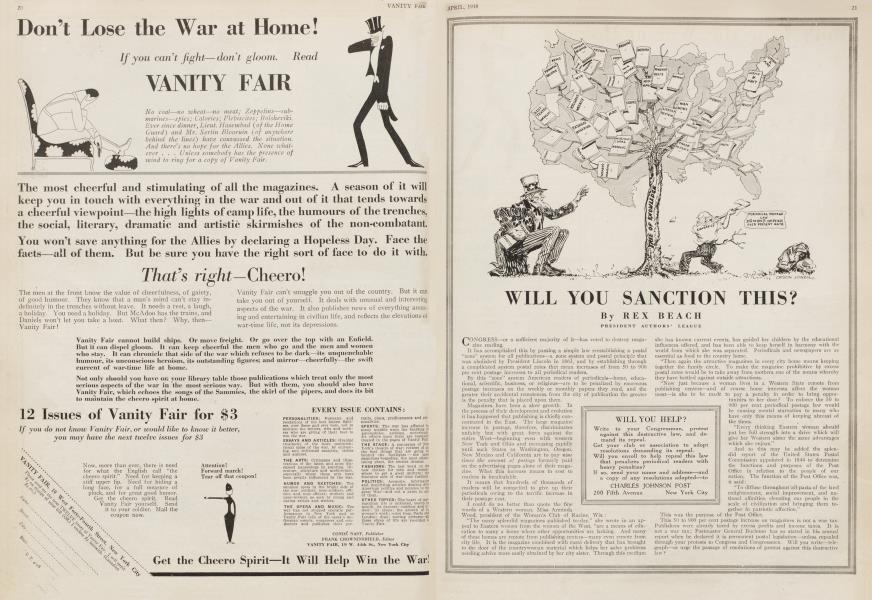
Sign In Not a Subscriber?Join NowWILL YOU SANCTION THIS?
REX BEACH
PRESIDENT AUTHORS' LEAGUE
CONGRESS—or a sufficient majority of it—has voted to destroy magazine reading.
It has accomplished this by passing a simple law reestablishing a postal "zone" system for all publications—a zone system and postal principle that was abolished by President Lincoln in 1863, and by establishing through a complicated system postal rates that mean increases of from 50 to 900 per cent postage increases to all periodical readers.
By this "zone" system American readers of periodicals—home, educational, scientific, business, or religious—are to be penalized by enormous postage increases on the weekly or monthly papers they read, and the greater their accidental remoteness from the city of publication the greater is the penalty that is placed upon them.
Magazines have been a slow growth. In the process of their development and evolution it has happened that publishing is chiefly concentrated in the East. The large magazine increase in postage, therefore, discriminates unfairly but with great force against the entire West—beginning even with western New York and Ohio and increasing rapidly until such States as Washington, Oregon,
New Mexico and California are to pay nine times the amount of postage formerly paid on the advertising pages alone of their magazine. What this increase means in cost to readers is incalculable.
It means that hundreds of thousands of readers will be compelled to give up their periodicals owing to the terrific increase in their postage cost.
I could do no better than quote the fine words of a Western woman, Miss Arminda Wood, president of the Woman's Club of Racine, Wis.:
"The many splendid magazines published to-day," she wrote in an appeal to Eastern women from the women of the West, "are a means of education to many a home where other opportunities are lacking. And many of these homes are remote from publishing centers—many even remote from city life. It is the magazine combined with rural delivery that has brought to the door of the countrywoman material which helps her solve problems needing advice more easily obtained by her city sister. Through this medium she has known current events, has guided her children by the educational influences offered, and has been able to keep herself in harmony with the world from which she was separated. Periodicals and newspapers are as essential as food to the country home.
"Then again the attractive magazines in every city home means keeping together the family circle. To make the magazine prohibitive by excess postal rates would be to take away from mothers one of the means whereby they have battled against outside attractions.
"Now just because a woman lives in a Western State remote from publishing centers—and of course home interests affect the woman most—is she to be made to pay a penalty in order to bring opportunities to her door? To enforce the 50 to 900 per cent periodical postage law would be causing mental starvation to many who have only this means of keeping abreast of the times.
"Every thinking Eastern woman should put her full strength into a drive which will give her Western sister the same advantages which she enjoys."
And to this may be added the splendid report of the United States Postal Commission appointed in 1844 to determine the functions and purposes of the Post Office in relation to the people of our nation. The function of the Post Office was, it said:
"To diffuse throughout all parts of the land enlightenment, social improvement, and national affinities, elevating our people in the scale of civilization and bringing them together in patriotic affection."
This was the purpose of the Post Office.
This 50 to 900 per cent postage increase on magazines is not a war tax. Publishers were already taxed by excess profits and income taxes. It is not a war tax; Postmaster General Burleson has so stated in his annual report when he declared it is permanent postal legislation—unless repealed through your protests to Congress and Congressmen. Will you write—telegraph—or urge the passage of resolutions of protest against this destructive law?
Subscribers have complete access to the archive.
Sign In Not a Subscriber?Join Now