Sign In to Your Account
Subscribers have complete access to the archive.
Sign In Not a Subscriber?Join Now"Could You Write a Play?"
'Feudal Methods Still Prevail in the Theatrical Trade
PHILIP CURTISS
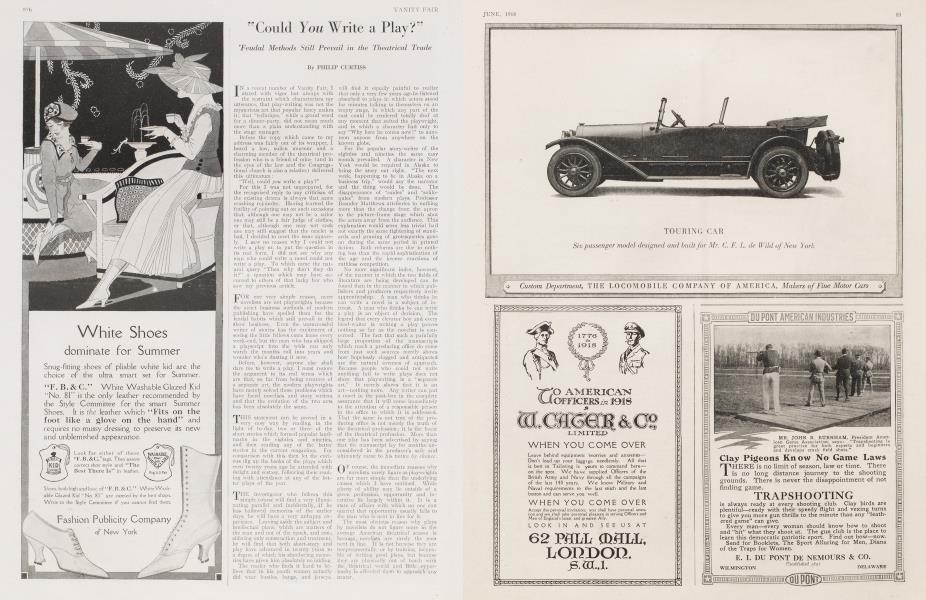
IN a recent number of Vanity Fair, I stated with vigor but always with the restraint which characterizes my utterance, that play-writing was not the mysterious art that popular fancy makes it; that "technique," while a grand word for a dinner-party, did not mean much more than a plain understanding with the stage manager.
Before the copy which came to my address was fairly out of its wrapper, I heard a low, sullen murmur and a charming member of the theatrical profession who is a friend of mine (and in the eyes of the law and the Congregational church is also a relative) delivered this ultimatum:
"Well, could you write a play?"
For this I was not unprepared, for the recognized reply to any criticism of the existing drama is always that same crushing rejoinder. Having learned the futility of pointing out on such occasions that, although one may not be a tailor one may still be a fair judge of clothes, or that, although one may not cook one may still suggest that the omelet is bad, I decided to meet the issue squarely. I saw no reason why I could not write a play or, to put the question in its real form, I did not see why any man who could write a novel could not write a play. To which came the natural query "Then why don't they do it?" a question which may have occurred to others of that lucky few who saw my previous article.
FOR one very simple reason, more novelists are not playwrights because the strict business methods of modern publishing have spoiled them for the feudal habits which still prevail in the Show business. Even the unsuccessful writer of stories has the excitement of seeing the little fellows come home every week-end, but the man who has shipped a playscript into the wide can only watch the months roll into years and wonder who's dusting it now.
Before, however, anyone else shall dare me to write a play, I must restore the argument to its real terms which are that, so far from being creators of a separate art, the modern playwrights have merely solved those problems which have faced novelists and story writers and that the evolution of the two arts has been absolutely the same.
THIS statement can be proved in a very easy way by reading, in the light of to-day, two or three of the short stories which formed popular landmarks in the eighties and nineties, and then reading any of the better stories in the current magazines. For comparison with this then let the curious dig up the books of the plays which even twenty years ago he attended with delight and ecstasy, following their reading with attendance at any of the better plays of the year.
THE investigator who follows this simple course will find a very illuminating parallel and incidentally, if he has hallowed memories of the earlier days, he will have a very unhappy experience. Leaving aside the subject and intellectual plane, which are matters of the man and not of the epoch, and considering only construction and treatment, he will find that both short-story and play have advanced in twenty years to a degree of which his slumbering memories have given him absolutely no inkling.
The reader who finds it hard to believe that in his youth women actually did wear bustles, bangs, and jerseys, will find it equally painful to realize that only a very few years ago he listened absorbed to plays in which actors stood for minutes talking to themselves on an empty stage, in which any part of the cast could be rendered totally deaf at any moment that suited the playwright, and in which a character had only to say "Why here he comes now!" to summon anyone from anywhere on the known globe.
For the popular story-writer of the eighties and nineties the same easy morals prevailed. A character in New York would be required in Alaska to bring the story out right. "The next week, happening to be in Alaska on a business trip," would say the narrator and the thing would be done. The disappearance of "asides" and "soliloquies" from modern plays, Professor Brander Matthews attributes to nothing more than the change from the apron to the picture-frame stage which shut the actors away from the audience. This explanation would seem less trivial had not exactly the same tightening of standards and pruning of grotesqueries gone on during the same period in printed fiction. Both reforms are due to nothing less than the rapid sophistication of the age and the keener exactions of ruthless competition.
No more significant index, however, of the manner in which the two fields of literature are being developed can be found than in the manner in which publishers and producers respectively invite apprenticeship. A man who thinks he can write a novel is a subject of interest. A man who thinks be can write a play is an object of derision. The legend that every elevator boy and every head-waiter is writing a play proves nothing so far as the novelist is concerned. The fact that such a painfully large proportion of the manuscripts which reach a producing office do come from just such sources merely shows how hopelessly clogged and antiquated are the natural avenues of approach. Because people who could not write anything fail to write plays does not show that play writing is a "separate art." It merely shows that it is an art—nothing more. Any writer can put a novel in the post-box in the complete assurance that it will come immediately to the attention of a responsible person in the office to which it is addressed. That the same is not true of the producing office is not merely the truth of the theatrical profession; it is the boast of the theatrical profession. More than one play has been advertised by saying that the manuscript lay for months unconsidered in the producer's safe and ultimately came to his notice by chance.
OF course, the immediate reasons why novelists rarely figure as playwrights are far more simple than the underlying causes which I have outlined. While plenty of ability may lie outside of a given profession, opportunity and incentive lie largely within it. It is a state of affairs with which no one can quarrel that opportunity usually falls to the man who is next in line for it.
The most obvious reason why plays by novelists do not figure more in the average American theatrical season is because novelists are rarely the men next in line. It is hot because they are temperamentally, or by training, incapable of writing good plays, but because they are physically out of touch with the theatrical world and little . . opportunity is afforded them to approach any nearer.
Subscribers have complete access to the archive.
Sign In Not a Subscriber?Join Now