Sign In to Your Account
Subscribers have complete access to the archive.
Sign In Not a Subscriber?Join NowThe New Plays—If Any
The Actors' Strike Has Seriously Cut In on the Theatrical Season
DOROTHY PARKER
JUST at this time, writing about the new plays is rather a delicate matter. The prospect of there being any new plays left by the time the printer finishes with this is extremely hazy—in fact, there seems to be room for grave doubts as to whether there will ever be any more plays at all. Along the Rialto, things are getting on just about as smoothly as they are over in Russia. As this paper cavorts to press, only three or four plays are staggering, feebly along; eighteen theatres have already been closed by the actors' strike and at any moment the stagehands may decide to walk out and leave the remaining attractions flat. Well, it has been a great little strike so far as the moving picture houses were concerned, anyway.
Of course, it is impossible to indulge in any guesswork as to what the outcome of the strike will be. It looks from here as if the little tiff between the Actors'
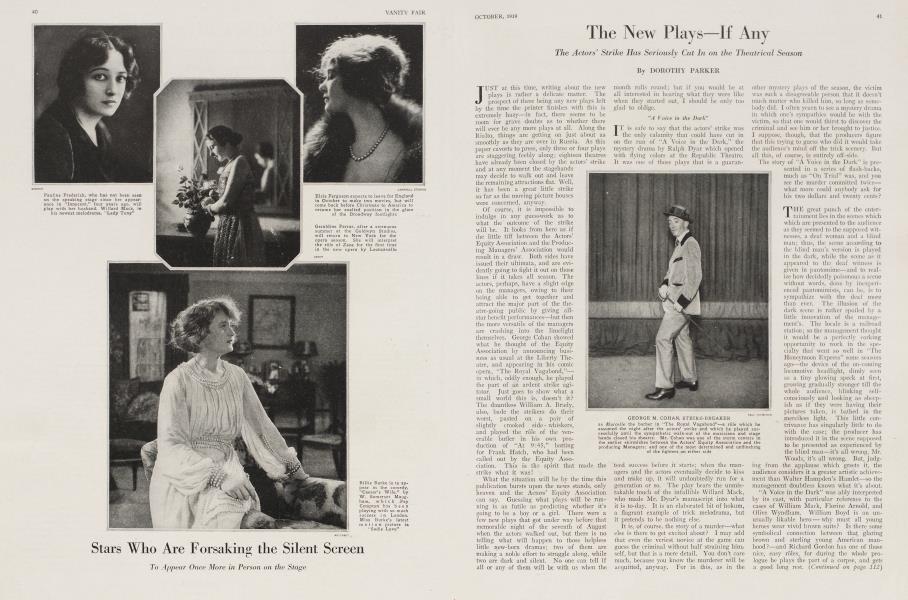
Equity Association and the Producing Managers' Association would result in a draw. Both sides have issued their ultimata, and are evidently going to fight it out on those lines if it takes all season. The actors, perhaps, have a slight edge on the managers, owing to their being able to get together and attract the major part of the theatre-going public by giving allstar benefit performances—but then the more versatile of the managers are crashing into the limelight themselves. George Cohan showed what he thought of the Equity Association by announcing business as usual at the Liberty Theatre, and appearing in his comic opera, "The Royal Vagabond,"— in which, oddly enough, he played the part of an ardent strike agitator. Just goes to show what a small world this is, doesn't it?
The dauntless William A. Brady, also, bade the strikers do their worst, pasted on a pair of slightly crooked side - whiskers, and played the role of the venerable butler in his own production of "At 9:45," batting for Frank Hatch, who had been called out by the Equity Association. This is the spirit that made the strike what it was!
What the situation will be by the time this publication bursts upon the news stands, only heaven and the Actors' Equity Association can say. Guessing what plays will be running is as futile as predicting whether it's going to be a boy or a girl. There were a few new plays that got under way before that memorable night of the seventh of August when the actors walked out, but there is no telling what will happen to those helpless little new-born dramas; two of them are making a noble effort to struggle along, while two are dark and silent. No one can tell if all or any of them will be with us when the month rolls round; but if you would be at all interested in hearing what they were like when they started out, I should be only too glad to oblige.
"A Voice in the Dark"
IT is safe to say that the actors' strike was the only calamity that could have cut in on the run of "A Voice in the Dark," the mystery drama by Ralph Dyar which opened with flying colors at the Republic Theatre. It was one of those plays that is a guaranteed success before it starts; when the managers and the actors eventually decide to kiss and make up, it will undoubtedly run for a generation or so. The play bears the unmistakable touch of the infallible Willard Mack, who made Mr. Dyar's manuscript into what it is to-day. It is an elaborated bit of hokum, a flagrant example of trick melodrama, but it pretends to be nothing else.
It is, of course, the story of a murder—what else is there to get excited about? I may add that even the veriest novice at the game can guess the criminal without half straining himself, but that is a mere detail. You don't care much, because you know the murderer will be acquitted, anyway. For in this, as in the other mystery plays of the season, the victim was such a disagreeable person that it doesn't much matter who killed him, so long as somebody did. I often yearn to see a mystery drama in which one's sympathies would be with the victim, so that one would thirst to discover the criminal and see him or her brought to justice. I suppose, though, that the producers figure that this trying to guess who did it would take the audience's mind off the trick scenery. But all this, of course, is entirely off-side.
The story of "A Voice in the Dark" is presented in a series of flash-backs, much as "On Trial" was, and you see the murder committed twice— what more could anybody ask for his two dollars and twenty cents?
THE great punch of the entertainment lies in the scenes which which are presented to the audience as they seemed to the supposed witnesses, a deaf woman and a blind man; thus, the scene according to the blind man's version is played in the dark, while the scene as it appeared to the deaf witness is given in pantomime—and to realize how decidedly poisonous a scene without words, done by inexperienced pantomimists, can be, is to sympathize with the deaf more than ever. The illusion of the dark scene is rather spoiled by a little innovation of the management's. The locale is a railroad station; so the management thought it would be a perfectly corking opportunity to work in the specialty that went so well in "The Honeymoon Express" some seasons ago—the device of the on-coming locomotive headlight, dimly seen as a tiny glowing speck at first, growing gradually stronger till the whole audience, blinking self-consciously and looking as sheepish as if they were having their pictures taken, is bathed in the merciless light. This little contrivance has singularly little to do with the case; the producer has introduced it in the scene supposed to be presented as experienced by the blind man—it's all wrong, Mr. Woods, it's all wrong. But, judging from the applause which greets it, the audience considers it a greater artistic achievement than Walter Hampden's Hamlet—so the management doubtless knows what it's about.
"A Voice in the Dark" was ably interpreted by its cast, with particular reference to the cases of William Mack, Florine Arnold, and Olive Wyndham. William Boyd is an unusually likable hero — why must all young heroes wear vivid brown suits? Is there some symbolical connection between that glaring brown and sterling young American manhood?—and Richard Gordon has one of those nice, easy roles, for during the whole prologue he plays the part of a corpse, and gets a good long rest.
Continued on page 112
Continued from page 41
"The Challenge," in which Holbrook Blinn starred at the Selwyn Theatre, is Eugene Walter's contribution to the great anti-Bolshevist propaganda which is now bucking up the country's morale. This anti-red drama was forced to shut down, owing to a strike of the stagehands; it seems as if a great moral lesson could be derived from that if one only had the time. Mr. Walter has chosen the vital and dramatic story of an ardent young idealist, who gives himself heart and soul to the cause of the common people, only to be turned upon and wrongfully accused by his party, and, utterly repudiated by them, to crawl back, beaten, to his own class.
But this sincere and poignant theme wasn't half catchy enough for the author. He began it with a dreary prologue, showing the hero convalescing from wounds received in battle, where he was decorated for his noble services with the most curious collection of medals yet displayed on the post-war stage—you can spot the Congressional Medal of Honor on the D. S. C. ribbon, if you look carefully, beside no less than two French war crosses, one of them depending nattily from the red ribbon of the Legion of Honor. Having thus worked in the uniform, Mr. Walter proceeds to roll up his sleeves and lay on the heart-interest. He has created the most thoroughly bone-headed heroine within the memory of the average theatre-goer,&emdashthe sort who goes about saying, "I don't know anything about politics, or anything like that. All I know is that I'm just a woman, and I want my man!" Jessie Glendenning did everything she could for the role, but it was a hopeless task. It seemed too much that the young idealist should have to marry that heroine, in the end. After all, he was not a bad youth. Mr. Walter might have had a heart, and let his sufferings stop with his expulsion from his political party.
The two leading roles in "The Challenge," the good-humored capitalist and the passionate young idealist, are extremely well played by Holbrook Blinn and Alan Dinehart, respectively. If you are at all excitable about that sort of thing, you might get quite a little entertainment out of the fact that Mr. Blinn, who portrays the capitalist, expressed himself as being heart and soul with the striking actors, while Mr. Dinehart, the left-wing socialist of the play, indignantly resigned from the Equity Association when it called the strike.
OWEN DAVIS' dramatization of Perley Poore Sheehan's novel, "Those Who Walk in Darkness," opened at the Forty-eighth Street Theatre, and proved to be the same old play we've been seeing ever since the theatre got its start. You can practically repeat the whole thing, line for line, in unison with the actors, it's all so familiar. There's the heroine, the friendless girl, who has come to that sink of iniquity, New York, from "a little town in Maryland, where it's pretty all the time, but when the Spring comes and the peach trees are in bloom—oh, then, it's beautiful." She has been forced into the widely known life of shame, but, of course, she remains a good woman at heart—they always do. She gets in as wrong as only a Good Woman can, for three long acts. There is a momentary gleam of hope, toward the end, when she decides to go away forever, but there's no such luck—she is persuaded to hang around. Then there's the hero, the sterling country youth in the belted coat, who always interrupts with a stem "Don't," when the heroine shrieks, "that's what I was, I tell you, nothing but a"—and thus spoils everything just as it was getting really interesting. There's the innocent young thing, to save whom from that vague region known as The Streets the noble heroine must reveal her own horrible past; there is the wicked boarding-house keeper; and the dear old drug-addict with the heart of gold, who talks like a Frank Crane wallcard; and all the rest of the good old stand-bys. Laura Walker played the heroine just as violently as she's always been played before, and Donald Gallaher and Howard Kyle do the same by the hero and the sweet old dopefiend. Helen Tracy seems to do the sincerest work of the evening, in her role of the wicked landlady.
"Those Who Walk in Darkness" was closed by the walking out of its stagehands. Heaven send that the brave lads don't weaken and return to work!
Another highly creditable action that the Actors' Equity Association was responsible for was the closing of "Oh, What A Girl!" a musical comedy presented at the Shubert Theatre. It was just the old one about the country deacon, who comes to the city and goes wild amongst the show-girls and the champagne bottles full of cold tea. Not even Harry Kelly and Frank Fay could make it amusing—but then, lines like "You come from Cemetery Comers, eh? That must be just outside of Philadelphia," were all they had to work with.
BY closing up "Those Who Walk in Darkness" and "Oh, What A Girl!" the Equity Association undoubtedly did a big thing towards ameliorating conditions among theatre-goers; but the great achievement of the actors' strike is the series of benefit performances which it has brought about. The striking actors chartered the Lexington Opera House, gave their services to the cause, and showed what they could do in the way of giving a performance without managerial aid. And from the way the public has flocked to the opera house, it looks to even the most casual observer as if only their own relatives can be backing up the managers.
Aside from the excellence of the bill, there is such a nice, homey atmosphere about these benefit performances. You can stand out in the lobby and be jostled by actors and actresses just as if you were one of them. You can buy a program—and get your change back —from one of a large flock of eminent ingenues. It is, undoubtedly, an evening to send night letters to the dear ones about. Marie Dressier, Eddie Cantor, W. C. Fields, Ivy Sawyer and Joseph Santley, Van and Schenck, John Charles Thomas—you can see for yourself that it is considerable entertainment. Frank Tinney was funnier than ever in a little scene with Pearl White, who proves to be an excellent feeder for him, and a new-comer, Jim Barton, simply drove everybody wild with his comedy dances. The big event of the bill was, of course, the second act of "The Lady of the Camellias," done by Ethel and Lionel Barrymore, with Conway Tearle and Doris Rankin in the supporting company. The Barrymores can never fail to be the big event of any bill on which they appear.
Unfortunately, the bill closes with what was classed as an oration, entitled "Equity," passionately delivered by Brandon Tynan, and written by Hassard Short and Perceval Knight, who based it on Mark Antony's speech in "Julius Caesar." A little of it might have been a good idea, but it seems to last for three or four hours. Far more effective propaganda for the actors' cause was the brief speech which, in response to the insistent audience, Lionel Barrymore made on behalf of himself and his sister: "We're proud to be here. We'll be here forever, if necessary."
Subscribers have complete access to the archive.
Sign In Not a Subscriber?Join Now
