Sign In to Your Account
Subscribers have complete access to the archive.
Sign In Not a Subscriber?Join NowThe Open Season for Closed Cars
Fall Styles in Custom Built and Stock Cars and the Re-opening of the Automobile Salon
VANITY FAIR'S OBSERVER
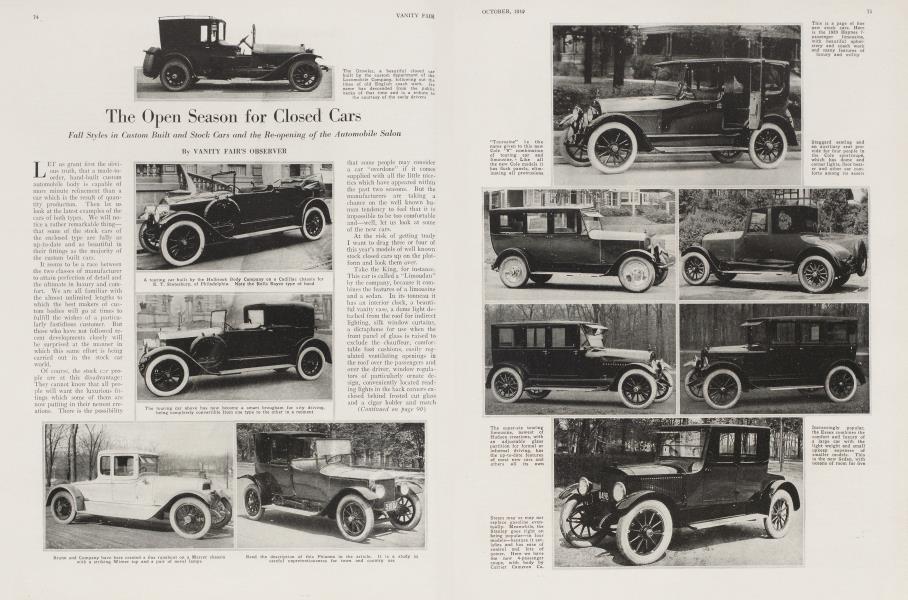
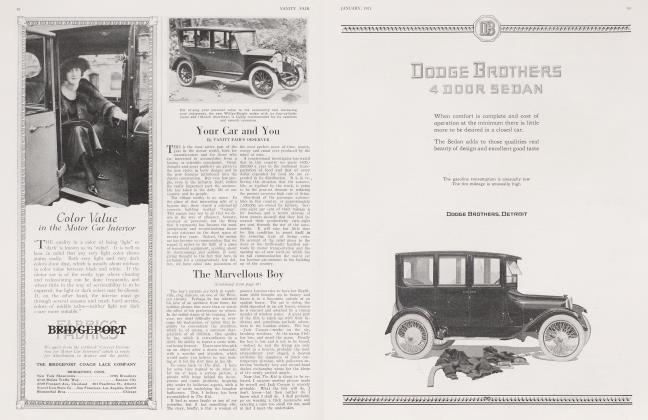
LET ous US truth, grant that first a made-tothe obviorder, hand-built custom automobile body is capable of more minute refinement than a car which is the result of quantity production. Then let us look at the latest examples of the cars of both types. We will notice a rather remarkable thing— that some of the stock cars of the enclosed type are fully as up-to-date and as beautiful in their fittings as the majority of the custom built cars.
It seems to be a race between the two classes of manufacturer to attain perfection of detail and the ultimate in luxury and comfort. We are all familiar with the almost unlimited lengths to which the best makers of custom bodies will go at times to fulfill the wishes of a particularly fastidious customer. But those who have not followed recent developments closely will be surprised at the manner in which this same effort is being carried out in the stock car world.
Of course, the stock car people are at this disadvantage: They cannot know that all people will want the luxurious fittings which some of them are now putting in their newest creations. There is the possibility that some people may consider a car "overdone" if it comes supplied with all the little niceties which have appeared within the past two seasons. But the manufacturers are taking a chance on the well known human tendency to feel that it is impossible to be too comfortable and—well, let us look at some of the new cars.
At the risk of getting trady I want to drag three or four of this year's models of well known stock closed cars up on the platform and look them over.
Take the King, for instance. This car is called a "Limoudan" by the company, because it combines the features of a limousine and a sedan. In its tonneau it has an interior clock, a beautiful vanity case, a dome light detached from the roof for indirect lighting, silk window curtains, a dictaphone for use when the front panel of glass is raised to exclude the chauffeur, comfortable foot cushions, easily regulated ventilating openings in the roof over the passengers and over the driver, window regulators of particularly ornate design, conveniently located reading lights in the back corners enclosed behind frosted cut glass and a cigar holder and match box. If you were building the car yourself you could not think of many more improvements to put in.
Continued on page 90
Continued from page 74
Now let us inspect the Haynes. The new 1920 dosed cars of this make are fairly redolent with luxurious touches. A vanity case of solid mahogany finished in bell silver with mirror, powder box and hairpin box in a beautiful Mount Vernon pattern and an alphabetically indexed gilt edged memorandum book are only some of many special features. A complete smoking set, including dgar lighter and ash tray, an adjustable driving wheel, an auxiliary seat upholstered in velvet mohair, artistic window regulators, silver decorated dome and quarter lamps, all in the Mount Vernon pattern, and a number of other interesting things, including a black Morocco case for visiting cards, are part of the regular equipment of this new stock car.
In the new Templar the equipment is so complete that even a compass and a folding kodak are included, not to mention six wire wheels, cord tires and tubes.
These three examples of the many dozens of beautiful stock cars now appearing on the market are sufficient to give an idea of the progress which is being made in the development of luxury in the standardized car.
On the other hand, some of the custom car people are deliberately going to the other extreme, to fill a special demand from wealthy people to whom simplicity appeals. I just saw a Phianna of this type. It was a new coupe, a miniature brougham for the use of a lady for calling, shopping and other city purposes. It is built on the lines of the old horse drawn vehicles, and is a rare example of studied unpretentiousness. In it the owner can seek seclusion with closed panels instead of the usual big, bright windows. Its upholstery is extremely plain, consisting of smooth broadcloth without tucking or pleating. There is no vanity case. When the designer asked the owner if she wanted a vanity case in her car, she replied, "No, I make my toilette at home." There are no side lamps, and only one dome light at the extreme rear of the roof. This car is very comfortable for two people and a driver, and has an extra folding seat for an unexpected passenger. It has a small turning radius and is therefore very handy in traffic. While essentially a car for town use it is also a car in which the owner can drive in from the country and do her shopping without changing cars.
In connection with the Haynes car, it might be interesting to insert here a little bit of history about it. The Haynes was the first practical car in America. On July 4th, 1893, it appeared for the first time on the streets of Kokomo, Indiana. It was built in the kitchen of Mr. Elwood Haynes, who has been president of the company since that time. Mr. Haynes, in addition to building America's first car, is a metallurgist of international reputation.
Those who think from our remarks that the stock cars are taking the place of the custom built bodies in point of luxury and completeness of fittings will have a chance to have their ideas upset at the coming Automobile Salon. This important event, after a lapse of a couple of years, will take place November 17th to 22nd, at the Hotel Commodore, where three big ballrooms will give twice the space that the Salon has usually had available at the Hotel Astor. In the early years of the Salon it was devoted entirely to imported cars. Later it was found that some of the American cars were equal in every way to the best that Europe could send over, so the show was changed to include the foreigners and some American cars within a certain high price range.
The American cars, which will be on exhibition this year from the present list of exihibits, will be the Locomobile, Cunningham, H.R.P. (Porter), Phianna, Daniels and the new Meteor. American body builders represented will be Brewster, Fleetwood, Rubay, BrooksOstruk and Holbrook. From Europe there will be the Rolls Royce, Renault, Lancia, Peugeot and Sunbeam and Barker & Company (coach builders), Ltd. The accessory exhibitors will be Laidlaw & Co., F. Smith & Sons of England, who will show high grade speed indicators and other appliances, and the Faure Tire.
This will be a particularly interesting show for several reasons. In the first place, it is the only opportunity the foreign manufacturers have had to show their products in the American markets since the beginning of the war in 1914, except, of course, the Rolls Royce which has been able to go on all through the war through the importation of used cars.
On the other hand, it will be an excellent opportunity for us to see what the foreign body builders have done in the way of developing new ideas since we last saw samples of their work. Most of the English, French and Italian companies, of course, gave their entire time to war work, so their cars this year may not be as original as will be those a year from now. In England, however, one or two of the companies created designs during the war which they have now been able to manufacture. It used to be that most of the original features on American cars were adopted from those brought out in European exhibits. Now, however, the American manufacturer has been thinking for himself for a number of years, and especially during the war has made tremendous strides, so a comparison of the work of the two continents will be well worth while. It is expected that a few additional French, Spanish and Italian cars will be shown.
The Salon has always been more or less of a social function. This year it is going to be more so than ever. The plan now is to end it up with a grand ball the last night.
Continued on page 92
Continued from page 90
In England motoring ceased almost entirely during the war, and the present condition there is a rather hopeless one from the standpoint of prices. For instance, 1914 Rolls Royce limousines are now bringing from four to five thousand pounds. The Brooks-Ostruk Company of New York has just shipped two new custom-built Rolls Royces to England, which is a good deal like shipping coals to Newcastle, considering that the Rolls Royce is an English car.
Prices here not only for closed cars but for all types this year are high, and the indications are that they are going to be higher. There seems no justification for predicting a fall in automobile prices within any measureable time. Everything connected with their manufacture has gone up in cost.
Most of the manufacturers of the very high priced cars are using upholstery of woolen fabrics and silk brocades, and some of these materials come now as high as $31 a yard. One custom body builder told me the other day that he is buying slip covers to-day for about the same price for which he used to upholster an entire car.
There continues to be a healthy interest in steam cars. Some people, including Barney Oldfield, seem to think that there is a possibility of their coming back into general favor. I will say that the steam cars that I have ridden in, the Stanley and the Doble, provided riding experiences which were delightful. The Doble Company has been hors de combat but is reviving. The Stanley Company is in a very healthy condition, manufacturing four types of cars.
Developments have come so fast in the automobile industry that the old recognized names for various types of cars no longer seem to fill the bill. Therefore some of the manufacturers have gone to great extremes of originality in coining new titles for their cars. The King "Limoudan" and the Cole "Tourosine" are only two examples of many ingenious names invented by these and other companies.
The regular automobile show will take place at the Grand Central Palace, New York, January 3rd to 10th, and tremendous plans are now being made to make it the biggest automobile exhibition in history. It will be held also in the Coliseum and Drexel Pavilion, Chicago, January 24th to 31st.
The attitude of the patrons at these shows will serve to inform automobile designers and manufacturers on the development of public taste throughout the war. During the past few years, torpedo and stream-line bodies have been much in demand, and ostentatious displays of luxury have been decidedly bad form. Indications point to a distinct reaction, but this is problematical; at any rate, war time severity will be relaxed to a certain extent.
All in all, it looks like a big year in the automobile world, especially in the closed car world—not so big a year, perhaps, as 1917, but big enough to indicate that the year 1920 will see the greatest production and the greatest development take place in the history of the American motor car world. The demand for cars is 'way ahead of the supply, and will continue to be ahead for some months. There seems to be no limit to the buying power of the American public, in spite of the high cost of everyday living.
Subscribers have complete access to the archive.
Sign In Not a Subscriber?Join Now


