Sign In to Your Account
Subscribers have complete access to the archive.
Sign In Not a Subscriber?Join NowSigns of Spring in the Theatre
The Early Plays Are Blossoming Out on Broadway
DOROTHY PARKER
NEWS, as the up-state gazettes put it, are pretty scarce hereabouts, at the time of going to press.
The local drama is getting along nicely, with but few new productions to cut in on its established routine. Just what has become of the expected outburst of new plays no one seems quite able to say. Theatrically speaking, it looks as if we were going to have a late Spring. Here and there, it is true, a brave little drama has poked its head up into the frosty air, but of the promised record crop there has been, as yet, no sign. The dramatic critics have led a life of idle pleasure, and the space in the newspapers usually devoted to reviews of the new plays has been filled with accounts of "Doings in the World of Women's Clubs," and with helpful hints from Constant Readers as to how this League of Nations ought to be run.
However, uneventful as these times are, there is still something to write to the papers about, beside the first bluebird. At the Liberty Theatre, Henry Miller is producing Philip Moeller's play, "Molière," and everything is decidedly better off, on that account. Probably it is the reaction from the olive-drab dramas, which have been so much before us this past season, that a play of wigs and buckled shoes and lace ruffles, of hoops and curls and patches seems decidedly good to look at once again.
It was just the right moment to launch a romantic play; weary souls will flock to it, filled with the restful assurance that for a few blessed hours they are to hear no mention of prohibition nor of Bolshevism, no word of the cost of living nor of the Mayor's Committee of Welcome, no allusion to Josephus Daniels nor to Henry Ford.
AND, since they were launching a romantic drama, Mr. Moeller's "Moliere" was unquestionably the thing to launch. The second act alone would insure its success. Unfortunately, the play is rather slow in getting under way—don't hurry through dinner when you go to see it. There is not much to divert your mind until the entrance of Blanche Bates, except watching the late-comers and trying to figure out just why it . is that so many of them can have sable evening wraps,—which, of course, rather takes you out of the old-world atmosphere of the play.
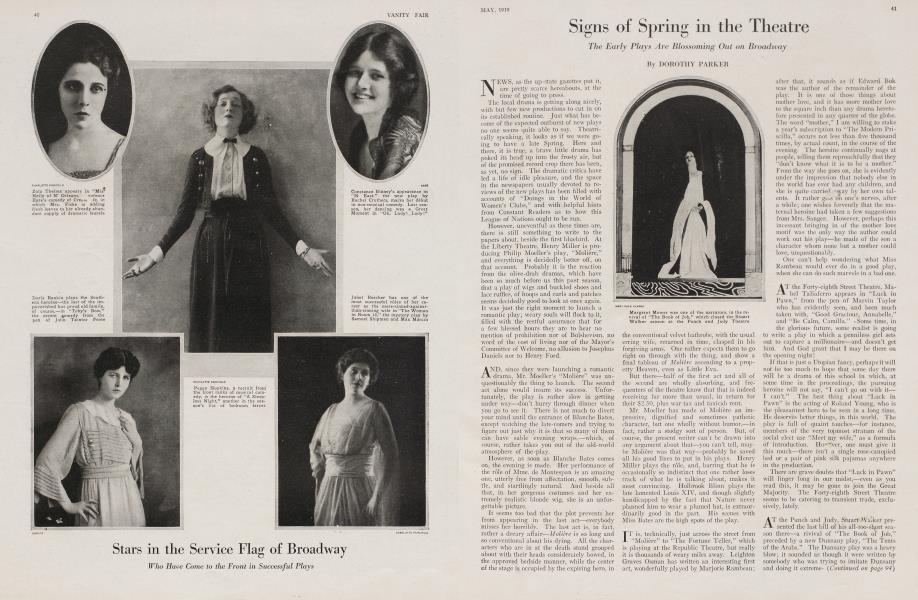
However, as soon as Blanche Bates comes on, the evening is made. Her performance of the rôle of Mme. de Montespan is an amazing one, utterly free from affectation, smooth, subtle, and startlingly natural. And beside all that, in her gorgeous costumes and her extremely realistic blonde wig, she is an unforgettable picture.
It seems too bad that the plot prevents her from appearing in the last act—everybody misses her horribly. The last act is, in fact, rather a dreary affair—Moliere is so long and so conventional about his dying. All the characters who are in at the death stand grouped about with their heads considerately bowed, in the approved bedside manner, while the center of the stage is occupied by the expiring hero, in the conventional velvet bathrobe, with the usual erring wife, returned in time, clasped in his forgiving arms. One rather expects them to go right on through with the thing, and show a final tableau of Molière ascending to a property Heaven, even as Little Eva.
But there—half of the first act and all of the second are wholly absorbing, and frequenters of the theatre know that that is indeed receiving far more than usual, in return for their $2.50, plus war tax and taxicab rent.
Mr. Moeller has made of Moliere an impressive, dignified and sometimes pathetic character, but one wholly without humor,—in fact, rather a stodgy sort of person. But, of course, the present writer can't be drawn into any argument about that—you can't tell, maybe Moliere was that way—probably he saved all his good lines to put in his plays. Henry Miller plays the role, and, barring that he is occasionally so indistinct that one rather loses track of what he is talking about, makes, it most convincing. Holbrook Blinn plays the late lamented Louis XIV, and though slightly handicapped by the fact that Nature never planned him to wear a plumed hat, is extraordinarily good in the part. His scenes with Miss Bates are the high spots of the play.
IT is, technically, just across the street from "Moliere" to "The Fortune Teller," which is playing at the Republic Theatre, but really it is thousands of weary miles away. Leighton Graves Osmun has written an interesting first act, wonderfully played by Marjorie Rambeau; after that, it sounds as if Edward Bok was the author of the remainder of the play. It is one of those things about mother love, and it has more mother love to the square inch than any drama heretofore presented in any quarter of the globe. The word "mother," I am willing.to stake a year's subscription to "The Modem Priscilla," occurs not less than five thousand times, by actual count, in the course of the evening. The heroine continually nags at people, telling them reproachfully that they "don't know what it is to be a mother." From the way she goes on, she is evidently under the impression that nobody else in the world has ever had any children, and she is quite carried away by her own talents. It rather goes on one's nerves, after a while; one wishes fervently that the maternal heroine had taken a few suggestions from Mrs. Sanger. However, perhaps this incessant bringing in of the mother love motif was the only way the author could work out his play—he made of the son a character whom none but a mother could love, unquestionably.
One can't help wondering what Miss Rambeau would ever do in a good play, when she can do such marvels in a bad one.
AT the Forty-eighth Street Theatre, Mabel Taliaferro appears in "Luck in Pawn," from the pen of Marvin Taylor who has evidently seen, and been much taken with, "Good Gracioue, Annabelle," and "Be Calm, Camilla." Some time, in the glorious future, some realist is going to write a play in which a penniless girl sets out to capture a millionaire—and doesn't get him. And God grant that I may be there on the opening night!
If that is just a Utopian fancy, perhaps it will not be too much to hope that some day there will be a drama of this school in which, at some time in the proceedings, the pursuing heroine will not say, "I can't go on with it— I can't." The best thing about "Luck in Pawn" is the acting of Roland Young, who is the pleasantest hero to be seen in a long time. He deserves better things, in this world. The play is full of quaint touches—for instance, members of the very topmost stratum of the social elect use "Meet my wife," as a formula of introduction. However, one must give it this much—there isn't a single rose-canopied bed or a pair of pink silk pajamas anywhere in the production.
There are grave doubts that "Luck in Pawn" will linger long in our midst,—even as you read this, it may be gone to join the Great Majority. The Forty-eighth Street Theatre seems to be catering to transient trade, exclusively, lately.
AT the Punch and Judy, Stuart Walker presented the last bill of his all-too-short season there—a rivival of "The Book of Job," preceded by a new Dunsany play, "The Tents of the Arabs." The Dunsany play was a heavy blow; it sounded as though it were written by somebody who was trying to imitate Dunsany and doing it extremely amateurishly. However, there were two people, at any rate, who were perfectly delighted with the entertainment; they were the ladies who chanced to be sitting in front of me. But then, they were perhaps a shade fanatical in their admiration for Lord Dunsany—they even credited him with the authorship of "The Book of Job."
Continued on page 94
Continued from page 41
"THE Book of Job" was impressively produced, and wonderfully acted by George Gaul, whose Job is a remarkable creation. Mr. Gaul has done extraordinary work during the comparatively short time New York has known him; he is undoubtedly one of the coming actors—if, indeed, he does not rank as one of those who have already come. His voice alone sets him far above the rest of the younger actors. McKay Morris also appeared at his best advantage in the play, while Elizabeth Pattison and Margaret Mower were the narrators.
The drama ends with a terrifying tempest, . and the thunderings of the mystic Voice in the Wilderness—a voice all the more awe-inspiring because one can't understand a single word it utters. Despite its beauty and dramatic qualities, however, there are times, during the evening, when one feels that one has been witnessing nothing but "The Book of Job" for years. It is as if one had been spending the greater part of one's life in the Punch and Judy Theatre. Somehow, it seems as if they could have shortened or even entirely omitted some of the speeches, without the slightest disrespect. As it is, one is conscious of a sense of strain, of a forcing of attention, and such a feeling is scarcely fair to the really wonderful work of the actors.
AT the Belmont Theatre, Maeterlinck's new play, "A Burgomaster of Belgium," is being produced by an English company headed by E. Lyall Swete. This is the second new Maeterlinck play to be seen here this season, and, of course, a Maeterlinck play is always an event in theatrical history. For weeks before the expected production, little children rush in from their play, crying, "Mother, mother, there is to be a new Maeterlinck drama"; librarians club together and go to matinees; high school teachers attend in bodies, drama leagues charter the entire balcony; and all the local cognoscenti stand on line for hours, to sit through the work in dreamy-eyed appreciation, each one discovering subtle beauties that no one else has the insight to observe. It has been a bit of a shock to the lofty-browed and the tortoiseshell-rimmed to find that M. Maeterlinck's latest play contained not even a trace of symbolism; it threw them off their form, so to speak. They didn't quite know how they ought to take the thing.
"FOR "A Burgomaster of Belgium" is another war play—just that. Not what you would think a Maeterlinck war play would be, with such characters as Victory, Right, Destruction, Courage, Madness, and all that, but a regular, straight war play, with overbearing German officers, and suffering Belgians. Unfortunately, it comes at rather a bad time, for the audiences seem to long madly to get away from these things, and one fears that the play will not settle down for a long run. We know all about Belgium, and about German atrocities—we know only too well, and we have done everything we can about it.
The audience takes the whole thing decidedly coldly. And that is not the fault of the author, nor of the actors, nor yet of the audience—it's just a surfeit of war and of war plays. If we had realized that war plays would go right on, even after the armistice, there are many of us who would not have celebrated so whole-heartedly on that wild and reckless evening of November eleventh.
Subscribers have complete access to the archive.
Sign In Not a Subscriber?Join Now
