Sign In to Your Account
Subscribers have complete access to the archive.
Sign In Not a Subscriber?Join NowThe Cartooning Tradition
Meditations of the "N. Y. World's" Cartoonist on Viewing His Materials for Satire
ROLLIN KIRBY
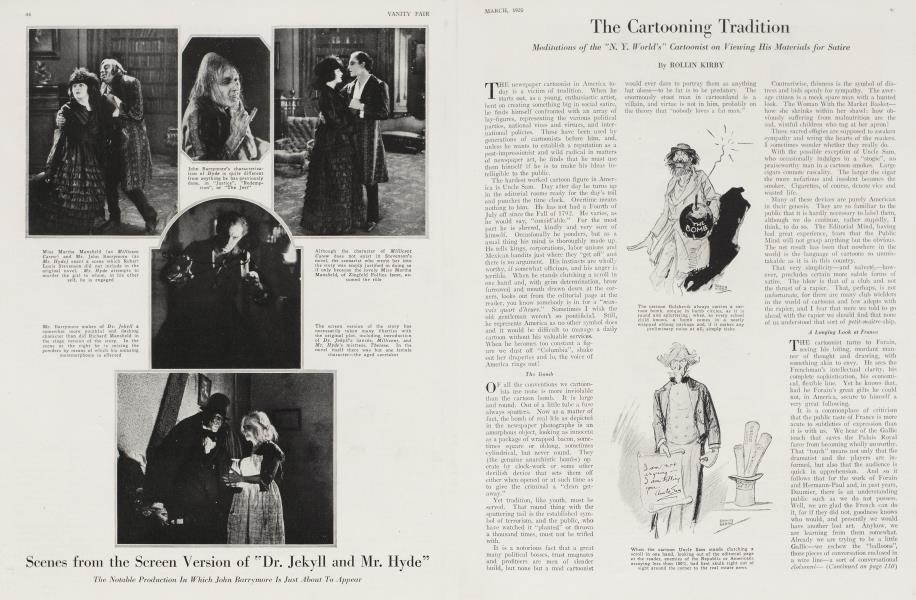
THE newspaper cartoonist in America today is a victim of tradition. When he starts out, as a young, enthusiastic artist, bent on creating something big in social satire, he finds himself confronted with an array of lay-figures, representing the various political parties, national vices and virtues, and international policies. These have been used by generations of cartoonists before him, and, unless he wants to establish a reputation as a post-impressionist and wild radical in matters of newspaper art, he finds that he must use them himself if he is to make his ideas intelligible to the public.
The hardest worked cartoon figure in America is Uncle Sam. Day after day he turns up in the editorial rooms ready for the day's toil and punches the time clock. Overtime means nothing to him. He has not had a Fourth of July off since the Fall of 1792. He varies, as he would say, "consid'able." For the most part he is shrewd, kindly and very sure of himself. Occasionally he ponders, but as a usual thing his mind is thoroughly made up. He tells kings, corporations, labor unions and Mexican bandits just where they "get off" and there is no argument. His instincts are wholly worthy, if somewhat officious, and his anger is terrible. When he stands clutching a scroll in one hand and, with grim determination, brow furrowed and mouth drawn down at the corners, looks out from the editorial page at the reader, you know somebody is in for a "mauvais quart d'heure" Sometimes I wish the old gentleman weren't so pontificial. Still, he represents America as no other symbol does and it would be difficult to manage a daily cartoon without his valuable services.
When he becomes too constant a figure we dust off "Columbia", shake out her draperies and lo, the voice of America rings out!
The Bomb
OF all the conventions we cartoonists use none is more inviolable than the cartoon bomb. It is large and round. Out of a little tube a fuse always sputters. Now as a matter of fact, the bomb of real life as depicted in the newspaper photographs is an amorphous object, looking as innocent as a package of wrapped bacon, sometimes square or oblong, sometimes cylindrical, but never round. They (the genuine anarchistic bombs) operate by clock-work or some other devilish device that sets them off either when opened or at such time as to give the criminal a "clean getaway."
Yet tradition, like youth, must be served. That round thing with the sputtering tail is the established symbol of terrorism, and the public, who have watched it "planted" or thrown a thousand times, must not be trifled with.
It is a notorious fact that a great many political bosses, trust magnates and profiteers are men of slender build, but none but a mad cartoonist would ever dare to portray them as anything but obese—to be fat is to be predatory. The enormously stout man in cartoonland is a villain, and virtue is not in him, probably on the theory that "nobody loves a fat man."
Contrariwise, thinness is the symbol of distress and bids openly for sympathy. The average citizen is a meek spare man with a hunted look. The Woman With the Market Basket— how she shrinks within her shawl: how obviously suffering from malnutrition are the sad, wistful children who tug at her apron!
These sacred effigies are supposed to awaken sympathy and wring the hearts of the readers. I sometimes wonder whether they really do.
With the possible exception of Uncle Sam, who occasionally indulges in a "stogie", no praiseworthy man in a cartoon smokes. Large cigars connote rascality. The larger the cigar the more nefarious and insolent becomes the smoker. Cigarettes, of course, denote vice and wasted life.
Many of these devices are purely American in their genesis. They are so familiar to the public that it is hardly necessary to label them, although we do continue, rather stupidly, I think, to do so. The Editorial Mind, having had great experience, fears that the Public Mind will not grasp anything but the obvious. The net result has been that nowhere in the world is the language of cartoons so unmistakable as it is in this country.
That very simplicity—and naivete,—however, precludes certain more subtle forms of satire. The blow is that of a club and not the thrust of a rapier. That, perhaps, is not unfortunate, for there are many club wielders in the world of cartoons and few adepts with the rapier, and I fear that were we told to go ahead with the rapier we should find that none of us understood that sort of petit-maitre-ship.
A Longing Look at France
THE cartoonist turns to Forain, seeing his biting, mordant manner of thought and drawing, with something akin to envy. He sees the Frenchman's intellectual clarity, his complete sophistication, his economical, flexible line. Yet he knows that, had he Forain's great gifts he could not, in America, secure to himself a very great following.
It is a commonplace of criticism that the public taste of France is more acute to subtleties of expression than it is with us. We hear of the Gallic touch that saves the Palais Royal farce from becoming wholly unworthy. That "touch" means not only that the dramatist and the players are informed, but also that the audience is quick in apprehension. And so it follows that for the work of Forain and Hermann-Paul and, in past years, Daumier, there is an understanding public such as we do not possess. Well, we are glad the French can do it, for if they did not, goodness knows who would, and presently we would have another lost art. Anyhow, we are learning from them somewhat. Already we are trying to be a little Gallic—we eschew the "balloons", those pieces of conversation enclosed in a wire line—a sort of conversational cloisonné— which rise from the mouths of the cartoon figures. We are less parochial than we used to be. The war has helped to an amazing degree. The cartoon which dealt with the Boy with his toe tied up goin' fishin' and which lived, moved and had its being in the Middle West, is slowly succumbing to the cartoon dealing with international affairs and domestic politics.
(Continued on page 110)
(Continued, from page 45)
The pictorial representation of ideas is limited. There are certain abstract things which have no pictorial complement.
I recall a cartoon in which the artist got into a sort of graphic fourth dimension by drawing two little fat men, one labelled "Fewer Ships Launched in 1916 Than in 1915" and the other "Less Coal Mined in 1916 Than in 1915." It was an interesting experiment.
Once, when the railroads were suffering from what they claimed to be unfair government restriction, a gentleman suggested to me that I draw a "lean and starved locomotive standing in an appealing attitude outside the doors of Congress." I leave it to my readers how best it could be done.
The Two Schools of Cartooning
nPHERE are, in this country, roughly speaking, two schools of political cartooning. One is shown in the picture of little, hurrying people—the picture of much incident drawn usually from aloft so that the observer looks down on a spread of room or landscape. From this vantage point all three rings of the circus can be seen at once. What a bustle there is, to be sure! Labels are thicker than—you know—the "leaves" one. You say, "isn't this jolly" and settle down to work it all out and enjoy it. The other group is not so hilarious. Their aim is terseness—even starkness. The idea must be stripped to its bones. One line is better than two. Fortunately, there is a big audience and room for both sorts. Let us take an imaginary subject as it would be treated by the Capulets and Montagues of cartooning.
Let us suppose a bill has been introduced into Congress which would, in the opinion of two -newspapers(should it become a law), wreck or at least hold up the country's progress. Capulet, the cartoonist of the Morning Star will draw a train swinging around a curve. The train will be labelled "The Nation's Progress". Uncle Sam or the President will lean from the engine cab. Agitated faces appear at the windows of the coaches. Smoke pours from the stack; steam from the whistle. The crossingman in the person, say of the Attorney General, tries to flag the onrushing train, for not ten feet away the author of the nefarious measure is spiking a log labelled with the name of the bill across the track. In the distance a farmer rushes from his barn waving a pitchfork—a cow, hysterical at the impending disaster, sprints across the landscape. The whole tempo is jazzed.
Now Montague of the Daily Banner, treating the same subject will do this: The author of the bill will be seen close up placing the log on the track. The pilot of the oncoming engine may be just emerging from around a spur of mountain. The log will bear the same label it bore in Capulet's picture. The effect will be got, however, by the drawing of the single figure. Montague's aim is to make him as sinister as the devil—nothing else will count.
The track, which in Capulet's picture had been labelled "The Road to Prosperity," will become a mere indication. An outline suffices for the mountain spur—a few lines for the engine.
In the first picture you know there is going to be a smash, but somehow it's all so hearty and good-natured that one does not really become very indignant ; and then one's eye goes trailing off after the comic cow and the farmer and, gol ding it, it IS a funny picture.
Now Montague doesn't want you to be pleased with the situation. He wants you to dislike the crook who is putting the log across the track and by the eternal, he is going to make you if he cant
I suspect that Capulet's wife has a happier life than Montague's.
That nothing is very static in the world to-day is shown by the decline and fall of the Russian Bear as a cartoon figure. Three years ago he was the accepted symbol—to-day he wouldn't be recognized without a label. Now the raging Bolshevist, the whiskered torch-carrier who is, in most cases, no Slav at all but a ferocious reincarnation of our old friend Dusty Roads of the old Puck days, is the pictorial representative of that bedeviled country.
You may also have noticed that nearly all cartoon radicals wear whiskers. In fact, whiskers and merit seldom go hand in hand, the one exception being that starvling labelled "The Public". He is the victim—he too, carries the empty market-basket—he, as the Innocent Bystander, gets the brick that Labor heaves at Capital. It is he who, looking like a pale and seedy Sec. Redfield, peers from the outside at the Lucullian feast spread by the Trusts. His role is that of the chump, and hence the side-whiskers.
After all, the idea is the important thing. Good drawing never saved a poor idea, but a good idea has rescued many poor drawings from sudden death.
There is perhaps no profession which seems to inspire people to go more completely outof their way to write insultingly than that of the cartoonist.
The flood of letters usually follows an attack that jars some racial sensibility. On the other hand, let the thrust be of a personal nature and the victim is more likely than otherwise to take it in good part and ask for the original drawing.
Thomas F. Ryan used to buy all the original cartoons in which he figured. Several cartoonists I know felt his retirement from public life keenly.
Subscribers have complete access to the archive.
Sign In Not a Subscriber?Join Now
