Sign In to Your Account
Subscribers have complete access to the archive.
Sign In Not a Subscriber?Join NowMovies—The Eighth Art
America's Contribution to the Artistic Progress of the World
JOHN EMERSON
ANITA LOOS
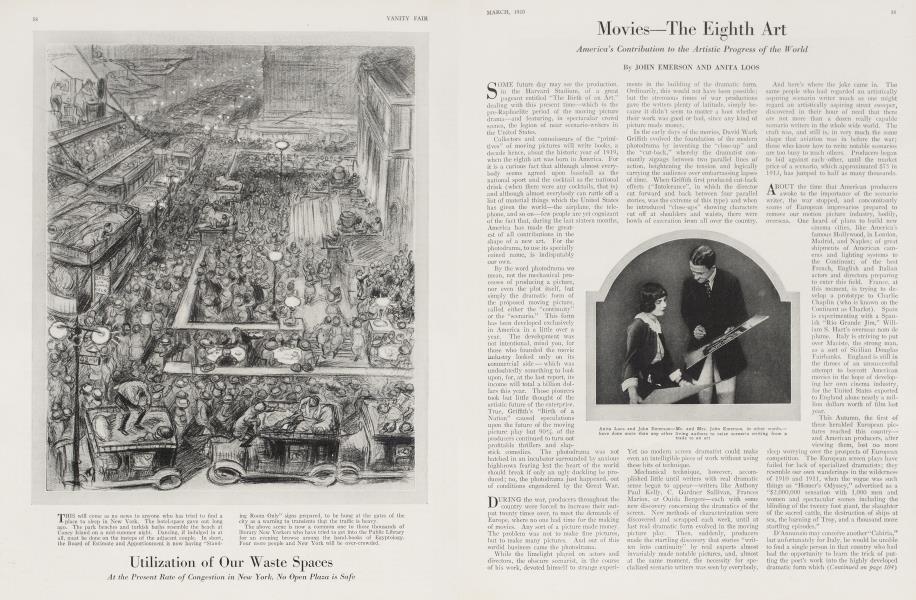
SOME future day may see the production, in the Harvard Stadium, of a great pageant entitled "The Birth of an Art," dealing with this present time—which is the pre-Raphaelite period of the moving picture drama—and featuring, in spectacular crowd scenes, the legion of near scenario-writers in the United States.
Collectors and connoisseurs of the "primitives" of moving pictures will write books, a decade hence, about the historic year of 1919, when the eighth art was born in America. For it is a curious fact that although almost everybody seems agreed upon baseball as the national sport and the cocktail as the national drink (when there were any cocktails, that is) and although almost everybody can rattle off a list of material things which the United States has given the world—the airplane, the telephone, and so on—few people are yet cognizant of the fact that, during the last sixteen months, America has made the greatest of all contributions in the shape of a new art. For the photodrama, to use its specially coined name, is indisputably our own.
By the word photodrama we mean, not the mechanical processes of producing a picture, nor even the plot itself, but simply the dramatic form of the proposed moving picture, called either the "continuity" or the "scenario." This form has been developed exclusively in America in a little over a year. The development was not intentional, mind you, for those who founded the movie industry looked only on its commercial side — which was undoubtedly something to look upon, for, at the last report, its income will total a billion dollars this year. Those pioneers took but little thought of the artistic future of the enterprise.
True, Griffith's "Birth of a Nation" caused speculations upon the future of the moving picture play but 90% of the producers continued to turn out profitable thrillers and slapstick comedies. The photodrama was not hatched in an incubator surrounded by anxious highbrows fearing lest the heart of the world should break if only an ugly duckling be produced; no, the photodrama just happened, out of conditions engendered by the Great War.
DURING the war, producers throughout the country were forced to increase their output twenty times over, to meet the demands of Europe, where no one had time for the making of movies. Any sort of a picture made money. The problem was not to make fine pictures, but to make many pictures. And out of this sordid business came the photodrama.
While the limelight played on actors and directors, the obscure scenarist, in the course of his work, devoted himself to strange experiments in the building of the dramatic form. Ordinarily, this would not have been possible; but the strenuous times of war productions gave the writers plenty of latitude, simply because it didn't seem to matter a hoot whether their work was good or bad, since any kind of picture made money.
In the early days of the movies, David Wark Griffith evolved the foundation of the modern photodrama by inventing the "close-up" and the "cut-back," whereby the dramatist constantly zigzags between two parallel lines of action, heightening the tension and logically carrying the audience over embarrassing lapses of time. When Griffith first produced cut-back effects ("Intolerance", in which the director cut forward and back between four parallel stories, was the extreme of this type) and when he introduced "close-ups" showing characters cut off at shoulders and waists, there were howls of execration from all over the country. Yet no modern screen dramatist could make even an intelligible piece of work without using these bits of technique.
Mechanical technique, however, accomplished little until writers with real dramatic sense began to appear—writers like Anthony Paul Kelly, C. Gardner Sullivan, Frances Marion, or Ouida Bergere—each with some new discovery concerning the dramatics of the screen. New methods of characterization were discovered and scrapped each week, until at last real dramatic form evolved in the moving picture play. Then, suddenly, producers made the startling discovery that stories "written into continuity" by real experts almost invariably made notable pictures, and, almost at the same moment, the necessity for specialized scenario writers was seen by everybody.
And here's where the joke came in. The same people who had regarded an artistically aspiring scenario writer much as one might regard an artistically aspiring street sweeper, discovered in their hour of need that there are not more than a dozen really capable scenario writers in the whole wide world. The craft was, and still is, in very much the same shape that aviation was in before the war; those who know how to write notable scenarios are too busy to teach others. Producers began to bid against each other, until the market price of a scenario, which approximated $75 in 1913, has jumped to half as many thousands.
ABOUT the time that American producers - awoke to the importance of the scenario writer, the war stopped, and concomitantly scores of European impresarios prepared to remove our motion picture industry, bodily, overseas. One heard of plans to build new cinema cities, like America's famous Hollywood, in London, Madrid, and Naples; of great shipments of American cameras and lighting systems to the Continent; of the best French, English and Italian actors and directors preparing to enter this field. France, at this moment, is trying to develop a prototype to Charlie Chaplin (who is known on the Continent as Chariot). Spain is experimenting with a Spanish "Rio Grande Jim," William S. Hart's overseas nom de plume. Italy is striving to put over Maciste, the strong man, as a sort of Sicilian Douglas Fairbanks. England is still in the throes of an unsuccessful attempt to boycott American movies in the hope of developing her own cinema industry, for the United States exported to England alone nearly a million dollars worth of film last year.
This Autumn, the first of these heralded European pictures reached this country— and American producers, after viewing them, lost no more sleep worrying over the prospects of European competition. The European screen plays have failed for lack of specialized dramatists; they resemble our own wanderings in the wilderness of 1910 and 1911, when the vogue was such things as "Homer's Odyssey," advertised as a "$2,000,000 sensation with 1,000 men and women and spectacular scenes including the blinding of the twenty foot giant, the slaughter of the sacred cattle, the destruction of ships at sea, the burning of Troy, and a thousand more startling episodes."
D'Annunzio may conceive another"Cabiria," but unfortunately for Italy, he would be unable to find a single person in that country who had had the opportunity to learn the trick of putting the poet's work into the highly developed dramatic form which audiences now demand. There is nobody, as yet, in all Europe capable of writing a continuity such as is found in "Broken Blossoms" or "The Miracle Man."
(Continued on page 104)
(Continued, from page 59)
ON the other hand, American producers are successfully making moving pictures with companies sent abroad to the very spots on which the native Europeans failed. One ambitious American concern is on its way to Palestine to put the Bible into a serial film play, while another producer is planning to make a screen version of Barrie's plays in England, and of Sardou's plays in France. The Americans have at least five years' lead on the Europeans for they have the one essential which cannot be imported or imitated—they have the dozen screen dramatists who write the best pictures.
The dearth of good scenario writers is at least not due to lack of aspirants to this profession. Even at the height of the Renaissance, the poets and painters of France and Italy could be numbered only by the hundreds; the fast multiplying tribe of modern novelists may still be tabulated without recourse to adding machines; but the number of scenario writers has passed the 100,000 mark. The imagination recoils from the staggering total, and one remembers the ancient joke about the Islanders who lived by taking in each other's washing.
At the present time, rejection slips, the cost of white paper, and discouraging statements by large producers on the chances for acceptance have decimated the ranks of these amateurs. The largest companies probably do not receive more than five hundred manuscripts weekly, and recently, when Mrs. Sidney Drew was seeking for two-reel comedies,—the easiest type of plot to write—she received twenty-five scenarios a day, one in five hundred of which was worth a second reading. As continuity writers and scenario editors for Douglas Fairbanks a year and a half ago, we received nearly seven hundred manuscripts weekly, while at the present, writing for the equally popular Constance Talmadge, we receive less than fifty scenarios a week. This is because present day producers will encourage only trained writers, and the school girls, motormen and plumbers who formerly deluged us with impossible plots have returned to their old vocations, with a low opinion of scenario editors.
There are three reasons why, despite the number of people ready and willing to write for the movies (at current prices), there are not more budding photodramatists. First is the beforementioned scarcity of opportunity to learn. Second is the national failing,— the unwillingness of Americans to serve an apprenticeship. Famous writers have not the patience to study the new dramatic form, while amateurs think it unnecessary. Yet these same writers are bewildered when their plots, if finally bought, are changed by the trained continuity writer to suit the screen, a procedure which would have been unnecessary had they built their plot according to the recognized principles of the screen drama.
BUT by far the most serious obstacle to the development of this new art is that root of all evil, the bonehead producer. There are, of course, a few producers in the movies with inherent culture and ideals; and it has been the great good fortune of the writers never to have been associated with the other kind. But for every Jesse Lasky or Adolph Zukor or Joseph Schenck or David Griffith there are a dozen little fellows whose altitude of brow varies inversely to the coefficient of friction of the neck. These producers, having perhaps great genius as organizers and money makers, are cursed with the belief that they have likewise a flair for the dramatic arts.
It follows, then, that the aspiring photodramatist, having built from his blood and tears some tender romance overlying a subtly satirical theme, presents the same to one of these Czars of Art. The producer reads rapidly through the manuscript,—they nearly all can read—misses all the finer points and demands changes throughout. The poor playsmith finds his play a scrap of paper in the hands of his enemies.
Even after the play is complete in film form, the author's troubles are not ended, for everyone from advertising department to censor must be at his elbow in cutting and assembling the masterpiece to see that the conventions are respected. The producer is nearly always amenable to the suggestions of everyone except the author. Recently, for example, the subtitles in a clever screen drama were changed throughout by order of an advertising department which decided that they reflected on the memory of a defunct soldier, never realizing that such was exactly the intention of the satirist who wished to emphasize the shallowness of those characters who were supposed to utter the subtitles. In another case, the producer himself became so enamored of a particularly fine play that he undertook to improve it personally by changing the important scenes about, in the process of cutting, with his own bejeweled hands—just as some picture collector, becoming enthusiastic about a great painting, might enter into the spirit of the thing by touching up the artist's work with a few new tints.
There are many, including Jesse S. Lasky, who predict that during the coming year the great studio cities of California will move to the Eastern seaboard. Already Griffith, Famous Players-Lasky, Goldwyn and other companies are building great studios about New York. And in this move may lie the real future of the screen dramatists, since, for once, the dramatists will be in personal contact with the producers.* Eastman, the kodak manufacturer, is at this moment building a national academy of motion picture arts in the East, hoping to develop the moving picture play. Columbia, Yale, and Harvard are teaching scenario composition. A dozen of Broadway's best known playwrights have left the field of spoken drama during the last few months, to make a study of screen technique.
For the benefit of those who wish to talk hard technicalities, we will state our own conviction that more and better subtitles, an improved "tempo" (the relative length of scenes), fewer blood and thunder plots, more subtlety in characterization, and the playing up of mental instead of physical action in the big scenes, will all constitute characteristics of the American school of moving picture.
But whatever is found to be the essentials of this art, the scenario writer must be the central figure. In the future, one man will conceive the story, write it into dramatic form for the screen, supervise direction, and other details of production, indicate on his manuscript every bit of action down to the last detail, and, finally, cut and assemble the film personally. Only by assuming this commanding position can the writer hope to sweep away countless conventions, and achieve true greatness. For the moving picture play, like the organ, responds to the virtuoso, but balks at duets.
Subscribers have complete access to the archive.
Sign In Not a Subscriber?Join Now
