Sign In to Your Account
Subscribers have complete access to the archive.
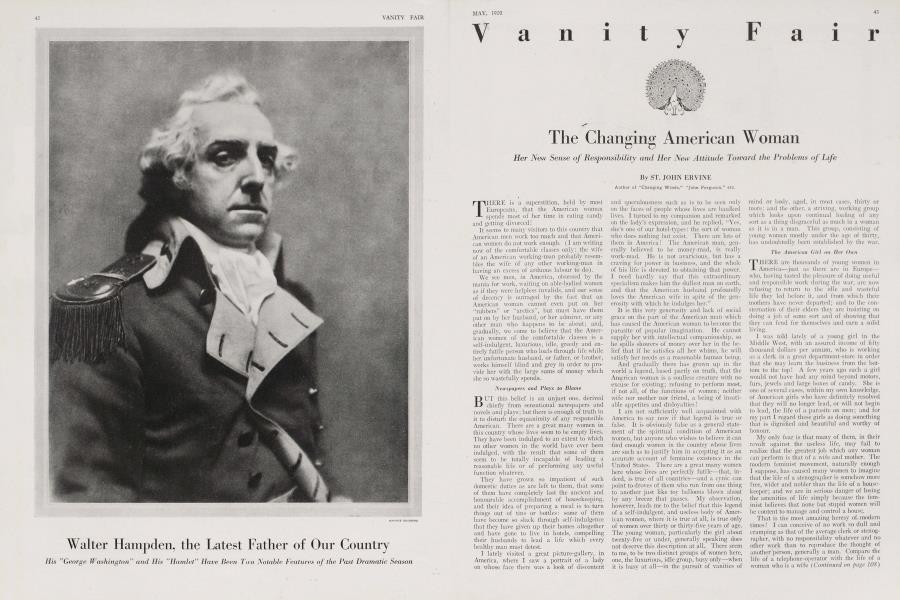
Sign In Not a Subscriber?Join NowThe Changing American Woman
Her New Sense of Responsibility and Her New Attitude Toward the Problems of Life
ST. JOHN ERVINE
Author of "Changing Winds," "John Ferguson," etc.
THERE is a superstition, held by most Europeans, that the American woman A spends most of her time in eating candy and getting divorced!
It seems to many visitors to this country that American men work too much and that American women do not work enough. (I am writing now of the comfortable classes only: the wife of an American working-man probably resembles the wife of any other working-man in having an excess of arduous labour to do).
We see men, in America, obsessed by the mania for work, waiting on able-bodied women as if they were helpless invalids, and our sense of decency is outraged by the fact that an American woman cannot even put on her "rubbers" or "arctics", but must have them put on by her husband, or her admirer, or any other man who happens to be about; and, gradually, we come to believe that the American women of the comfortable classes is a self-indulgent, luxurious, idle, greedy and entirely futile person who loafs through life while her unfortunate husband, or father, or brother, works himself blind and grey in order to provide her with the large sums of money which she so wastefully spends.
Newspapers and Plays to Blame
BUT this belief is an unjust one, derived chiefly from sensational newspapers and novels and plays; but there is enough of truth in it to disturb the equanimity of any responsible American. There are a great many women in this country whose lives seem to be empty lives. They have been indulged to an extent to which no other women in the world have ever been indulged, with the result that some of them seem to be totally incapable of leading a reasonable life or of performing any useful function whatever.
They have grown so impatient of such domestic duties as are left to them, that some of them have completely lost the ancient and honourable accomplishment of housekeeping, and their idea of preparing a meal is to turn things out of tins or bottles: some of them have become so slack through self-indulgence that they have given up their homes altogether and have gone to live in hotels, compelling their husbands to lead a life which every healthy man must detest.
I lately visited a great picture-gallery, in America, where I saw a portrait of a lady on whose face there was a look of discontent and querulousness such as is to be seen only on the faces of people whose lives are baulked lives. I turned to my companion and remarked on the lady's expression, and he replied, "Yes, she's one of our hotel-types: the sort of woman who does nothing but exist. There are lots of them in America! The American man, generally believed to be money-mad, is really work-mad. He is not avaricious, but has a craving for power in business, and the whole of his life is devoted to obtaining that power. I need hardly say that this extraordinary specialism makes him the dullest man on earth, and that the American husband profoundly loves the American wife in spite of the generosity with which he indulges her."
It is this very generosity and lack of social grace on the part of the American man which has caused the American woman to become the parasite of popular imagination. He cannot supply her with intellectual companionship, so he spills showers of money over her in the belief that if he satisfies all her whims, he will satisfy her needs as a reasonable human being.
And gradually there has grown up in the world a legend, based partly on truth, that the American woman is a soulless creature with no excuse for existing; refusing to perform most, if not all, of the functions of women; neither wife nor mother nor friend, a being of insatiable appetites and disloyalties!
I am not sufficiently well acquainted with America to say now if that legend is true or false. It is obviously false as a general statement of the spiritual condition of American women, but anyone who wishes to believe it can find enough women in the country whose lives are such as to justify him in accepting it as an accurate account of feminine existence in the United States. There are a great many women here whose lives are perfectly futile—that, indeed, is true of all countries—and a cynic can point to droves of them who run from one thing to another just like toy balloons blown about by any breeze that passes. My observation, however, leads me to the belief that this legend of a self-indulgent, and useless body of American women, where it is true at all, is true only of women over thirty or thirty-five years of age. The young woman, particularly the girl about twenty-five or under, generally speaking does not deserve this description at all. There seem to me, to be two distinct groups of women here, one, the luxurious, idle group, busy only—when it is busy at all—in the pursuit of vanities of mind or body, aged, in most cases, thirty or more; and the other, a striving, working group which looks upon continual loafing of any sort as a thing disgraceful as much in a woman as it is in a man. This group, consisting of young women mostly under the age of thirty, has undoubtedly been established by the war.
The American Girl on Her Own
THERE are thousands of young women in America—just as there are in Europe— who, having tasted the pleasure of doing useful and responsible work during the war, are now refusing to return to the idle and wasteful life they led before it, and from which their mothers have never departed; and to the consternation of their elders they are insisting on doing a job of some sort and of showing that they can fend for themselves and earn a solid living.
I was told lately of a young girl in the Middle West, with an assured income of fifty thousand dollars per annum, who is working as a clerk in a great department-store in order that she may learn the business from the bottom to the top! A few years ago such a girl would not have had any mind beyond motors, furs, jewels and large boxes of candy. She is one of several cases, within my own knowledge, of American girls who have definitely resolved that they will no longer lead, or will not begin to lead, the life of a parasite on men; and for my part I regard these girls as doing something that is dignified and beautiful and worthy of honour.
My only fear is that many of them, in their revolt against the useless life, may fail to realize that the greatest job which any woman can perform is that of a wife and mother. The modern feminist movement, naturally enough I suppose, has caused many women to imagine that the life of a stenographer is somehow more free, wider and nobler than the life of a housekeeper; and we are in serious danger of losing the amenities of life simply because the feminist believes that none but stupid women will be content to manage and control a house.
That is the most amazing heresy of modern times! I can conceive of no work so dull and cramping as that of the average clerk or stenographer, with no responsibility whatever and no other work than to reproduce the thought of another person, generally a man. Compare the life of a telephone-operator with the life of a woman who is a wife and a mother! Why, even a poor working-woman, hardly pressed as she is, has a far more interesting life than a stenographer or a store-clerk, and how infinitely more responsible her work is!
(Continued on page 108)
(Continued from page 43)
I like to think of the modern young women revolting against the damnable doctrine that idleness is desirable for her sex, but I hope she will not fall out of her mother's error into the fresh error, that there is something mean and disgusting in the life of a woman who makes and maintains a home and bears and rears children.
Men make civilization, and women maintain it. That wayward animal, man, having invented the amenities of life, immediately tries to destroy them; but the conserving animal, woman, prevents him from doing so. She takes control of the good things that man invents, but has not got the sense to save, and she saves them for him. And that is her principal job in the world.
However, the younger generation is looking very steadily at life, and perhaps we may safely leave them to discover for themselves just what is the best thing that a woman can do for her country. The important thing is that they want to do something, and are not content to consume without producing.
What that means to a disturbed and suffering world is incalculable.
Subscribers have complete access to the archive.
Sign In Not a Subscriber?Join Now
