
Sign In to Your Account
Subscribers have complete access to the archive.
Sign In Not a Subscriber?Join NowRollo's Evening with Uncle George
In Which Our Hero, Under the Tutelage of an Expert, Becomes a Boy-About-Town
GEORGE S. CHAPPELL
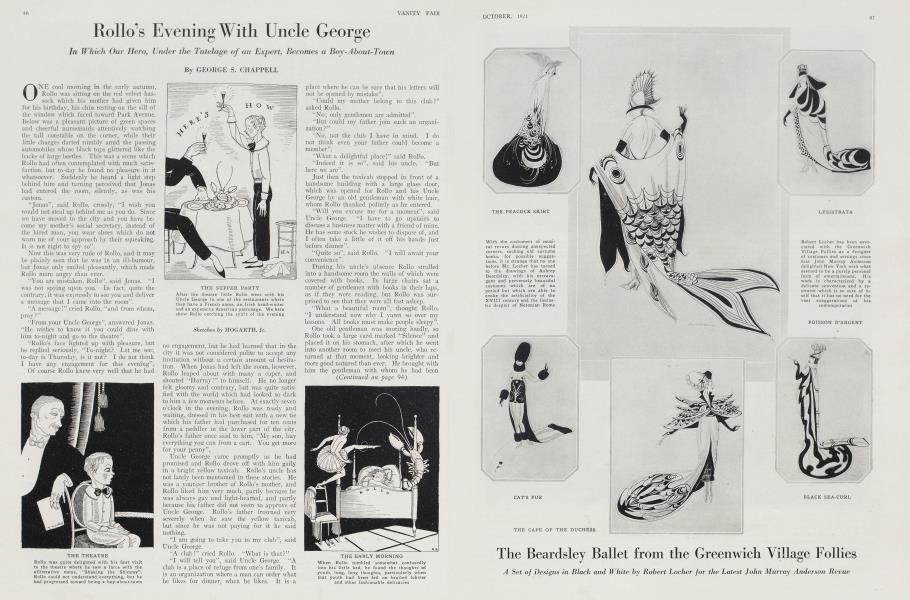
ONE cool morning in the early autumn, Rollo was sitting on the red velvet hassock which his mother had given him for his birthday, his chin resting on the sill of the window which faced toward Park Avenue. Below was a pleasant picture of green spaces and cheerful nursemaids attentively watching the tall constable on the comer, while their little charges darted nimbly amid the passing automobiles whose black tops glittered like the backs of large beetles. This was a scene which Rollo had often contemplated with much satisfaction, but to-day he found no pleasure in it whatsoever. Suddenly he heard a light step behind him and turning perceived that Jonas had entered the room, silently, as was his custom.
"Jonas", said Rollo, crossly, "I wish you would not steal up behind me as you do. Since we have moved to the city and you have become my mother's social secretary, instead of the hired man, you wear shoes which do not warn me of your approach by their squeaking. It is not right to spy so".
Now this was very rude of Rollo, and it may be plainly seen that he was in an ill-humour, but Jonas only smiled pleasantly, which made Rollo more angry than ever.
"You are mistaken, Rollo", said Jonas. "I was not spying upon you. In fact, quite the contrary, it was expressly to see you and deliver a message that I came into the room".
"A message!" cried Rollo, "and from whom, pray?"
"From your Uncle George", answered Jonas. "He wishes to know if you could dine with him to-night and go to the theatre".
"Rollo's face lighted up with pleasure, but he replied seriously, "To-night? Let me see; to-day is Thursday, is it not? I do not think I have any engagement for this evening".
Of course Rollo knew very well that he had no engagement, but he had learned that in the city it was not considered polite to accept any invitation without a certain amount of hesitation. When Jonas had left the room, however, Rollo leaped about with many a caper, and shouted "Hurray!" to himself. He no longer felt gloomy and contrary, but was quite satisfied with the world which had looked so dark to him a few moments before. At exactly seven o'clock in the evening, Rollo was ready and waiting, dressed in his best suit with a new tie which his father had purchased for ten cents from a peddler in the lower part of the city. Rollo's father once said to him, "My son, buy everything you can from a cart. You get more for your penny".
Uncle George came promptly as he had promised and Rollo drove off with him gaily in a bright yellow taxicab. Rollo's uncle has not lately been mentioned in these stories. He was a younger brother of Rollo's mother, and Rollo liked him very much, partly because he was always gay and light-hearted, and partly because his father did not seem to approve of Uncle George. Rollo's father frowned very severely when he saw the yellow taxicab, but since he was not paying for it he said nothing.
"I am going to take you to my club", said Unrip Gporfrp
"A club!" cried Rollo. "What is that?"
"I will tell you", said Uncle George. "A club is a place of refuge from one's family. It is an organization where a man can order what he likes for dinner, when he likes. It is a place where he can be sure that his letters will not be opened by mistake".
"Could my mother belong to this club?" asked Rollo.
"No; only gentlemen are admitted".
"But could my father join such an organization?"
"No, not the club I have in mind. I do not think even your father could become a member".
"What a delightful place!" said Rollo.
"Indeed it is so", said his uncle. "But here we are".
Just then the taxicab stopped in front of a handsome building with a large glass door, which was opened for Rollo and his Uncle George by an old gentleman with white hair, whom Rollo thanked politely as he entered.
"Will you excuse me for a moment", said Uncle George. "I have to go upstairs to discuss a business matter with a friend of mine. He has some stock he wishes to dispose of, and I often take a little of it off his hands just before dinner".
"Quite so", said Rollo. "I will await your convenience".
During his uncle's absence Rollo strolled into a handsome room the walls of which were covered with books. In large chairs sat a number of gentlemen with books in their laps, as if they were reading, but Rollo was surprised to see that they were all fast asleep.
"What a beautiful room", thought Rollo. "I understand now why I yawn so over my lessons. All books must make people sleepy".
One old gentleman was snoring loudly, so Rollo took a large card marked "Silence" and placed it on his stomach, after which he went into another room to meet his uncle, who returned at that moment, looking brighter and more good natured than ever. He brought with him the gentleman with whom he had been doing business.
(Continued on page 94)
(Continued from page 46)
"Rollo", he said, "this is my friend, Mr. Ross, who is going to dine and go to the theatre with us. He is a member of the old Shaker Colony".
"Is it so?" said Rollo. "There are a number of Shakers living near my home in the country. One of them has made several comforters for my mother".
"Yes", said Mr. Ross. "And I have made a number of comforters for your uncle, have I not, George?"
"Indeed you have", said Rollo's uncle, and together they walked upstairs to a splendid room, where they all dined together very merrily. Rollo stood for a moment beside his chair expecting that his Uncle George would ask a blessing, but Uncle George evidently forgot to do so and bade Rollo sit down and fall to, which he did.
The Theatre
"HAVE you been to the theatre, often, Rollo?" asked Mr. Ross, while they were eating dinner.
"No, not exactly", replied Rollo. "My mother took me to Boston two years ago, and I saw a very wonderful panorama of the battle of Gettysburg. But that is not exactly the theatre, is it?"
"Not exactly", said Mr. Ross, "though I am sure some of the plays in New York are much worse than any battle".
"What play are we to see, Uncle George?" asked Rollo. "Is it to be Shakespere?"
"No", answered Uncle George. "I hardly thought Shakespere would be lively enough. You see, Rollo, the plays in New York are divided into two groups. There are the very serious plays acted by great people, which all the critics say are great successes. But unfortunately, no one goes to see them. Then there are the very silly comedies about people in bath-tubs, which the critics say are very low and wicked and which everyone flocks to see. That is the kind we are going to see".
"How delightful!" said Rollo. "I have never seen any one in a bath-tub but myself".
As soon as dinner was finished, Rollo and the two gentlemen drove in another cab to the theatre, which was on the main street of New York, called Broadway, because it is quite narrow and goes zig zag through the city. But Rollo was entranced with the brilliant electric lights, the flashing signs and great rush of traffic.
"Is it a celebration?" he asked.
"Yes", said Uncle George. "Broadway is always a celebration. But come; let us alight".
Rollo greatly admired the interior of the theatre, which was at least five times larger than the Second Congregational Church, which he was accustomed to attend when at home. Just then to his surprise all the lights in the edifice went out.
"O dear", said Rollo. "Isn't that provoking".
"Hush", said the two gentlemen. "The play is about to begin".
At that moment an enormous curtain rose slowly, music filled the air from some hidden and mysterious source, and Rollo saw before him a picture more beautiful than anything he had ever seen before.
The name of the play which Uncle George had selected was "Shaking the Shimmy".
It was in three acts. The first act was in the ladies' dressing room of a parlor car, the second was on the beach at Atlantic City, and the third was in the dormitory of a young ladies' seminary in Greenwich. A notice on the program explained that the last act enabled the producers, two Jewish gentlemen, to have twenty beds on the stage at one time, which broke all records.
Rollo never dreamed that young ladies could be so beautiful as those who flitted about on the stage. Although he understood very little of what was said on the stage, he was tingling with excitement and sat far forward on the edge of his chair, resting his chin on the shoulder of a lady in front of him, who smiled and patted his hand.
Rollo heaved a great sigh of disappointment when the play was over. Then looking about at the audience he said, "Does it not seem strange, Uncle George, to see all those people fully clothed? I vow I had forgotten that there were such things as dresses".
"And how did you like the play?" asked Uncle George.
"It was superb, sir", said Rollo politely. "And much pleasanter than the 'Battle of Gettysburg'."
"Good", said his uncle, "and now we shall go to supper".
"Bless my soul!" cried Rollo. "Is not the evening over?"
"No indeed", replied Unde George, "it is but just beginning".
"Hurray! Hurray!" shouted Rollo, tossing his cap in the air.
The Supper Party
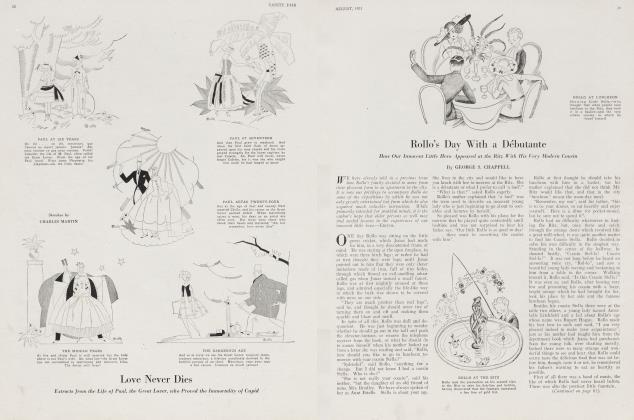
THE place where Rollo and Uncle George and Mr. Ross went for supper was high up on the top of a tall building. At the entrance a gentleman held a red velvet rope across the door, but he smiled pleasantly when he saw Uncle George and let them pass to the annoyance of a number of people who were waiting. This of course pleased Rollo not a little.
"What is the name of this place?" asked Rollo.
"It is called the Place Blanche", explained Uncle George. "French is the language spoken by the people who name New York restaurants. If a restaurant should have a name which a taxi-driver could pronounce correctly, it would not last a week!"
"It is very crowded", said Rollo, "and the space for dancing seems quite small".
"That too is carefully arranged for", said his uncle. "People like to eat in stuffy, uncomfortable places. As for dancing, it is much better to dance when one is pressed hard against several other couples, for if you do not happen to care particularly for your partner you can close your eyes and imagine you are dancing with a number of other ladies at the same time".
"What strange music", said Rollo.
"It is indeed so", agreed Mr. Ross. "We are gradually getting away from the old-fashioned instruments such as violins and flutes. You will notice, Rollo, that in the orchestra are two drums, a pair of cymbals, a siren and a pistol; also the pianist does not use his fingers but his clenched fists".
Rollo fully expected that this time at least Uncle George would not forget to ask the blessing, but lo! a second time he did so, perhaps because he was at the time very much occupied trying to get the cork out of a large bottle, which he had managed to conceal in his inside pocket. As soon as this was open, Uncle George and Mr. Ross became very gay indeed, and Rollo, catching the spirit of the evening, joined merrily in the conversation. Later in the evening they met several friends at other tables, with whom they danced and thoroughly enjoyed themselves.
The sky in the east was a pale bluegreen when Rollo entered the door of the apartment. Jonas, who kept to his country hours, was just rising.
"Good morning", said Jonas.
"Good night", said Rollo.
It was but the work of a moment to undress and leap into bed. But before he did so Rollo knelt for a moment and asked a blessing—for Uncle George.
Subscribers have complete access to the archive.
Sign In Not a Subscriber?Join Now
