Sign In to Your Account
Subscribers have complete access to the archive.
Sign In Not a Subscriber?Join NowThe Secret of Charlie Chaplin's Popularity
Why is it That Both Highbrows and Lowbrows Pay Tribute to the Great Comedian of the Screen ?
ST. JOHN ERVINE
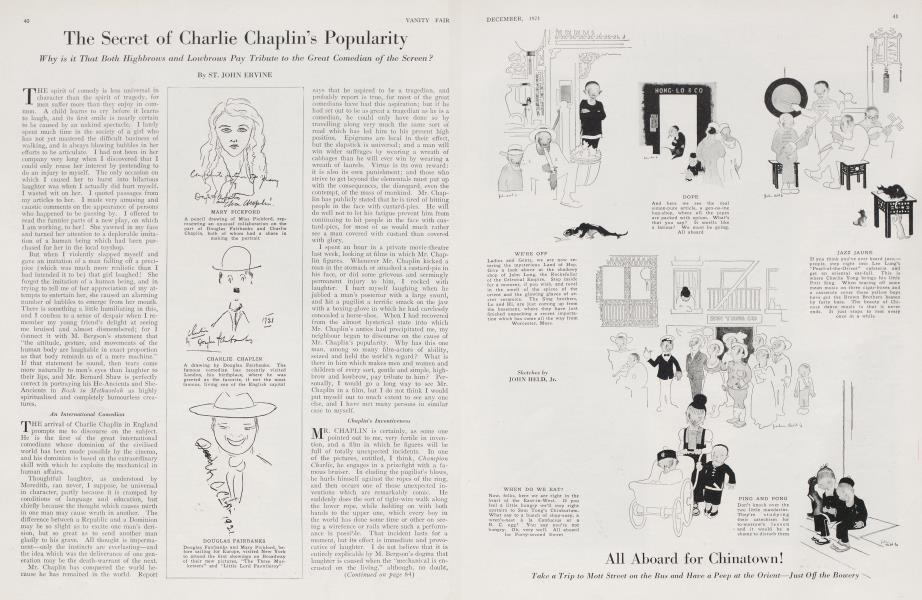
THE spirit of comedy is less universal in character than the spirit of tragedy, for men suffer more than they enjoy in common. A child learns to cry before it learns to laugh, and its first smile is nearly certain to be caused by an unkind spectacle. I lately spent much time in the society of a girl who has not yet mastered the difficult business of walking, and is always blowing bubbles in her efforts to be articulate. I had not been in her company very long when I discovered that X could only rouse her interest by pretending to do an injury to myself. The only occasion on which I caused her to burst into hilarious laughter was when I actually did hurt myself. I wasted wit on her. I quoted passages from my articles to her. I made very amusing and caustic comments on the appearance of persons who happened to be passing by. I offered to read the funnier parts of a new play, on which I am working, to her! She yawned in my face and turned her attention to a deplorable imitation of a human being which had been purchased for her in the local toyshop.
But when I violently slapped myself and gave an imitation of a man falling off a precipice (which was much more realistic than I had intended it to be) that girl laughed! She forgot the imitation of a human being, and in trying to tell me of her appreciation of my attempts to entertain her, she caused an alarming number of bubbles to emerge from her mouth. There is something a little humiliating in this, and I confess to a sense of despair when I remember my young friend's delight at seeing me bruised and almost dismembered; for I connect it with M. Bergson's statement that "the attitude, gesture, and movements of the human body are laughable in exact proportion as that body reminds us of a mere machine." If that statement be sound, then tears come more naturally to men's eyes than laughter to their lips, and Mr. Bernard Shaw is perfectly correct in portraying his He-Ancients and SheAncients in Back to Methuselah as highly spiritualised and completely humourless creatures.
An International Comedian
THE arrival of Charlie Chaplin in England prompts me to discourse on the subject. He is die first of the great international comedians whose dominion of the civilised world has been made possible by the cinema, and his dominion is based on the extraordinary skill with which he exploits the mechanical in human affairs.
Thoughtful laughter, as understood by Meredith, can never, I suppose, be universal in character, partly because it is cramped by conditions of language and education, but chiefly because the thought which causes mirth in one man may cause wrath in another. The difference between a Republic and a Dominion may be so slight as to excite one man's derision, but so great as to send another man gladly to his grave. All thought is impermanent—only the instincts are everlasting—and the idea which was the deliverance of one generation may be the death-warrant of the next.
Mr. Chaplin has conquered the world because he has remained in the world. Report says that he aspired to be a tragedian, and probably report is true, for most of the great comedians have had this aspiration; but if he had set out to be as great a tragedian as he is a comedian, he could only have done so by travelling along very much the same sort of road which has led him to his present high position. Epigrams are local in their effect, but the slapstick is universal; and a man will win wider suffrages by wearing a wreath of cabbages than he will ever win by wearing a wreath of laurels. Virtue is its own reward: it is also its own punishment; and those who strive to get beyond the elementals must put up with the consequences, the disregard, even the contempt, of the mass of mankind. Mr. Chaplin has publicly stated that he is tired of hitting people in the face with custard-pies. He will do well not to let his fatigue prevent him from continuing to hit people in the face with custard-pies, for most of us would much rather see a man covered with custard than covered with glory.
I spent an hour in a private movie-theatre last week, looking at films in which Mr. Chaplin figures. Whenever Mr. Chaplin kicked a man in the stomach or smashed a custard-pie in his face, or did some grievous and seemingly permanent injury to him, I rocked with laughter. I hurt myself laughing when he jabbed a man's posterior with a large sword, and hit a pugilist a terrific smack on the jaw with a boxing-glove in which he had carelessly concealed a horse-shoe. When I had recovered from the almost hysterical state into which Mr. Chaplin's antics had precipitated me, my neighbour began to discourse on the cause of Mr. Chaplin's popularity. Why has this one man, among so many film-actors of ability, seized and held the world's regard? What is there in him which makes men and women and children of every sort, gentle and simple, highbrow and lowbrow, pay tribute to him? Personally, I would go a long way to see Mr. Chaplin in a film, but I do not think I would put myself out to much extent to see any one else, and I have met many persons in similar case to myself.
Chaplin's Inventiveness
MR. CHAPLIN is certainly, as some one pointed out to me, very fertile in invention, and a film in which he figures will be full of totally unexpected incidents. In one of the pictures, entitled, I think, Champion Charlie, he engages in a prizefight with a famous bruiser. In eluding the pugilist's blows, he hurls himself against the ropes of the ring, and then occurs one of those unexpected inventions which are remarkably comic. He suddenly does the sort of tight-wire walk along the lower rope, while holding on with both hands to the upper one, which every boy in the world has done some time or other on seeing a wirefence or rails where such a performance is possible. That incident lasts for a moment, but its effect is immediate and provocative of laughter. I do not believe that it is entirely explicable by M. Bergson's dogma that laughter is caused when the "mechanical is encrusted on the living," although, no doubt, that goes a long way towards explaining it.
(Continued on page 84)
(Continued from page 40)
But there is something profounder than the comicality of seeing the mechanical imposed upon the living in the laughter provoked by this one of many similar incidents in Mr. Chaplin's repertoire. The spontaneity of the act seems irreconcilable with the theory of mechanics, but whether that be so or not, surely the basic fact in the promotion of this laughter is the memory it stimulates. All of us, highbrow and lowbrow, have tried to emulate Blondin on a tight-rope. I remember trying to do it on a bed-rail one morning, and falling with such violence on the floor that I nearly went through into the kitchen. Mr. Chaplin builds his movies on the things which enthralled and amused us when we were children; and he keeps us who are adult continually entertained because he takes the secret aspirations of children, together with their cruelties and fears and vanities and adventures, and puts them into the circumstances of men. And since man is never so universal in character as he is in his childhood, it follows that the laughter which Mr. Chaplin excites can be shared by the whole world. We do not love the stars the less because all men can see them: we are not any the less amused by Mr. Chaplin because he can make an old man laugh as heartily as he can make a child.
The Small Boy's Heart
MR. CHAPLIN is the small boy realising his ambitions. He has fierce fights with big men, and always wins them. When he meets a policeman, instantly he reveals the small boy's heart. Observe the sudden look of dismay that comes over Mr. Chaplin's face as he turns quickly and finds a policeman at his elbow. It is not the dismay of a criminal, but the dismay of the child in contact with authority. There is a little twitch of nervousness, followed by a disarming smile and a futile effort to appear unconcerned and detached. You can almost hear the small boy's heart thumping as he tries to pretend that he had nothing whatever to do with the unfortunate affair now engaging a policeman's attention. And then comes the triumph when authority is humbled and defeated. The policeman dives towards the terrified small boy—and misses him, for Mr. Chaplin, fulfilling the small boy's secret desire to be a proficient acrobat and to flout authority, leaps through the policeman's distent legs and gallops up the street with the humiliated bobby vainly following. The boy who sauced a "peeler" in Ireland, when he becomes a ratepayer and an elector, may not feel much sympathy with ratepayers and electors, if there are such, in the Balearic Islands, but he has immediate kinship with them, when he identifies them as boys who sauced policemen, even as he sauced them. And it is the great gift of Mr. Chaplin, as it is also his privilege, to make men recognise their identities. He has taken Englishmen and Irishmen, Spaniards and Russians, Frenchmen and Germans, Americans and Japanese, and reduced them all to their elements; and in so doing has achieved very largely what the more sober Dr. Wilson failed to do at Paris.
Subscribers have complete access to the archive.
Sign In Not a Subscriber?Join Now
