Sign In to Your Account
Subscribers have complete access to the archive.
Sign In Not a Subscriber?Join NowCrab Meat Sympathique
A Diminutive Drama of the Larger Life
NIB
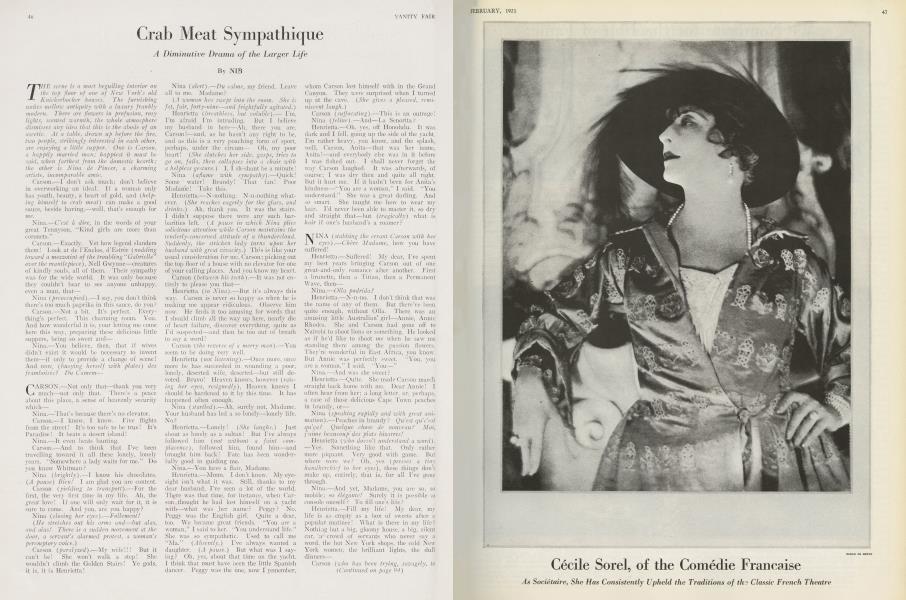
THE scene is a most beguiling interior on the top floor of one of New York's old, Knickerbocker houses. The furnishing unites mellow antiquity with a luxury frankly modern. There are flowers in profusion, rosy lights, scented warmth, the whole atmosphere dismisses any idea that this is the abode of an ascetic. At a table, drawn up before the fire, two people, strikingly interested in each other, are enjoying a little supper. One is Carson, a happily married man; happiest it must be said, when farthest from the domestic hearth; the other is Nina de Pincer, a charming artiste, incomparable amie.
Carson.—I don't ask much; don't believe in overworking an ideal. If a woman only has youth, beauty, a heart of gold, and (helping himself to crab meat) can make a good sauce, beside having,—well, that's enough for me.
Nina.—C'est a dire, in the words of your great Tennyson, "Kind girls are more than coronets."
Carson.—Exactly. Yet how legend slanders them! Look at de l'Enclos, d'Estree (nodding toward a mezzotint of the troubling "Gabrielle" over the mantlepiece), Nell Gwynne—creatures of kindly souls, all of them. Their sympathy was for the wide world. It was only because they couldn't bear to see anyone unhappy, even a man, that—
Nina (preoccupied).—I say, you don't think there's too much paprika in this sauce, do you?
Carson.—Not a bit. It's perfect. Everything's perfect. This charming room. You. And how wonderful it is, your letting me come here this way, preparing these delicious little suppers, being so sweet and—
Nina.—You believe, then, that if wives didn't exist it would be necessary to invent them—if only to provide a change of scene! And now, (busying herself with plates) des framboises? Du Camem—
CARSON.—Not only that—thank you very much—not only that. There's a peace about this place, a sense of heavenly security which—
Nina.—That's because there's no elevator. Carson.—I know, I know. Five flights from the street! It's too safe to be true! It's Paradise! It beats a desert island!
Nina.—It even beats banting.
Carson.—And to think that I've been travelling toward it all these lonely, lonely years. "Somewhere a lady waits for me." Do you know Whitman?
Nina (brightly).—I know his chocolates. (A pause) Bien! I am glad you are content.
Carson (yielding to transport).—For the first, the very first time in my life. Ah, the great love! If one will only wait for it, it is sure to come. And you, are you happy? Nina (closing her eyes).—Follement!
(He stretches out his arms and—but alas, and alas! There is a sudden movement at the door, a servant's alarmed protest, a woman's peremptory voice.)
Carson (paralyzed).—My wife!!! But it can't be! She won't walk a step! She wouldn't climb the Golden Stairs! Ye gods, it is. it is Henrietta!
Nina (alert).—Du calme, my friend. Leave all to me. Madame?
(A woman has swept into the room. She is fat, fair, forty-nine—and frightfully agitated.)
Henrietta (breathless, but voluble).— I'm, I'm afraid I'm intruding. But I believe my husband in here—Ah, there you are, Carson!—and, as he hasn't any right to be, and as this is a very poaching form of sport, perhaps, under the circum— Oh, my poor heart! (She clutches her side, gasps, tries to go on, fails, then collapses into a chair with a helpless gesture.) I, I sh-shant be a minute!
Nina (aflame with sympathy).—Quick! Some water! Brandy! That fan! Poor Madame! Take this.
Henrietta.—N-nothing. N-n-nothing whatever. (She reaches eagerly for the glass, and drinks.) Ah, thank you. It was the stairs. I didn't suppose there were any such barbarities left. (A pause in which Nina plies solicitous attention while Carson maintains the tenderly-concerned attitude of a thundercloud. Suddenly, the stricken lady turns upon her husband with great vivacity.) This is like your usual consideration for me, Carson; picking out the top floor of a house with no elevator for one of your calling places. And you know my heart.
Carson (between his teeth).—It was not entirely to please you that—
Henrietta (to Nina).—But it's always this way. Carson is never so happy as when he is making me appear ridiculous. Observe him now. He finds it too amusing for words that I should climb all the way up here, nearly die of heart failure, discover everything, quite as I'd suspected—and then be too out of breath to say a word!
Carson (the reverse of a merry man).—You seem to be doing very well.
Henrietta (not listening).—Once more, once more he has succeeded in wounding a poor, lonely, deserted wife, deserted—but still devoted. Bravo! Heaven knows, however (raising her eyes, resignedly), Heaven knows I should be hardened to it by this time. It has happened often enough.
Nina (startled).—Ah, surely not, Madame. Your husband has led a so lonely—lonely life. No?
Henrietta.—Lonely! (She laughs.) Just about as lonely as a sultan! But I've always followed him (not without a faint complacence), followed him, found him—and brought him back! Fate has been wonderfully good in guiding me.
Nina.—You have a flair, Madame.
Henrietta.—Mmm. I don't know. My eyesight isn't what it was. Still, thanks to my dear husband, I've seen a lot of the world. Th^re was that time, for instance, when Carson thought he had lost himself on a yacht with—what was her name? Peggy? No, Peggy was the English girl. Quite a dear, too. We became great friends. "You are a woman," I said to her. "You understand life." She was so sympathetic. Used to call me "Ma." (Absently.) I've always wanted a daughter. (A pause.) But what was I saying? Oh, yes, about that time on the yacht. I think that must have been the little Spanish dancer. Peggy was the one, now I remember, whom Carson lost himself with in the Grand Canyon. They were surprised when I turned up at the cave. . (She gives a pleased, reminiscent laugh.)
Carson (suffocating).—This is an outrage!
Nina (feline).—And—La Senorita?
Henrietta.—Oh, yes, off Honolulu. It was dark and I fell, going up the side of the yacht. I'm rather heavy, you know, and the splash, well, Carson, Anita—that was her name, Anita!—and everybody else was in it before I was fished out. I shall never forget the way Carson laughed. It was afterwards, of course; I was dry then and quite all right. But it hurt me. If it hadn't been for Anita's kindness—"You are a woman," I said. "You understand." She was a great darling. And so smart. She taught me how to wear my hair. I'd never been able to master it, so dry and straight that—but (tragically) what is hair if one's husband's a roamer?
NINA (stabbing the errant Carson with her eyes).—Chore Madame, how you have suffered!
Henrietta.—Suffered! My dear, I've spent my best years bringing Carson out of one great-and-only romance after another. First a brunette, then a Titian, then a Permanent Wave, then—
Nina.—Olla podrida?
Henrietta.—N-n-no. I don't think that was the name of any of them. But there've been quite enough, without Olla. There was an amusing little Australian* girl—Annie, Annie Rhodes. She and Carson had gone off to Nairobi to shoot lions or something. He looked as if he'd like to shoot me when he saw me standing there among the passion flowers. They're wonderful in East Africa, you know. But Annie was perfectly sweet. "You, you are a woman," I said. "You—"
Nina.—And was she sweet?
Henrietta.—Quite. She made Carson march straight back home with me. Dear Annie! I often hear from her; a long letter, or, perhaps, a case of those delicious Cape Town peaches in brandy, or—
Nina (speaking rapidly and with great animation).—Peaches in brandy? Qu'est qu'c'est qu'ga? Quelque chose de nouveau? Moi, j'aime beaucoup des plats bizarres!
Henrietta (who doesn't understand a word). —Yes. Something like that. Only rather more piquant. Very good with game. But where were we? Oh, yes (presses a tiny handkerchief to her eyes), these things don't make up, entirely, that is, for all I've gone through.
Nina.—And yet, Madame, you are so, so mobile; so elegante! Surely it is possible to console oneself? To fill one's life?
Henrietta.—Fill my life! My dear, my life is as empty as a box of sweets after a popular matinee! What is there in my life? Nothing but a big, gloomy house, a big, silent car, a crowd of servants who never say a word, the hot New York shops, the cold New York women; the brilliant lights, the dull dinners—
Carson (who has been trying, savagely, to interpose a word).—You're talking wildly, as usual, Henrietta. I'm going to call a taxi and take you home.
(Continued on page 94)
(Continued, from page 46)
(Neither of the women pay the slightest attention to him. He moves to the telephone.)
Henrietta (brokenly).—And now, all I want is a little love. Just a little bit of love.
Nina.—Love ?
Henrietta.—Yes. My husband's, I, mean.
Nina.—It is not always—not always a husband's love that one seeks. You think ?
Henrietta.—With you, perhaps not. But I, I'm old, fat, and a Presbyterian monogamist. All I want is my own husband, though he is a terrible fraud. (She looks at Nina with eyes suspiciously dewy.) You are a woman—
Nina (infinitely touched).—Of course, of course. Poor darling!
(The two women fall into each others arms.)
CARSON (dangerously).—When this farce is over, perhaps—
Henrietta (drying her tears).—Thank you, my dear. I felt that you would. They all do. Indeed, you remind me very much of another little French friend of Carson's. Yvonne-de-Something. The same warm heart. She taught me how to do the most fascinating filet work. You draw out all the threads and (breaks off with an engaging smile). But you are suresure you don't mind?
Nina.—Au contraire. f With an icy glance she recalls, and dismisses, the versatile Carson's existence.) Your husband and I were but, what you call, platonic. He was amused by my modest little appartement, my simple efforts as chef, and I, I was amused by his—his so beautiful ideals! But I could not bear to see anyone unhappy, not even a wife.
Henrietta (lightly, now thoroughly restored).—So kind of you. How comfy you are here! (Looks about her with frank pleasure.) Fancy a place without an elevator being so charming! And what are you having for supper? Crab meat—?
Nina.—A I'Espagnole.
Henrietta (with an ecstatic little scream).—I adore it! But that wretched cook of mine never gets the sauce right. I. wonder if you would be an angel and tell me how—
Carson.—Are you coming, Henrietta? The taxi's—
Nina.—It's very simple. You dissolve everything in the hot vinegar first, then—
Henrietta.—I see, then there's the little trick of getting it smooth and—
Nina.—Oh, only be careful not to take it off the flame too soon, nor leave it on too long. At the very last you add—it's a hint from an old maitre d'hotel—just a pinch, the merest soup^on of—but here, why not sit down and we will have some. I know you must be hungry.
Henrietta (brightly).—Starved.
(The two women seat themselves in high spirits. Henrietta takes Carson's place. The latter stands for a moment, irresolute, his hand on the door knob; then, with a look of mingled defeat and exasperation at the supper group, utterly indifferent to his presence, he dashes from the room.)
Nina (dispensing the crab meat).— Voilà!
Henrietta (her mouth full).—Mmmmm! How heavenly l My dear, I must give you my recipe for terrapin without sherry. I had it from my grandmother Fairfax. You take a little brown butter, quite a good deal, that is, and—
(The curtain comes down as the women's chatter flows happily on, and on.)
Subscribers have complete access to the archive.
Sign In Not a Subscriber?Join Now
