Sign In to Your Account
Subscribers have complete access to the archive.
Sign In Not a Subscriber?Join NowThe Art of Dramatic Criticism
Possible Comment by Some Well-Known Critics on a Performance of "Atalanta in Calydon"
JOHN PEALE BISHOP
Mr. George Jean Nathan Enjoys No Illusion
IN my capacity as commentator on the posturings of the local mimes, it has been my custom from time to time to refer to the critical obfuscations of the local Hazlitts, Leweses and Lambs, to whose repertorial talent the daily journals allot the Monday premieres of the native masques of Momus. I have been under frequent necessity of referring to their parochial ignorance of any stage further east than Sixth Avenue or any play older than The Queen of the White Devils, a divertissement in burlesque circa 1877.
Being an honest fellow, I admit that I was recently, though quite temporarily, a lodge brother to these professional ignoramuses. That is, I accepted an invitation of the management of the Plymouth Theatre to attend a performance of A. C. Swinburne's Atalanta in Calydon, with as slight a knowledge of Mr. Swinburne as the aforesaid critics of Broadway dramaturgy have, say of Turszinsky, Bracco or Jacques Burg. I knew he was a fiery young Heliogabalus, who set the Rev. Drs. and Lord Mayors of his day gaping; that his verses, being writ on cognac were superior to the outpourings of the native sarsaparilla muse; that he had a pretty gift for Tristan und Isolde tonalities.
I anticipated something between a Ben Ali Haggin tableau at Florenz Ziegfeld's Follies, and a first performance at the Theatron in Athens during the Greater Dionysia. Distilling a subtle aroma of Corona Prodigiosa Splendosa over the upholstery of the Plymouth first row, I folded my overcoat over one of my two seats and, slipping my lower dorsal region into the other, awaited the performance.
Said the program: 'Herald'; greeted my eyes a fat-jowled play actor, fresh from his dinner at the Hotel Algonquin, dressed in baby-blue kilts, with Hess's No. 13 grease paint plentifully smeared over his bare legs, who recited a ventriloqual monologue in the dialect of the Lambs Club. Appeared a Chorus, draped in mauve mousseline, who, with the possible exception of the yaller-haired cutie on the right end, bore birth certificates dating from 1887 to 1891. Followed a lengthy lyric with much business of stroking draperies and punctuated by absurd contortions derived less obviously from Greek sculpture than from posters of the Dalcroze School of Eurhythmies. Followed an alternation of mouthings by the play-actors, and posturings by the lady contortionists.
Undeterred by this exhibition, I waited the coming of this Atalanta, heralded in the text as
Most fair and fearful, feminine, a god, Faultless.
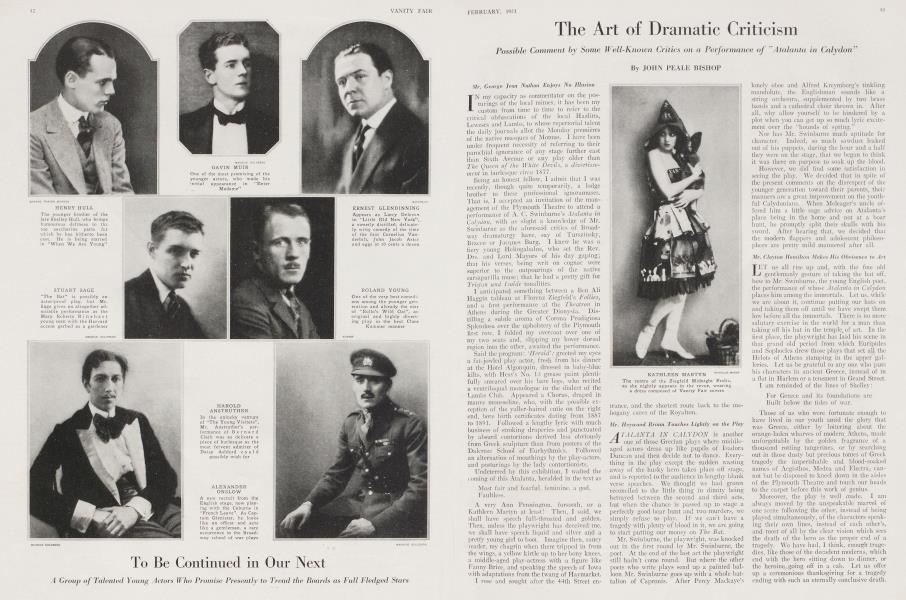
A very Ann Pennington, forsooth, or a Kathleen Martyn at least! Then, I said, we shall have speech full-throated and golden. Then, unless the playwright has deceived me, we shall have speech liquid and silver and a pretty young girl to boot. Imagine then, saucy reader, my chagrin when there tripped in from the wings, a yellow kirtle up to her bony knees, a middle-aged play-actress with a figure like Fanny Brice, and speaking the speech of Iowa with adaptations from the twang of Haymarket. I rose and sought after the 44th Street entrance, and the shortest route back to the mahogany caves of the Royalton.
Mr. Hey wood Broun Touches Lightly on the Play
ATALANTA IN CALYDON is another one of those Grecian plays where middleaged actors dress up like pupils of Isadora Duncan and then decide not to dance. Everything in the play except the sudden wasting away of the husky hero takes place off stage, and is reported to the audience in lengthy blank verse speeches. We thought we had grown reconciled to the little tiling in dimity being betrayed between the second and third acts, but when the chance is passed up to stage a perfectly good boar hunt and two murders, we simply refuse to play. If we can't have a tragedy with plenty of blood in it, we are going to start putting our money on The Bat.
Mr. Swinburne, the playwright, was knocked out in the first round by Mr. Swinburne, the poet. At the end of the last act the playwright still hadn't come round. But where the other poets who write plays send up a painted balloon Mr. Swinburne goes up with a whole battalion of Capronis. After Percy Mackaye's lonely oboe and Alfred Kreymborg's tinkling mandolute, the Englishman sounds like a string orchestra, supplemented by two brass bands and a cathedral choir thrown in. After all, why allow yourself to be hindered by a plot when you can get up so much lyric excitement over the "hounds of spring."
Nor has Mr. Swinburne much aptitude for character. Indeed, so much sawdust leaked out of his puppets, during the hour and a half they were on the stage, that we began to think it was there on purpose to soak up the blood.
However, we did find some satisfaction in seeing the play. We decided that in spite of the present comments on the disrespect of the younger generation toward their parents, their manners are a great improvement on the youthful Calydonians. When Meleager's uncle offered him a little sage advice on Atalanta's place being in the home and not at a boar hunt, he promptly split their skulls with his sword. After hearing that, we decided that the modern flappers and adolescent philosophers are pretty mild mannered after all.
Mr. Clayton Hamilton Makes His Obeisance to Art
LET us all rise up and, with the fine old gentlemanly gesture of taking the hat off, bow to Mr. Swinburne, the young English poet, the performance of whose Atalanta in Calydon places him among the immortals. Let us, while we are about it, continue putting our hats on and taking them off until we have swept them low before all the immortals. There is no more salutary exercise in the world for a man than taking off his hat in the temple^of art. In the first place, the playwright has laid his scene in that grand old period from which Euripides and Sophocles drew those plays that set all the Helots of Athens stamping in the upper galleries. Let us be grateful to any one who puts his characters in ancient Greece, instead of in a flat in Harlem or a tenement in Grand Street. I am reminded of the lines of Shelley:
For Greece and its foundations are Built below the tides of war.
Those of us who were fortunate enough to have lived in our youth amid the glory that was Greece, either by loitering about the orange-laden wharves of modern Athens, made unforgettable by the golden fragrance of a thousand rotting tangerines, or by searching out in those dusty but precious tomes of Greek tragedy the imperishable and blood-soaked names of Aegisthos, Medea and Electra, cannot but be disposed to kneel down in the aisles of the Plymouth Theatre and touch our heads to the carpet before this work of genius.
Moreover, the play is well made. I am always moved by the unspeakable marvel of one scene following the other, instead of being played simultaneously, of the characters speaking their own lines, instead of each other's, and most of all by the clear vision which sees the death of the hero as the proper end of a tragedy. We have had, I think, enough tragedies, like those of the decadent moderns, which end with the hero sitting down to dinner, or the heroine going off in a cab. Let us offer up a ceremonious thanksgiving for a tragedy ending with such an eternally conclusive death.
Subscribers have complete access to the archive.
Sign In Not a Subscriber?Join Now