
Sign In to Your Account
Subscribers have complete access to the archive.
Sign In Not a Subscriber?Join NowAdjoining Rooms
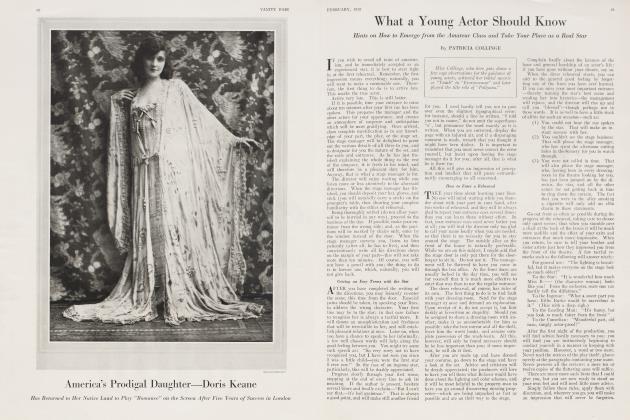
PATRICIA COLLINGE
A Drama of Deshabille, Based on the Dozen or More Bedroom Farces So Popular Today
THE first act takes place in the country house of Professor Fasia. The scene is the combined hall and living-room, showing a staircase leading to the second floor where the bedroom doors are visible.
As the curtain rises a knocking is heard. The housekeeper, Eliza, is seen crossing the ice—I mean the stage—to open the front door. She is a grey-haired woman with a suspicious nature and elastic-sided boots. She speaks with a strong New England dialect, as follows :
Who bane coming to this 'ouse at this hour o' the nicht?
She opens the door, and, suspiciously, admits Tom Collins and Sylvia Single. Tom is a gentle youth who stutters (this being an unfailingly humorous affliction in farce). Sylvia is a very pretty blond young person, also gentle—but without the sign of a stutter.
They enter, both carrying portmanteaus.
Tom Collins: Is this Prof. Fasia's h-h-hhouse ?
Eliza: Hoot mon—I'm yoost his housekeeper.
Tom Collins: I mean—is this where he—he—he—lives?
Eliza: It is that—when he vas here. Tom: Isn't he here—here—here—?" Eliza: What are you cheering for?
Sylvia Single: Better let me do it, Tom. (To Eliza): Is the Professor at home? He is expecting us.
Sylvia now explains that she and Tom are old pupils of the Professor, and that they have been invited to spend the week-end with him. The housekeeper tells them that the Professor has gone away on a hunting trip and is not expected back for a week.
Sylvia: There. You see, he has forgotten all about us. Oh! dear. I might have expected as much from Professor Fasia.
Tom: Fasia! As-phasia, I should s-ssay! (If this joke is too subtle for the audience, it can be simplified.)
Sylvia: Well-—what are we to do?
Tom: We'd better g-go back to New York. Sylvia (to Eliza): When is the next train? Eliza: Zere is a -vair good one at ten— Sylvia and Tom: Splendid!
Eliza: —at ten, tomorrow morning. Sylvia and Tom: Oh!
It now becomes necessary to begin getting Eliza off stage for the purpose of the plot. Tom asks her to bring him a timetable.
!Tom and Sylvia, in a short scene, disclose that they are recently betrothed; in fact, the week-end party, which the Professor has forgotten, was to celebrate their engagement. They agree that in the absence of their host, Sylvia would better spend the night where she is, while 'Tom goes to the hotel in the village.
Eliza returns (with or without the timetable) and Sylvia says: I shall stay here tonight—and Mr. Collins will go to the hotel.
Eliza: Hotel, is it? Faith he'll have to walk faster than he can talk to get there before morning. There isn't one within forty miles.
Sylvia: Oh! Tom.
Eliza: Ay tank you have quarrelled. Yes?
To the Editor:
Dear Sir: I recently visited a modest country house which boasted of but two bedrooms. Not a very startling fact; but I was struck by it, for here, said I to myself, lurks material for a farce. So, after an exhaustive, not to say exhausting, study of the current drama of dishabille, I evolved this farce scenario. In it I have proceeded on the theory that, if one bedroom is funny, two bedrooms are twice as funny, and if two beds are intriguing,—then four should be wholly irresistible. I have added bathrooms, without extra charge.
I submit this, in all humility; it is a simple thing. In fact, the more you read it the simpler it seems. If produced, I think it would run for two years in New York alone,—six months for each bedroom, and a year for the title. Hopefully yours.
THE AUTHOR.
For why don't your husband stay here, too?
Sylvia: Husband?
Eliza (with stern New England suspicion): Ain't he bane your husband?
Sylvia: YES!!
Situation! Eliza takes their bags upstairs, while Sylvia whispers (stage whispers) to Tom: I couldn't let you walk the streets all night. She'd never let you stay if she thought we weren't married. We can take separate rooms.
Just at that moment there is a knock at the hall-door. Eliza comes down and opens it. Mrs. Julia Jimpson enters. She is tall and dark and speaks with a slight lisp. She also carries a suitcase and announces that she has been invited for the week-end, with her husband—who will follow her shortly.
It now seems that not only has the Professor forgotten Sylvia and Tom, but that he has mixed up several dates. Sylvia explains that he is away andthat there is no train till morning. Mrs. Jimpson says: How thrilling. Well, we'll just have to make the best of it. She adds that she is very tired and will go straight to her rooms. She then says to Eliza: My husband will be here in a few minutes. Send him up to my room when he arrives.
She goes upstairs—leaving Tom and Sylvia aghast. Sylvia says to Eliza: If Mrs. Jimpson takes that room and I take the other— what room can Mr. Collins have? Eliza: Shure, there ain't but two bedrooms in zee house, bose of zem double.
And here we have a situation quite new to the theatre—and quite, I believe, foreign to farces. The housekeeper leads the unmarried couple to the same room. It is a novel idea— and a subtle one, but not too subtle.
This leaves Tom and Sylvia in Room 1. AndMrs: Jimpson, awaiting her husband, in Room 2.
After seeing Tom and Sylvia to their room, Eliza comes downstairs and turns out the lights. As she does so, a knocking is heard. Once more she opens the hall door, and once more a man enters, carrying a suitcase. He is short and somewhat stock-brokerish. He is about to speak, but Eliza, thinking he is Mr. Jimpson, forestalls him. She points to Mrs. Jimpson's room and says: The lady says to tell you that you are to go right up.
The newcomer goes up and goes in.
Exit Eliza.
Then we see the door of Sylvia Single's room open cautiously, and Tom tiptoes out. Then there is a scream from Mrs. Jimpson's room and the newcomer rushes out. He collides violently with Tom, and they roll downstairs as
The Curtain Falls.
ACT II
ND now the audience can settle back and prepare for an act of supreme enjoyment, for this scene shows not one—but two bedrooms. The stage is bisected by a wall; in this wall is a door, through which the characters can pass from one room to the other. There is also a door, at the back of the stage in each room, facing the audience; these doors lead to the staircase. Each room has, also, a door in its outer side wall, leading to a bathroom. And—piece de resistance—each bedroom possesses twin beds. Imagine. Figurezvous! Four beds, when everyone knows how hilariously, how unrestrainedly funny just one bed can be.
Mrs. Jimpson is discovered (in more ways than one) in pale blue pyjamas. She is sitting on one of the beds in her room—which is on the right side of the stage. Sylvia Single is seated on one of the beds in the room on the left, which is her's. She wears pink pyjamas. (These colours may be changed to suit the tastes of the actresses playing these parts, but they must be pyjamas. They must be very intricate, adorned with plenty of ribbons and silver lace—and rosebuds. Rosebuds are essential; they give such an air of practicability to the costume.)
Sylvia Single registers extreme nervousness. Finally she rises and, crossing to the dividing wall, knocks on the communicating door. Mrs. Jimpson says: Come in. Sylvia goes to her and confides her predicament. Mrs. Jimpson listens sympathetically—and decides that the simplest solution will be for Tom Collins to share a room with Mr. Jimpson, when he arrives, while Sylvia and Mrs. Jimpson share the other. Then Mrs. Jimpson says: But there was a strange man who came into my room—who was he?
Sylvia disclaims any knowledge of him, when there is a knock at Mrs. Jimpson's door (the one that leads to the hall). Mrs. Jimpson, nothing if not clubby, lisps: Come in.
It is Tom Collins and the strange man. The latter introduces himself as follows: I am Samuel Tucker. I am an old friend of the Professor's, and expected to spend this week-end with him. Evidently he has mixed several invitations. I shall have to wait in the house until my wife comes. She is following me here from her mother's. In the meantime I want to get my bag, which I left here in the—er—haste of my departure a few moments ago!
He starts to pick up his bag. As he does so, a loud voice is heard outside the door. Mrs. Jimpson says: My God, my husband. What will he think if he finds you here. Oh, fly! Fly!
(Continued on page 90)
(Continued from page 53)
This of course, ts the signal for complete panic on the part of Mr. Tucker. (People who frequent farces will understand. why—people who don't, won't care.) At any rate, panic-stricken he is —and so are Tom Collins and Sylvia Single, who rush back into Sylvia's room. Tom says: They musn't find me here. I can't be found in your bedroom.
Sylvia: Then hide in my bathroom. (Which he does.)
The innocent onlooker may ask himself: But is all this hiding necessary? I answer: Not necessary, merely farce.
In the meantime, and in the next room, Mrs. Jimpson has thrust the terrorized Tucker into her bathroom and shut the door on him just as Mr. Jimpson enters. He is rough and red-haired; he has a large moustache and a Sinn Fein manner.
He has a short scene with his wife in which they deplore the unfortunate memory of Prof. Fasia. (I am considering saving the Asphasia joke and using it here, but perhaps witty dialogue is not so essential in this act. After all, who wants banter when one can have beds!)
Now comes an exquisite moment. Mr. Jimpson announces his intention of taking a bath. He strides to the bathroom, followed by his wife, who tries hysterically to prevent him, finally shrieking: But darling—it isn't Saturday !
Her husband, however, persists and does indeed enter the bathroom, and turns on the shower, thus discovering Samuel Tucker, who has naively hidden there. Jimpson hauls him out and says: What were you doing in there?
Tucker: I was taking a shower.
Jimpson: Fully dressed?
Tucker: Yes. I always take a
shower fully dressed. I catch cold so easily.
Situation! Saved, however, by Mrs. Jimpson, who remembers that Sylvia is in the next room. So, opening the connecting door she calls: My dear. Your husband has gotten into the wrong shower. And she introduces poor Sylvia as "Mrs. Tucker"—and bundles Samuel Tucker into Sylvia's room and closes the door. Sylvia subsides sobbing (alliteration accidental), on one of the twin beds, while Tucker, aghast, drops on the other. He tries to comfort Sylvia—and is about to leave by the door leading to the hall, but, as he is all wet from the shower, he stops to wrap himself in a quilt from one of the beds. This delay is fatal. A female voice is heard on the landing. It is Mrs. Tuckerl Samuel cries: My God, —my wife!
Sylvia: Hide. Oh! Hide!
Tucker: Never again. You hide. He pushes her into the bathroom, where Tom Collins has previously hidden and slams the door, just as the belated Mrs. Tucker enters. (In contrast to her short husband, she is tall and commanding—one never-failing humorous combination in farces.) She is very much annoyed over the Professor's mistake, which has been made clear to her off stage. (Don't ask me who does it, maybe one of the stage hands; isn't it enough to know that she knows?) She says to her husband: Why are you wearing that quilt?
Tucker: Don't you think it suits me?
Mrs. Tucker: No, it's not a crazyquilt ! Take it off.
He resists. She pulls it off and discovers his dripping raiment. (It will be as well to secure for this part an actor who is not susceptible to colds.
Mrs. Tucker: How did you get that way?
Tucker: Well, it was raining—
Mrs. Tucker: Raining!
Tucker: Yes, it was raining—
Mrs. Tucker: Why, it hasn't rained since last week.
Tucker: Exactly. It was raining
last week, and it made a large hole out in front of the house, and it filled up with rainwater—and—I saw a little goldfish fall into it, and I jumped in— and saved it from drowning!
Mrs. Tucker: My brave husband! But you mustn't catch cold. Now the first thing for you to have—is a nice hot—
Tucker: My darling.
Mrs. Tucker: Bath! I'll go and
see to it at once.
Tucker tries to keep her out of the bathroom, but she insists on entering, and here I have a quaint whimsy, the repetition of a line used in the previous scene. Tucker, in a last despairing effort, cries: But darling—it isn't Saturday.
(You see—almost a Barrie trend, and it will serve a double purpose. Those in the audience who saw the point the first time will laugh twice as loud now, and those who missed it have had time to think it over, and can now roar with the rest.)
And now I must pause to explain a point that will be perfectly clear at the performance—(that is, as clear as the rest of the play).
The present situation is: Samuel Tucker is keeping his wife out of the bathroom because he knows Sylvia Single is hiding there. Much earlier in the act, Tom Collins hid there, too, but crept out and hid under one of the twin beds! So that when Mrs. Tucker finally sweeps aside her husband and invades the bathroom she finds Sylvia there alone. Sylvia is dragged out. She now has to register, without speaking a word, that she thinks Tom has jumped out of the window, that she is sure he is dead—but that she doesn't want anyone to know, because they might think she had murdered him. She chooses a policy of masterly inactivity and pretends to be walking in her sleep. She then tries to escape, but Mrs. Tucker holds her. Sylvia backs into the bed underneath which Tom is now hiding, and steps on his hand. He says Damn (sure laugh) and Sylvia recognizes his voice, but registers that she thinks it's a ghost. She screams—which causes Mr. and Mrs. Jimpson (who have retired during the previous scene) to arise and rush in to see what has happened.
Mrs. Tucker (pointing to Sylvia): Who is that woman?
Tucker: I never saw her before in my life.
Mr. Jimpson: Why — that's the woman you said was your wife!!
Situation!
I haven't worked out the final climax very carefully, but it will be something in the nature of a chase, in and out of the rooms and over the beds. Tom— to avoid being discovered—rolls from under one bed to the other, till the audience, not to mention Tom, is exhausted.
At last he will be discovered and pounced on. And recognized immediately by Mrs. Tucker as her nephew whom she has never seen. This clears up everything—and as it is now 10:45 and the audience has had its $3.30 or $4.40's worth (as the case may be) the simple words of explanation that might have settled everything at 9:10 are offered at last and the little farce ends merrily.
of course, there will be an enormously funny curtain line—something about Brooklyn, perhaps, or Philadelphia—or Babe Ruth, or even, Saturday night.
Subscribers have complete access to the archive.
Sign In Not a Subscriber?Join Now
