Sign In to Your Account
Subscribers have complete access to the archive.
Sign In Not a Subscriber?Join Now"Rum, Lemon, or Sugar?"
How to Drink Tea Without Tipping the Cup
DWIGHT TAYLOR
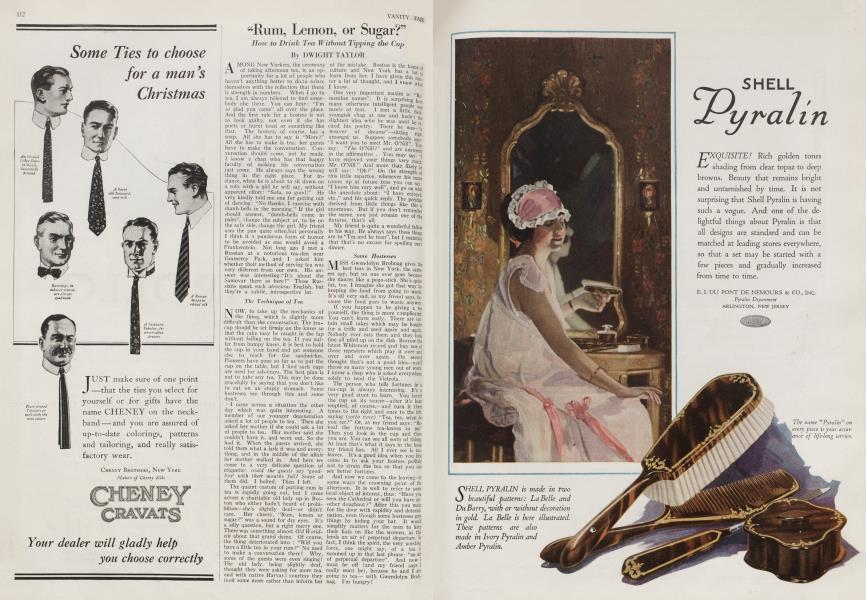
AMONG New Yorkers, the ceremony of taking afternoon tea, is an opportunity for a lot of people who haven't anything better to do,to solace themselves with the reflection that there is strength in numbers. When I go to tea, I am always relieved to find somebody else there. You can hear: "I'm so glad you came" all over the place. And the first rule for a hostess is not to look guilty, not even if she has poets or burnt toast or something like that. The hostess, of course, has a snap. All she has to say is "More?" All she has to make is tea: her guests have to make the conversation. Conversation should come, not be made. I know a chap who has that happy faculty of making his conversation just come. He always says the wrong thing in the right place. For instance, when he is about to sit down on a sofa with a girl he will say, without apparent effort: "Sofa, so good!" He very kindly told me one for getting out of dancing: "No thanks. I exercise with dumb-bells in the morning." If the girl should answer, "dumb-bells come in pairs", change the subject or, to be on the safe side, change the girl. My friend uses the pun quite often,but personally I think it a punderous form of humor to be avoided as one would avoid a Frankenstein. Not long ago I met a Russian at a notorious tea-den near Gramercy Park, and I asked him whether their method of serving tea was very different from our own. His answer was interesting :"It's about the Samovar there as here!" These Russians speak such atrocious English, but they're a subtle, introspective lot.
The Technique of Tea
NOW, to take up the mechanics of the thing, which is slightly more difficult than the conversation. The teacup should be set firmly on the knees so that the cake may be caught in the lap without falling on the tea. If you suffer from bumpy knees, it is best to hold the cup in your hand and get someone else to reach for the sandwiches. Pioneers have gone so far as to put the cup on the table, but I find such cups are used for ash-trays. The best plan is not to take any tea. This may be done gracefully by saying that you don't like to eat on an empty stomach. Some hostesses see through this and some don't.
I came across a situation the other day which was quite interesting. A member of our younger degeneration asked a lot of people to tea. Then she asked her mother if she could ask a lot of people to tea. Her mother said she couldn't have it, and went out. So she had it. When the guests arrived, she told them what a lark it was and everything, and in the middle of the affair her mother walked in. And here we come to a very delicate question of etiquette: could, the guests say 1goodbye' with their mouths full? Some of them did. I bolted. Then I left.
The quaint custom of putting rum in tea is rapidly going out, but I came across a charitable old lady up in Boston who either hadn't heard of prohibition—she's slightly deaf—or didn't care. Her cheery, "Rum, lemon or sugar?" was a sound for dry eyes. It's a silly question, but a right merry one. There was something almost Old Worldish about that grand dame. Of course, the thing deteriorated into : "Will you have a little tea in your rum?" No need to make a conversation there! Why, some of the guests were even singing! The old lady, being slightly deaf, thought they were asking for more tea, and with native Harvard courtesy they took some more rather than inform her of the mistake. Boston is the home of culture and New York has a lot to learn from her. I have given this matter a lot of thought, and I know whit I know.
One very important maxim is: "Remember names". It is surprising how many otherwise intelligent people one meets at teas. I met a little dark. youngish chap at one and hadn't the slightest idea who he was until he re cited his poetry. There he was-"a weaver of dreams"—sitting right amongst us. Suppose somebody says: "I want you to meet Mr. O'Nill". You say: "The O'Nill? ana are answered in the affirmative . You may say: "I have enjoyed your things very much. Mr. O'Nill." And more than likelv he will say: "Oh?" On the strength of this little repartee, whenever his name comes up at future teas you can say: "I know him very well", and go on with the anecdote about: "I have enjoyed, etc.," and his quick reply. The prestige derived from little things like this is enormous. But if you don't remember the name, you just remain one of the fixtures, that's all.
My friend is quite a wonderful fellow in his way. He always says these things are to "Tea and be tean", but I maintain that that's no excuse for spoiling one's dinner.
Some Hostesses
MISS Gwendolyn Brobnag gives the best teas in New York, the cater, ers say, but no one ever goes because she dances like a pogo-stick. She's quite fat, too. I imagine she got that way by keeping the food from going to waste. It's all very sad, as my friend says, because the food goes to waste anyway.
If you happen to be giving a tea yourself, the thing is more complicated. You can't leave early. There are certain small cakes which may be bought for a trifle and used again and again. Nobody ever eats them and they look fine all piled up on the dish. Borrow the latest Whiteman record and buy one of those repeaters which play it over and over and over again. On second thought that's not a good idea—you'll throw so many young men out of work. I know a chap who is asked everywhere solely to tend the Victrola.
The person who tells fortunes in a tea-cup is always interesting. It's a very good stunt to learn. You invert the cup on its saucer—after it's been emptied, of course,—and turn it three times to the right and once to the left, saying (sotto voce) "Tea, tea, what do you see?" Or, as my friend says: "Reveal the fortune tea-leaves to me." Then you look in the cup and there you are. You can see all sorts of things. At least that's what it says in the book my friend has. All I ever see is tealeaves. It's a good idea when you first come in to ask your hostess politely not to strain the tea so that you can see better fortunes.
And now we come to the leaving—in some ways the crowning point of the afternoon. It is well to refer to some local object of interest, thus: "Have you seen the Cathedral or will you have another doughnut?" After this you make for the door with rapidity and determination, even though some hostesses gum things by hiding your hat. It would simplify matters for the men to keep their hats on like the women, as this lends an air of perpetual departure. In fact, I think the spirit, the very working force, one might say, of a tea is summed up in that last phrase: "an air of perpetual departure". And now I must be off (and my friend says I really must be), because he and I are going to tea— with Gwendolyn Brobnag. I'm hungry!
Subscribers have complete access to the archive.
Sign In Not a Subscriber?Join Now