


Sign In to Your Account
Subscribers have complete access to the archive.
Sign In Not a Subscriber?Join NowThe Sculpture of Aristide Maillol
Representative Works of the Great French Sculptor who Seems Likely to Take the Place of Rodin
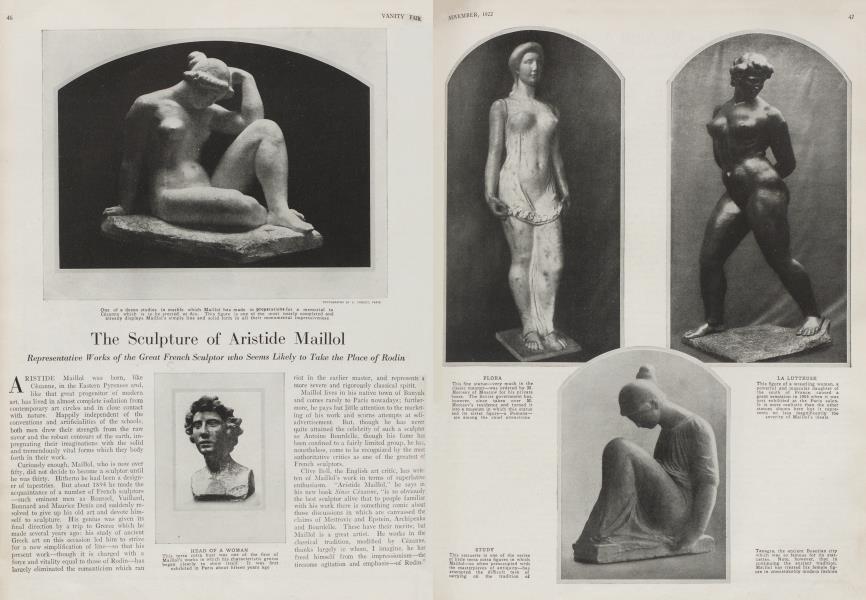
ARISTIDE Maillol was born, like Cezanne, in the Eastern Pyrenees and, like that great progenitor of modern art, has lived in almost complete isolation from contemporary art circles and in close contact with nature. Happily independent of the conventions and artificialities of the schools, both men drew their strength from the raw savor and the robust contours of the earth, impregnating their imaginations with the solid and tremendously vital forms which they body forth in their work.
Curiously enough, Maillol, who is now over fifty, did not decide to become a sculptor, until he was thirty. Hitherto he had been a designer of tapestries. But about 1894 he made the acquaintance of a number of French sculptors —such eminent men as Roussel, Yuillard, Bonnard and Maurice Denis and suddenly resolved to give up his old art and devote himself to sculpture. His genius was given its final direction by a trip to Greece which he made several years ago: his study of ancient Greek art on this occasion led him to strive for a new simplification of line—so that his present work—though it is charged with a force and vitality equal to those of Rodin—has largely eliminated the romanticism which ran riot in the earlier master, and represents a more severe and rigorously classical spirit.
Maillol lives in his native town of Banyuls and comes rarely to Paris nowadays; furthermore, he pays but little attention to the marketing of his work and scorns attempts at selfadvertisement. But, though he has never quite attained the celebrity of such a sculptor as Antoine Bourdelle, though his fame has been confined to a fairly limited group, he has, nonetheless, come to be recognized by the most authoritative critics as one of the greatest ot French sculptors.
Clive Bell, the English art critic, has written of Maillol's work in terms of superlative enthusiasm. "Aristide Maillol," he says in his new book Since Cezanne, "is so obviously the best sculptor alive that to people familiar with his work there is something comic about those discussions in which are canvassed the claims of Mestrovic and Epstein, Archipenko and Bourdelle. These have their merits; but Maillol is a great artist. He works in the classical tradition, modified by Cezanne, thanks largely ic whom, I imagine, he has freed himself from the impressionism—the tiresome agitation and emphasis—of Rodin.
Subscribers have complete access to the archive.
Sign In Not a Subscriber?Join Now
