Sign In to Your Account
Subscribers have complete access to the archive.
Sign In Not a Subscriber?Join NowLatter Day Helens
The Twelfth of a Series of Impressions of Modern Feminine Types: Chrysis—Myself Alone
W. L. GEORGE
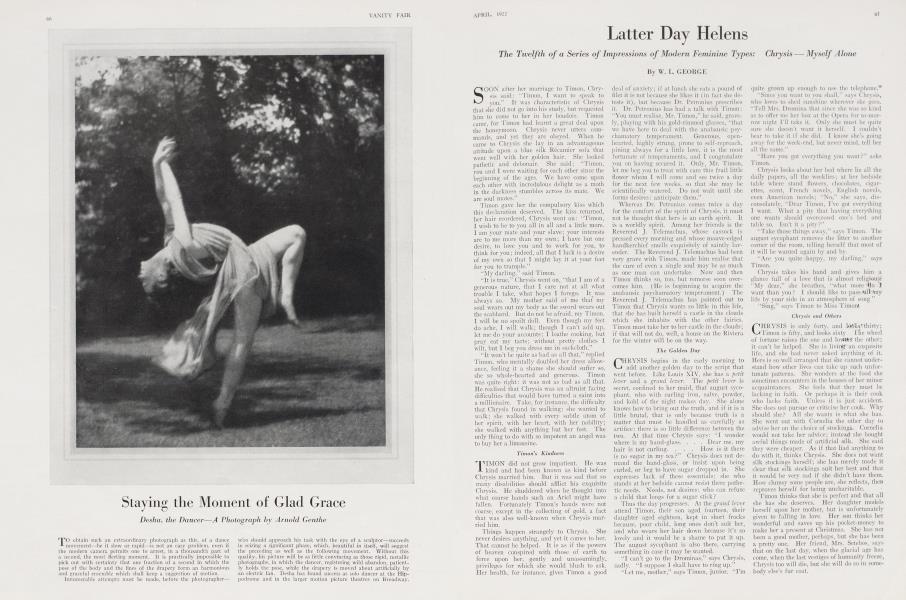
SOON after her marriage to Timon, Chrysis said: "Timon, I want to speak to you." It was characteristic of Chrysis that she did not go into his study, but requested him to come to her in her boudoir. Timon came, for Timon had learnt a great deal upon the honeymoon. Chrysis never utters commands, and yet they are obeyed. When he came to Chrysis she lay in an advantageous attitude upon a blue silk Recamier sofa that went well with her golden hair. She looked pathetic and debonair. She said: "Timon, you and I were waiting for each other since the beginning of the ages. We have come upon each other with incredulous delight as a moth in the darkness stumbles across its mate. We are soul mates."
Timon gave her the compulsory kiss which this declaration deserved. The kiss returned, her hair reordered, Chrysis went on: "Timon,
I wish to be to you all in all and a little more.
I am your mate and your slave; your interests are to me more than my own; I have but one desire, to love you and to work for you, to think for you; indeed, all that I lack is a desire of my own so that I might lay it at your feet for you to trample."
"My darling," said Timon.
"It is true," Chrysis went on, "that I am of a generous nature, that I care not at all what trouble I take, what hopes I forego. It was always so. My mother said of me that my soul wears out my body as the sword wears out the scabbard. But do not be afraid, my Timon.
I will be no spoilt doll. Even though my feet do ache, I will walk; though I can't add up, let me do your accounts; I loathe cooking, but pray eat my. tarts; without pretty clothes I wilt, but I beg you dress me in sackcloth."
"It won't be quite as bad as all that," replied Timon, who mentally doubled her dress allowance, feeling it a shame she should suffer so, she so whole-hearted and generous. Timon was quite right: it was not as bad as all that. He realised that Chrysis was an altruist facing difficulties that would have turned a saint into a millionaire. Take, for instance, the difficulty that Chrysis found in walking; she wanted to walk; she walked with every subtle atom of her spirit, with her heart, with her nobility; she walked with anything but her feet. The only thing to do with so impotent an angel was to buy her a limousine.
Timon's Kindness
TIMON did not grow impatient. He was kind and had been known as kind before Chrysis married him. But it was sad that so many disabilities should afflict his exquisite Chrysis. He shuddered when he thought into what coarse hands such an Ariel might have fallen. Fortunately Timon's hands were not coarse, except in the collecting of gold, a fact that was also well-known when Chrysis married him.
Things happen strangely to Chrysis. She never desires anything, and yet it comes to her. That cannot be helped. It is as if the powers of heaven conspired with those of earth to force upon her, gently and unassumingly, privileges for which she would blush to ask. Her health, for instance, gives Timon a good deal of anxiety; if at lunch she eats a pound of filet it is not because she likes it (in fact she detests it), but because Dr. Petronius prescribes it. Dr. Petronius has had a talk with Timon: "You must realise, Mr. Timon," he said, gravely, playing with his gold-rimmed glasses, "that we have here to deal with the anabausic psychamatory temperament. Generous, openhearted, highly strung, prone to self-reproach, pining always for a little love, it is the most fortunate of temperaments, and I congratulate you on having secured it. Only, Mr. Timon, let me beg you to treat with care this frail little flower whom I will come and see twice a day for the next few weeks, so that she may be scientifically watered. Do not wait until she forms desires: anticipate them."
Whereas Dr. Petronius comes twice a day for the comfort of the spirit of Chrysis, it must not be thought that hers is an earth spirit. It is a worldly spirit. Among her friends is the Reverend J. Telemachus, whose cassock is pressed every morning and whose mauve-edged handkerchief smells exquisitely of saintly lavender. The Reverend J. Telemachus had been very grave with Timon, made him realise that the cure of even a single soul may be as much as one man can undertake. Now and then Timon thinks so, too, but remorse soon overcomes him. (He is beginning to acquire the anabausic psychamatory temperament.) The Reverend J. Telemachus has pointed out to Timon that Chrysis wants so little in this life, that she has built herself a castle in the clouds which she inhabits with the other fairies. Timon must take her to her castle in the clouds; if that will not do, well, a house on the Riviera for the winter will be on the way.
The Golden Day
CHRYSIS begins in the early morning to add another golden day to the script that went before. Like Louis XIV, she has a petit lever and a grand lever. The petit lever is secret, confined to her maid, that august sycophant, who with curling iron, salve, powder, and kohl of the night makes day. She alone knows how to bring out the truth, and if it is a little brutal, that is only because truth is a matter that must be handled as carefully as artifice: there is so little difference between the two. At that time Chrysis says: "I wonder where is my hand-glass. . . . Dear me, my hair is not curling. . . . How is it there
is no sugar in my tea?" Chrysis does not demand the hand-glass, or insist upon being curled, or beg to have sugar dropped in. She expresses lack of these essentials; she who stands at her bedside cannot resist there pathetic needs. Needs, not desires: who can refuse a child that longs for a sugar stick?
Thus the day progresses. At the grand lever attend Timon, their son aged fourteen, their daughter aged eighteen, kept in short frocks because, poor child, long ones don't suit her, and who wears her hair down because it's so lovely and it would be a shame to put it up. The august sycophant is also there, carrying something in case it may be wanted.
"I can't go to the Drominas," says Chrysis, sadly. "I suppose I shall have to ring up." "Let me, mother," says Timon, junior. "I'm quite grown up enough to use the telephone."
"Since you want to you shall," says Chrysis, who loves to shed sunshine wherever she goes. "Tell Mrs. Dromina that since she was so kind as to offer me her box at the Opera for to-morrow night I'll take it. Only she must be quite sure she doesn't want it herself. I couldn't bear to take it if she did. I know she's going away for the week-end, but never mind, tell her all the same."
"Have you got everything you want?" asks Timon.
Chrysis looks about her bed where lie all the daily papers, all the weeklies; at her bedside table where stand flowers, chocolates, cigarettes, scent, French novels, English novels, even American novels; "No," she says, disconsolately, "Dear Timon, I've got everything I want. What a pity that having everything one wants should overcrowd one's bed and table so. Isn't it a pity?"
"Take those things away," says Timon. The august sycophant removes the litter to another corner of the room, telling herself that most of it will be wanted again by and by.
"Are you quite happy, my darling," says Timon.
Chrysis takes his hand and gives him a glance full of a love that is almost religious! "My dear," she breathes, "what more ⅜0 -I want than you? I should like to passMll'^rhy life by your side in an atmosphere of song "
"Sing," says Timon to Miss Timon*.
Chrysis and Others
HRYSIS is only forty, and lorbks'thirty; Timon is fifty, and looks sixty iHe wheel of fortune raises the one and lo\vt&-$ the other; it can't be helped. She is living" an exquisite life, and she had never asked anything of it. Hers is so well arranged that she cannot understand how other lives can take up such unfortunate patterns. She wonders at the food she sometimes encounters in the houses of her minor acquaintances. She feels that they must be lacking in faith. Or perhaps it is their cook who lacks faith. Unless it is just accident. She does not pursue or criticise her cook. Why should she? All she wants is what she has. She went out with Cornelia the other day to advise her on the choice of stockings.. Cornelia would not take her advice; instead she bought awful things made of artificial silk. She said they were cheaper. As if that Had anything to do with it, thinks Chrysis. She does not want silk stockings herself; she has merely made it clear that silk stockings suit her best and that it would be very sad if she didn't have them. How clumsy some people are, she reflects, then reproves herself for being uncharitable.
Timon thinks that she is perfect and that all she has she deserves. Her daughter models herself upon her mother, but is unfortunately given to falling in love. Her son thinks her wonderful and saves up his pocket-money to make her a present at Christmas. She has not been a good mother, perhaps, but she has been a pretty one. Her friend, Mrs. Setebos, says that on the last day, when the glacial age has come, when the last vestiges of humanity freeze, Chrysis too will die, but she will do so in somebody else's fur coat.
Subscribers have complete access to the archive.
Sign In Not a Subscriber?Join Now