
Sign In to Your Account
Subscribers have complete access to the archive.
Sign In Not a Subscriber?Join NowAn Essay on Behaviorism
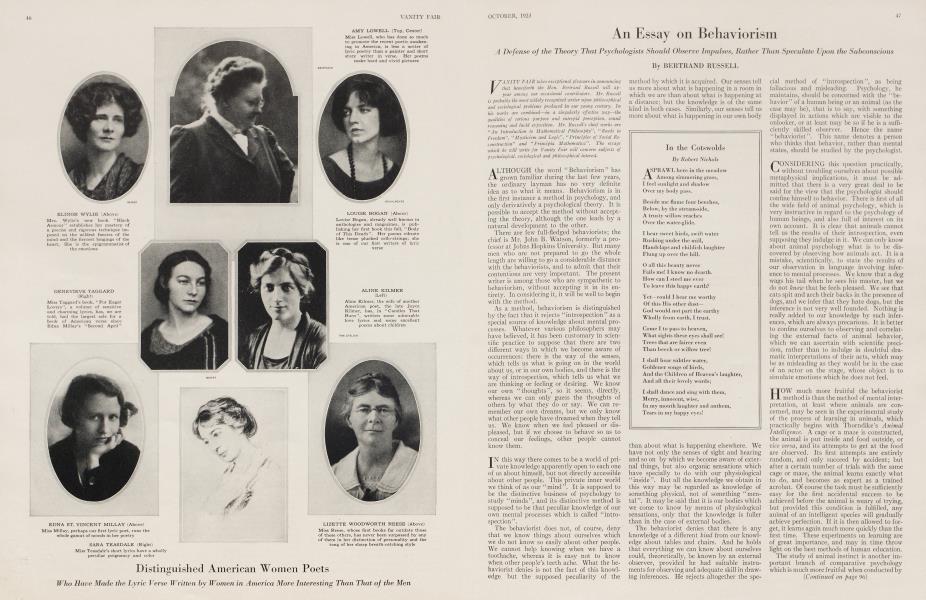
A Defense of the Theory That Psychologists Should Observe Impulses, Rather Than Speculate Upon the Subconscious
BERTRAND RUSSELL
VANITY FAIR takes exceptional pleasure in announcing that henceforth the Hon. Bertrand Russell will appear among our occasional contributors. Mr. Russell is probably the most widely recognized writer upon philosophical and sociological problems produced in our young century. In his works are combined—in a singularly effective way—the qualities of serious purpose and intrepid perception, sound reasoning and lucid exposition. Mr. Russell's chief works arc "An Introduction to Mathematical Philosophy", "Roads to Freedom", "Mysticism and Logic", "Principles of Social Reconstruction" and "Principia Mathematica". The essays which he will write for Vanity Fair will concern subjects of psychological, sociological and philosophical interest.
ALTHOUGH the word "Behaviorism" has grown familiar during the last few years, the ordinary layman has no very definite idea as to what it means. Behaviorism is in the first instance a method in psychology, and only derivatively a psychological theory. It is possible to accept the method without accepting the theory, although the one leads by a natural development to the other.
There are few full-fledged behaviorists; the chief is Mr. John B. Watson, formerly a professor at Johns Hopkins University. But many men who are not prepared to go the whole length are willing to go a considerable distance with the behaviorists, and to admit that their contentions are very important. The present writer is among those who are sympathetic to behaviorism, without accepting it in its entirety. In considering it, it will be well to begin with the method.
As a method, behaviorism is distinguished by the fact that it rejects "introspection" as a special source of knowledge about mental processes. Whatever various philosophers may have believed, it has been customary in scientific practice to suppose that there are two different ways in which we become aware of occurrences: there is the way of the senses, which tells us what is going on in the world about us, or in our own bodies, and there is the way of introspection, which tells us what we are thinking or feeling or desiring. We know our own "thoughts", so it seems, directly, whereas we can only guess the thoughts of others by what they do or say. We can remember our own dreams, but we only know what other people have dreamed when they tell us. We know when we feel pleased or displeased, but if we choose to behave so as to conceal our feelings, other people cannot know them.
IN this way there comes to be a world of private knowledge apparently open to each one of us about himself, but not directly accessible about other people. This private inner world we think of as our "mind". It is supposed to be the distinctive business of psychology to study "minds", and its distinctive method is supposed to be that peculiar knowledge of our own mental processes which is called "introspection".
The behaviorist does not, of course, deny that we know things about ourselves which we do not know so easily about other people. We cannot help knowing when we have a toothache, whereas it is easy not to know when other people's teeth ache. What the behaviorist denies is not the fact of this knowledge but the supposed peculiarity of the method by which it is acquired. Our senses tell us more about what is happening in a room in which we are than about what is happening at a distance; but the knowledge is of the same kind in both cases. Similarly, our senses tell us more about what is happening in our own body than about what is happening elsewhere. We have not only the senses of sight and hearing and so on by which we become aware of external things, but also organic sensations which have specially to do with our physiological "inside". But all the knowledge we obtain in this way may be regarded as knowledge of something physical, not of something "mental". It may be said that it is our bodies which we come to know by means of physiological sensations, only that the knowledge is fuller than in the case of external bodies.
The behaviorist denies that there is any knowledge of a different kind from our knowledge about tables and chairs. And he holds that everything we can know about ourselves could, theoretically, be known by an external observer, provided he had suitable instruments for observing and adequate skill in drawing inferences. He rejects altogether the special method of "introspection", as being fallacious and misleading. Psychology, he maintains, should be concerned with the "behavior" of a human being or an animal (as the case may be), that is to say, with something displayed in actions which are visible to the onlooker, or at least may be so if he is a sufficiently skilled observer. Hence the name "behaviorist". This name denotes a person who thinks that behavior, rather than mental states, should be studied by the psychologist.
CONSIDERING this question practically, without troubling ourselves about possible metaphysical implications, it must be admitted that there is a very great deal to be said for the view that the psychologist should confine himself to behavior. There is first of all the wide field of animal psychology, which is very instructive in regard to the psychology of human beings, and also full of interest on its own account. It is clear that animals cannot tell us the results of their introspection, even supposing they indulge in it. We can only know about animal psychology what is to be discovered by observing how animals act. It is a mistake, scientifically, to state the results of our observation in language involving inference to mental processes. We know that a dog wags his tail when he sees his master, but we do not know that he feels pleased. We see that cats spit and arch their backs in the presence of dogs, and we infer that they hate dogs, but the inference is not very well founded. Nothing is really added to our knowledge by such inferences, which are always precarious. It is better to confine ourselves to observing and correlating the external facts of animal behavior, which we can ascertain with scientific precision, rather than to indulge in doubtful dramatic interpretations of their acts, which may be as misleading as they would be in the case of an actor on the stage, whose object is to simulate emotions which he does not feel.
HOW much more fruitful the behaviorist method is than the method of mental interpretation, at least where animals are concerned, may be seen in the experimental study of the process of learning in animals, which practically begins with Thorndike's Animal Intelligence, A cage or a maze is constructed, the animal is put inside and food outside, or vice versa, and its attempts to get at the food are observed. Its first attempts are entirely random, and only succeed by accident; but after a certain number of trials with the same cage or maze, the animal learns exactly what to do, and becomes as expert as a trained acrobat. Of course the task must be sufficiently easy for the first accidental success to be achieved before the animal is weary of trying, but provided this condition is fulfilled, any animal of an intelligent species will gradually achieve perfection. If it is then allowed to forget, it learns again much more quickly than the first time. These experiments on learning are of great importance, and may in time throw light on the best methods of human education.
The study of animal instinct is another important branch of comparative psychology which is much more fruitful when conducted by behaviorist methods than when entangled in discussions as to what an animal "foresees" or "desires". These discussions lead nowhere, because we have no means of testing the various hypotheses. Observations of behavior, on the contrary, yield definite results, and give whatever genuine knowledge is possible as to the instincts of animals. These instincts are much clearer and more definite than those of human beings, and yet they are the source from which human instincts have developed. For all who wish to understand human instincts, accordingly, animal instincts are very enlightening. A book such as Rivers' Instinct and the Unconscious shows how they throw light even upon such a subject as the nervous disorders caused by the war, many of which were of the nature of a throw-back to some more primitive form of the instinct of fear.
(Continued on page 96)
(Continued from page 47)
THIS brings us to the matters dealt with by psychoanalysis, which is primarily a method of understanding and curing certain kinds of nervous disorders. It is undoubtedly a very valuable method, representing an immense advance. But the subject has been obscured by the emphasis laid on the distinction between the conscious and the unconscious. There was formerly a notion that we ought to be "conscious" of all that goes on in our "minds", and when this notion had to be abandoned, people resorted to "unconscious" mental processes as something rather strange and mysterious.
In fact, however, everybody—whether layman, psychologist, or philosopher— has had the very vaguest ideas as to what was meant by "consciousness". William James threw out a challenge in his essay called Does "Consciousness"Exist?, but the effect of this challenge was less than it ought to have been. It seems to be the rule that our mental processes are unconscious, and the exception when they arc conscious; and even when they arc conscious, this is a quite unimportant characteristic of them. What is more, the unconscious desires with which Freudians operate appear to be, not mental states at all, but merely tendencies to a certain kind of behavior. When this is realized, and psychoanalytic material is re-stated in the language of behaviorism, the mystery surrounding "unconscious wishes" disappears, and the facts concerned cease to be surprising. Thus, in regard to the "unconscious" or "sub-conscious", behaviorism as a method has advantages quite as great as in regard to animal psychology.
As a method, however, it is not obliged to claim that it can cover the whole field of psychology; when it advances this claim it ceases to be merely a method and becomes a psychological theory. It is time to consider it from this point of view.
BEHAVIORISM as a theory holds that none of the facts upon which psychology is based are essentially private to one observer. This involves the view that there is no such thing as "thought", as opposed to bodily movements; for bodily movements can be observed by others, but my thoughts, if they exist, can only be observed by myself. We are thus faced with the question: Do people think? And, if so, what happens when they think?
To this question Mr. Watson gives'a very radical answer: People do not think, they only talk. What is called "thinking" consists of talking to oneself. He maintains that, if we had suitable instruments, we could discover incipient little movements of a man's throat and longue when he "thinks", and that these are the movements of beginning to pronounce the words to himself. A person who can "think", according to this view, is merely a person who has learned to pronounce words in the right order, like a rat which has learned to take the right turns in a maze. Freud relates somewhere that, when he was lecturing in America, after he had explained that dreams are always egoistic, a lady got up and said that might be true in Austria, but was not true in America, where dreams were often full of virtue. I hope nobody will retort by maintaining that Air. Watson's view of thinking may be correct in America, but is not correct in Europe.
MR. Watson's view of thought is not so easily disposed of as some might be inclined to suppose. To begin with: we only know the thoughts of others through their behavior, and especially through what they say or write, so that any evidence that thinking is more than talking must be derived from observation of ourselves. Now, obviously something goes on when we think. Is this of the nature of small bodily movements? Or is it of some quite different nature? Before going into the question, I recommend the reader to think concentratedly about a bubble with his mouth open. Nine people out of ten will feel an almost irresistible impulse to bring their lips together so as to form the letter B. This little experiment will show the reader that Mr. Watson may be right.
There are, however, great difficulties in the way of accepting his view as the whole of the truth. To begin with, many people are "visual" types; they "think" mainly in visual images, and even words are represented rather by the look of them in print than by the pronunciation of them. Most of their "thinking" is not in words at all, but in more or less vague images. This seems to be true of the bulk of the human race, and only untrue of writers and orators, to whom words as such are specially important. If so, Mr. Watson's theory of thinking may be true of "thinkers", but not of ordinary mortals. Purely verbal thinking may be the highest stage, not the lowest. In that case, what happens when the rest of us think? Or, for that matter, what happens in sensation, for example when we see something?
THE traditional view is that when we look at an object something occurs which is called a "perception", and that when afterwards we remember the object or imagine a similar one, something occurs which is called an "image". Both of these seem to be radically different occurrences from matter in motion. Mr. Watson denies the "image" altogether; that is to say, he denies that what we take to be images arc anything radically different from sensations or perceptions. They may be fainter, and they may have no proximate cause external to the nervous system; but they arc not a different kind of entity. This is a difficult question, upon which there has been much controversy. Let us, for the sake of argument, concede Mr. Watson's contention as to images. What, then, shall we say of perceptions?
It is, of course, admitted by the bchaviorist that we perceive things. This is essential to his position. In acquiring physical knowledge, we are all supposed to perceive the same things; this is the advantage of physical knowledge over the psychological knowledge supposed to be derived from introspection, which no other observer can directly verify. But the question arises: How does the bchaviorist know that he perceives things? Does not this knowledge involve that very introspection which he professes to discard?
It is a perfectly possible hypothesis that animals, although they perceive objects just as well as we do, are quite unaware that they do so. A cat, we may suppose, can have the knowledge which we should express by saying "there is a mouse", but not the knowledge "I see a mouse". Perceptions are fleeting occurrences, which do not have the persistence believed to belong to physical things. You may open your eyes for a moment, see the things in your room, and then shut your eyes again. You believe that the things in your room have not existed only during the moment when your eyes were open, but something did exist only during that moment. This something is what is called a perception. It is impossible to deny that we have knowledge of fleeting occurrences of this sort. And it is impossible to identify these fleeting perceptions with the movement of the eyelids or the stimulus to the optic nerve or the disturbance in the brain caused by this stimulus.
(Continued on page 98)
(Continued from page 96)
AND the odd thing is that, when we come to reflect, we find these fleeting perceptions to be what we really know about the external world. The permanent objects of traditional physics and common sense are inferred from what we perceive. And the publicity of physical observation is only a matter of degree, because no two people, looking at the "same" object, have precisely similar visual impressions. The momentary perception, moreover, is more like what the most modern physics requires as its substratum than is the permanent "thing" of common sense. Matter and bodies, which used to be thought to persist through time, have been dissolved by Einstein and Relativity into series of "events", each brief and evanescent like my perception when I open my eyes for a moment.
It seems, therefore, that what occurs in this moment is the sort of thing to be taken as the ultimate reality out of which both mind and matter are constructed. If so, we shall require new categories and new modes of thought. The behaviorist may remain justified as against traditional psychology, but not as against the revolutionary physics of our time. The physicists have undermined our belief in "matter" at the same time that the psychologists have undermined our belief in "mind". Therefore, the work of the psychologists cannot be used to further the cause of matter, but must be placed to the account of a "tertium quid", which the American realists, following a suggestion of Dr. H. M. Shcffer, call "neutral stuff". But this opens a very large question, which cannot be dealt with as an appendix to a discussion of Behaviorism.
Subscribers have complete access to the archive.
Sign In Not a Subscriber?Join Now

