Sign In to Your Account
Subscribers have complete access to the archive.
Sign In Not a Subscriber?Join Now"I Am Here Today!"
Charlie Chaplin Descends Upon Us, In a Gale of Laughter and a Blaze of Light
GILBERT SELDES
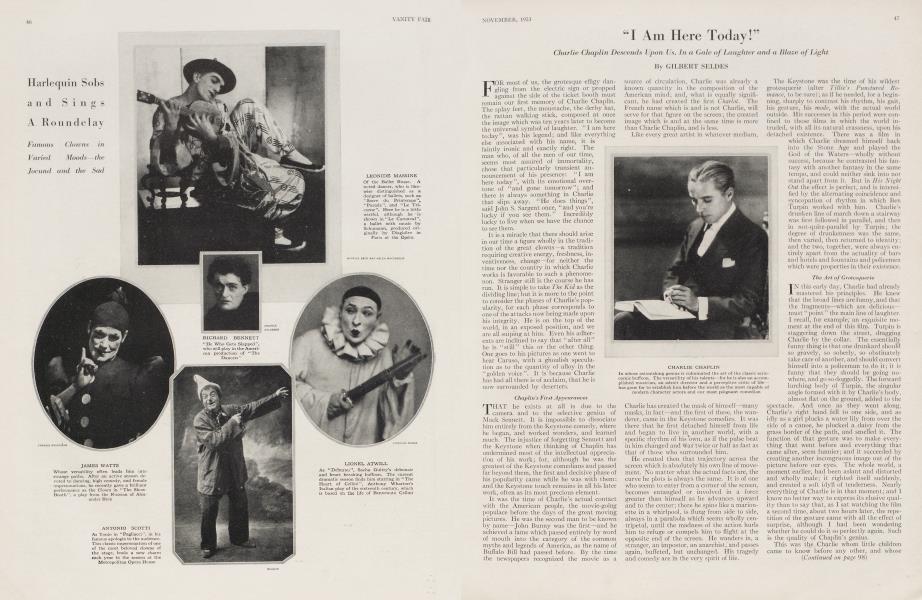
FOR most of us, the grotesque effigy dangling from the electric sign or propped against the side of the ticket booth must remain our first memory of Charlie Chaplin. The splay feet, the moustache, the derby hat, the rattan walking stick, composed at once the image which was ten years later to become the universal symbol of laughter. "I am here today", was his legend; and like everything else associated with his name, it is faintly ironic and exactly right. The man who, of all the men of our time, seems most assured of immortality, chose that particularly transient announcement of his presence: "I am here today", with its emotional overtone of "and gone tomorrow"; and there is always something in Charlie that slips away. "He does things", said John S. Sargent once, "and you're lucky if you see them." Incredibly lucky to live when we have the chance to see them.
It is a miracle that there should arise in our time a figure wholly in the tradition of the great clowns—a tradition requiring creative energy, freshness, inventiveness, change—for neither the time nor the country in which Charlie works is favorable to such a phenomenon. Stranger still is the course he has run. It is simple to take The Kid as the dividing line; but it is more to the point to consider the phases of Charlie's popularity, for each phase corresponds to one of the attacks now being made upon his integrity. He is on the top of the world, in an exposed position, and we are all sniping at him. Even his adherents are inclined to say that "after all" he is "still" this or the other thing. One goes to his pictures as one went to hear Caruso, with a ghoulish speculation as to the quantity of alloy in the "golden voice". It is because Charlie has had all there is of acclaim, that he is now surrounded by deserters.
Chaplin's First Appearances
THAT he exists at all is due to the camera and to the selective genius of Mack Sennett. It is impossible to dissociate him entirely from the Keystone comedy, where he began, and worked wonders, and learned much. The injustice of forgetting Sennett and the Keystone when thinking of Chaplin has undermined most of the intellectual appreciation of his work; for, although he was the greatest of the Keystone comedians and passed far beyond them, the first and decisive phase of his popularity came while he was with them: and the Keystone touch remains in all his later work, often as its most precious element.
It was the time of Charlie's actual contact with the American people, the movie-going populace before the days of the great moving pictures. He was the second man to be known by name—John Bunny was the first—and he achieved a fame which passed entirely by word of mouth into the category of the common myths and legends of America, as the name of Buffalo Bill had passed before. By the time the newspapers recognized the movie as a source of circulation, Charlie was already a known quantity in the composition of the American mind; and, what is equally significant, he had created the first Chariot. The French name which is and is not Charlie, will serve for that figure on the screen; the created image which is and at the same time is more than Charlie Chaplin, and is less.
Like every great artist in whatever medium, Charlie has created the mask of himself—many masks, in fact—and the first of these, the wanderer, came in the Keystone comedies. It was there that he first detached himself from life and began to live in another world, with a specific rhythm of his own, as if the pulse beat in him changed and was twice or half as fast as that of those who surrounded him.
He created then that trajectory across the screen which is absolutely his own line of movement. No matter what the actual facts are, the curve he plots is always the same. It is of one who seems to enter from a corner of the screen, becomes entangled or involved in a force greater than himself as he advances upward and to the center; there he spins like a marionette in a whirlpool, is flung from side to side, always in a parabola which seems wholly centripetal, until the madness of the action hurls him to refuge or compels him to flight at the opposite end of the screen. He wanders in, a stranger, an impostor, an anarchist, and passes again, buffeted, but unchanged. His tragedy and comedy are in the very spirit of life.
The Keystone was the time of his wildest grotesquerie (after Tillie's Punctured Romance, to be sure); as if he needed, for a beginning, sharply to contrast his rhythm, his gait, his gesture, his mode, with the actual world outside. His successes in this period were confined to those films in which the world intruded, with all its natural crassness, upon his detached existence. There was a film in which Charlie dreamed himself back into the Stone Age and played the God of the Waters—wholly without success, because he contrasted his fantasy with another fantasy in the same tempo, and could neither sink into nor stand apart from it. But in His Night Out the effect is perfect, and is intensified by the alternating coincidence and syncopation of rhythm in which Ben Turpin worked with him. Charlie's drunken line of march down a stairway was first followed in parallel, and then in not-quite-parallel by Turpin; the degree of drunkenness was the same, then varied, then returned to identity; and the two, together, were always entirely apart from the actuality of bars and hotels and fountains and policemen which were properties in their existence.
The Art of Grotesquerie
IN this early day, Charlie had already A mastered his principles. He knew that the broad lines are funny, and that the fragments—which are delicious must "point" the main line of laughter. I recall, for example, an exquisite moment at the end of this film. Turpin is staggering down the street, dragging Charlie by the collar. The essentially funny thing is that one drunkard should so gravely, so soberly, so obstinately take care of another, and should convert himself into a policeman to do it; it is funny that they should be going nowhere, and go so doggedly. The forward lurching body of Turpin, the singular angle formed with it by Charlie's body, almost fiat on the ground, added to the spectacle. And once as they went along, Charlie's right hand fell to one side, and as idly as a girl plucks a water lily from over the side of a canoe, he plucked a daisy from the grass border of the path, and smelled it. The function of that gesture was to make everything that went before and everything that came after, seem funnier; and it succeeded by creating another incongruous image out of the picture before our eyes. The whole world, a moment earlier, had been aslant and distorted and wholly male; it righted itself suddenly, and created a soft idyll of tenderness. Nearly everything of Charlie is in that moment; and 1 know no better way to express its elusive quality than to say that, as I sat watching the film a second time, about two hours later, the repetition of the gesture came with all the effect of surprise, although I had been wondering whether he could do it so perfectly again. Such is the quality of Chaplin's genius.
This was the Charlie whom little children came to know before any other, and whose name they added to their prayers. He was then popular with the people; he was soon to become universally known and admired—the Charlie of The Bank and of Shoulder Anns; and finally he became "the great artist" in The Kid. The second period is pure development; the third is change; and the adherents of each join with the earlier enthusiasts to instruct and alarm their idol. NQ doubt, the middle phase is the one which is richest in memory. It includes the masterpieces A Dog's Life, The Pawnshop, The Fugitive, Easy Street, as well as the two I have just mentioned; and, if I am not mistaken, the genre pictures like The Floorwalker, The Fireman, The Immigrant, and the fantastic Cure.
(Continued on page 98)
(Continued from page 47)
To name these pictures is to call to mind their special scenes and the atmosphere in which they were played: the mock heroic of The Bank and its parody of passion; the unbelievable scene behind the curtain in A Dog's Life; Charlie as policeman in Easy Street, which had some of the beginnings of The Kid; Charlie left marking time alone after the squad had marched away, in the film which made camp life supportable. Compare them with the very earliest films, The Pile Driver, the wheel-chairman film and so on: the later ones are richer in inventiveness, more solid in texture; the emotions grow more complex, and the interweaving of tenderness and gravity with the fun, becomes infinitely more deft. In essence it is the same figure—he is still a vagrant, an outsider; only now, when he becomes entangled in the lives of other people, he is a bit of a crusader, too. The accidental does not occur so frequently; the progress of each film is plotted in advance: there is a definite rise and fall, as in A Dog's Life, where the climax is in the curtain scene towards which tends the first episode of the dog and from which the flight and the rustic idyl flow gently downward.
The pace in the earlier pictures was more instinctive. In The Count, the tempo is jerky; it moves from extreme to extreme. Yet one gets beautifully the sense of the impending flight when, at the close, Charlie as the bogus Count has been shown up and is fleeing pell-mell through every room in the house. The whole movement grows tense; the rate of acceleration perceptibly heightens, as Charlie slides in front of a vast birthday cake, pivots on his heel, and begins to play alternate pool and golf with the frosting. making every shot count like a machine gunner barricaded in a pillar box or a bandit in a deserted cabin.
Subtle and Calculated Spontaneity
IT was foreordained that the improvised
kind of comedy should give way to something more calculated; and in Charlie's case, it is particularly futile to cry over spilt milk, because for a long time he continued to give the effect of impromptu. His sudden movements, and his finds in the way of unsuspected sources of fun, are exceptional to this day. In The Pawnshop, Charlie begins to sweep, and catches in his broom the end of a long rope which, instead of being swept away, keeps getting longer, actively fighting the broom. I have no way to prove it, but I am sure from the context that this is all he had originally intended to do with the scene. Suddenly the tape on the floor creates something in his mind, and Charlie transforms the backroom of the pawnshop into a circus with himself walking the tightrope—a graceful, nimble balancing along the thin line of tape on the floor, the quick turn and coming forward, the conventional bow, arms flung out, smiling to receive applause at the end. Again, as ever, he has created an imaginary scene out of the material of the actual.
The plotting of these comedies did not destroy Charlie's inventiveness, but made it possible for him to develop cer-
tain other of his characteristics. The moment the vagrant came to rest, the natural man appeared, the paradoxical creature who has the wisdom of simple souls and the incalculable strength of the weak. Charlie, all through the middle period, is at least half Tyl Eulenspiegel. It is another way for him to live apart from the world, by assuming that the world actually means what it says, by taking every one of its conventional formulas, its polite phrases and idioms, with dreadful seriousness.
He has created in Chariot a radical with an extraordinarily logical mind. Witness Chariot, arriving late at the theater and stepping on the toes of a whole row of people on his way to his seat at the far end; the gravity of his expressions of regret is only matched by his humiliation when he discovers that he is, after all, in the wrong row, and makes his wayback again and all through the next row to his scat. It is a careful exaggeration of the social fiction that when you apologize you can do anything to anyone. 1 he same feeling undeilies the characteristic moment when Charlie is fighting and suddenly stops, takes off his hat and coat, gives them to his opponent to hold, and then promptly knocks his obliging adversary down. Revisiting an old Charlie once, I saw him do this, and a few minutes later saw the same thing in a new Harold Lloyd film; all there is to know of the difference between the two men was to be learned there, for Lloyd, w ho is a clever fellow, made it seem a smart trick so to catch his enemy off guard, while Chaplin made the moment a crisis.
The Kid
THE KID was undoubtedly a beginning in "literature" for Charlie. I realize that in admitting this I am giving the whole case away-, for in the opinion of certain critics the beginning of literature is the end of creative art. This attitude is not so familiar in America, but in France you hear the Chariot of The Kid spoken of as "theater", as one who has entirely ceased to be of the film. I doubt if this is just. Like the one other great artist in America (George Herriman, with whom he is eminently in sympathy), Charlie has always had the Dickens touch, a thing which in its purity we do not otherwise discover in our art. Dickens himself is mixed; only a part of him is literature, and that not the best; nor is that part essentially the one which Charlie has imported to the screen.
The Kid had some bad things in it: the story, the halo round the head of the unmarried mother, the quarrel with the authorities; it had an unnecessary amount of realism and its tempo was uncertain, for it was neither serious film nor Keystone. Yet it possessed moments of unbelievable intensity and touches of high imagination. The scene in and outside the dosshouse were excellent and disclosed the old Charlie; the glazier's assistant was inventive, and the training of Jackie Coogan to look like his foster-father was beautiful.
Far above these scenes stood the beginning of the film: Chariot in his usual polite rags strolling down to his club after his breakfast (it would have been a grilled bone) and, avoiding slops as Villon did, twirling his cane, taking off his fingerless gloves to reach for his cigarette case (a sardine box) and selecting from the butts one of quality, tapping it to shake down the excess tobacco at the tip—all of this, as Mr. Herriman pointed out to me, was the creation of the societygentleman, the courageous refusal to be undermined by slums and poverty and rags.
At the end of the film there was the vision of Heaven—apotheosis of the long suffering of Chariot at the hands of the police, not only in The Kid, but in a hundred films where he stood always against the authorities, always for his small independent freedom. The world in which even policemen have wings is also shattered, but something remains. The invincible Charlie, dazed by his dream, looking for wings on the actual policeman who is apparently taking him to jail, will not down. For as they start, a post comes between them, and Charlie, without the slightest effort to break away, too submissive to fight, still dodges back to walk round the post and so avoid bad luck. A moment later comes one of the highest points in Charlie's career. He is ushered into a limousine instead of a patrol wagon—it is the beginning of the happy ending. And as the motor starts, Charlie flashes at the spectators of his felicity a look of indescribable poignancy. It is frightened, it is hopeful, it is bewildered; it lasts a fraction of a second, and is blurred by the plate glass of the car. I cannot hope to set down the quality of it, how it becomes a moment of unbearable intensity, and how one is breathless with suspense—and with adoration.
(Continued on page 100)
{Continual from page 98)
For, make no mistake, it is adoration, not less, that he deserves and receives from us. He corresponds to our secret desires, because he alone has passed beyond our categories, at one bound placing himself outside space and time. His escape from the world is complete and extraordinarily rapid, and what makes him more than a figure of romance is his immediate creation of another world. He has the vital energy, the composing and the functioning brain. This is what makes him aesthetically interesting, what will make him for ever a school, not only of acting, but of the whole creative process. The flow of his line always corresponds to the character and tempo; there is a definite relation between the melody and the orchestration he gives it. Beyond his technique—the style of his pieces—he has composition, because he creates anything but chaos in his separate world.
There is a future for him, as for others; and it is quite possible that the future may not be as rich and as dear as the past. I write this without having seen The Pilgrim, which ought to be a test case; for the two films which followed The Kid (Pay Day and The Idle Class) determined nothing. If the literary side conquers, we shall have a great character actor and not a creator; we shall certainly not have again the image of riot and fun, the annihilation of actuality.
I hope this will not happen, because I do not believe that it is the necessary curve of Charlie's genius—it is the direction of worldly success, not in money, but in fame; it is not the curve of life at all. For the slowing-up of Charlie's physical energies and the deepening of his understanding may well restore to him his appreciation of those early monuments to laughter which are his greatest achievement. He stood then, shod in absurdity, but with his feet on the earth. And he danced on the earth, an eternal figure of lightness, and of the wisdom which knows that the earth was made to dance on. It was a green earth, excited with its own abundance and fruitfulness, and he possessed it entirely. F'or me, he remains established, in possession. As it spins under his feet, he dances silently and with infinite grace upon it. It is as if in his whole life he had spoken only one word: "I am here today"—the beginning before time, the end without end of his wisdom.
Subscribers have complete access to the archive.
Sign In Not a Subscriber?Join Now

