Sign In to Your Account
Subscribers have complete access to the archive.
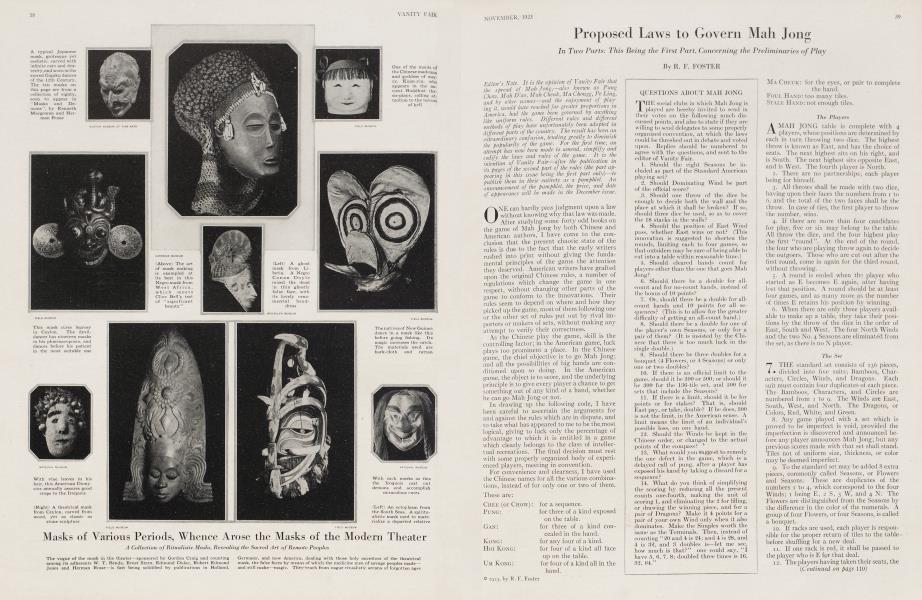
Sign In Not a Subscriber?Join NowProposed Laws to Govern Mali Jong
In Two Parts: This Being the First Part, Concerning the Preliminaries of Play
R. F. FOSTER
Editor's Note. It is the opinion of Vanity Fair that the spread of Mah Jong,—also known as Pung Chow Mah Diao, Mah Cheuk, MaChongg, Pe Ling, and by other names—and the enjoyment of playing it' would have reached far greater proportions in America, had the game been governed by anything like uniform rules. Different rules and different methods of play have unfortunately been adopted in different parts of the country. The result has been an extraordinary confusion, tending greatly to diminish the popularity of the game. For the first time, an attempt has now been made to amend, simplify and codify the laws and rules of the game. It is the intention of Vanity Fair—after the publication in its pages of the second part of the rules (the part appearing in this issue being the first part only)—to publish them in their entirety as a pamphlet. An announcement of the pamphlet, the price, and date of appearance will be made in the December issue.
ONE can hardly pass judgment upon a law without knowing why that law was made. After studying some forty odd books on the game of Mah Jong by both Chinese and American authors, I have come to the conclusion that the present chaotic state of the rules is due to the fact that the early writers rushed into print without giving the fundamental principles of the game the attention they deserved. American writers have grafted upon the original Chinese rules, a number of regulations which change the game in one respect, without changing other parts of the game to conform to the innovations. Their rules seem to depend on where and how they picked up the game, most of them following one or the other set of rules put out by rival importers or makers of sets, without making any attempt to verify their correctness.
As the Chinese play the game, skill is the controlling factor; in the American game, luck plays too prominent a place. In the Chinese game, the chief objective is to go Mah Jong; and all the possibilities of big hands are conditioned upon so doing. In the American game, the object is to score, and the underlying principle is to give every player a chance to get something out of any kind of a hand, whether he can go Mah Jong or not.
In drawing up the following code, I have been careful to ascertain the arguments for and against the rules which are in dispute, and to take what has appeared to me to be the.most logical, giving to luck only the percentage of advantage to which it is entitled in a game which clearly belongs to the class of intellectual recreations. The final decision must rest with some properly organized body of experienced players, meeting in convention.
For convenience and clearness, I have used the Chinese names for all the various combinations, instead of for only one or two of them.
These are:
CHEE (or CHOW): PUNG:
GAN:
KONG:
HOI KONG:
UM KONG:
for a sequence,
for three of a kind exposed
on the table.
for three of a kind con-
cealed in the hand,
for any four of a kind,
for four of a kind all face
up on the table,
for four of a kind all in the
hand.
® 192.5, by R. F. Foster
MA CHEUK: for the eyes, or pair to complete the hand.
FOUL HAND: too many tiles.
STALE HAND: not enough tiles.
The Flayers
A MAH JONG table is complete with 4 players, whose positions are determined by each in turn throwing two dice. The highest throw is known as East, and has the choice of seats. The next highest sits on his right, and is South. The next highest sits opposite East, and is West. The fourth player is North.
2. There are no partnerships; each player being for himself.
3. All throws shall be made with two dice, having upon their faces the numbers from 1 to 6, and the total of the two faces shall be the throw. In case of ties, the first player to throw the number, wins.
4. If there are more than four candidates for play, five or six may belong to the table. All throw the dice, and the four highest play the first "round". At the end of the round, the four who are playing throw again to decide the outgoers. Those who are cut out after the first round, come in again for the third round, without throwing.
5. A round is ended when the player who started as E becomes E again, after having lost that position. A round should be at least four games, and as many more as the number of times E retains his position by winning.
6. When there are only three players available to make up a table, they take their positions by the throw of the dice in the order of East, South and West. The four North Winds and the two No. 4 Seasons are eliminated from the set, as there is no N player.
The Set
7. THE standard set consists of 136 pieces, divided into five suits; Bamboos, Characters, Circles, Winds, and Dragons. Each suit must contain four duplicates of each piece. The Bamboos, Characters, and Circles are numbered from 1 to 9. The Winds are East, South, West, and North. The Dragons, or Colors, Red, White, and Green.
8. Any game played with a set which is proved to be imperfect is void, provided the imperfection is discovered and announced before any player announces Mah Jong; but any previous scores made with that set shall stand. Tiles not of uniform size, thickness, or color may be deemed imperfect.
9. To the standard set may be added 8 extra pieces, commonly called Seasons, or Flowers and Seasons. These are duplicates of the numbers 1 to 4, which correspond to the four Winds; 1 being E, 2 S, 3 W, and 4 N. The Flowers are distinguished from the Seasons by the difference in the color of the numerals. A group of four Flowers, or four Seasons, is called a bouquet.
10. If racks are used, each player is responsible for the proper return of tiles to the table before shuffling for a new deal.
11. If one rack is red, it shall be passed to the player who is E for that deal.
12. The players having taken their seats, the entire 136 (or 144) tiles are placed on the table, face down, and thoroughly shuffled by the four players simultaneously.
(Continued on page 110)
QUESTIONS ABOUT MAH JONG
THE social clubs in which Mah Jong is played arc hereby invited to send in their votes on the following much discussed points, and also to state if they arc willing to send delegates to some properly organized convention, at which the laws could be threshed out in debate and voted upon. Replies should be numbered to agree with the questions, and sent to the editor of Vanity Fair.
1. Should the eight Seasons be included as part of the Standard American playing set?
2. Should Dominating Wind be part of the official score?
3. Should one throw of the dice be enough to decide both the wall and the place at which it shall be broken? If so, should three dice be used, so as to cover the 18 stacks in the walls?
4. Should the position of East Wind pass, whether East wins or not? (This innovation is suggested to shorten the rounds, limiting each to four games, so that outsiders may be sure of being able to cut into a table within reasonable time.)
5. Should cleared hands count for players other than the one that goes Mah Jong?
G. Should there be a double for allcount and for no-count hands, instead of the bonus of 10 points?
7. Or, should there be a double for allcount hands and 10 points for all sequences? (This is to allow for the greater difficulty of getting an all-count hand.)
8. Should there be a double for one of the player's own Seasons, or only for a pair of them? (It is insisted by the Chinese that there is too much luck in the single double.)
9. Should there be three doubles for a bouquet (4 Flowers, or 4 Seasons) or only one or two doubles?
10. If there is an official limit to the game, should it be 300 or 500; or should it be 300 for the 136-tile set, and 500 for sets that include the Seasons?
11. If there is a limit, should it be for points or for stakes? That is, should East pay, or take, double? If he does, 300 is not the limit, in the American sense. A limit means the limit of an individual's possible loss, on one hand.
12. Should the Winds be kept in the Chinese order, or changed to the actual points of the compass?
13. What would you suggest to remedy the one defect in the game, which is a delayed call of pung, after a player has exposed his hand by biking a discard for a sequence?
14. What do you think of simplifying the scoring by reducing all the present counts one-fourth, making the unit ot scoring 1, and eliminating the 2 for filling, or drawing the winning piece, and for a pair of Dragons? Make it 4 points for a pair of your own Wind only when it also dominates. Make the Simples worth the same as the Terminals. Then, instead of counting "20 and 4 is 24; and 4 is 28, and 4 is 32, and 3 doubles is—let me see, how much is that?" one could say, "I have 5, G, 7, 8; doubled three times is 16, 32, 04."
(Continued from page 59)
13. Each player then draws at random a sufficient number of tiles to build a wall in front of him two tiles high and of the same length as that built by each of the other players, which must be 17 tiles long without the Seasons; or 18 with the Seasons. [When three play, the walls are each 23 tiles long.) The four walls (each two tiles high) arc then pushed together to form a hollow square.
14. If one wall is short and another long, the adjustment may be made without penalty before play begins. If one wall is too long or too short, the others being correct, the missing tiles must be found, and that wall reshuffled and rebuilt. Should this error be due to any player having left some of his tiles in the rack from the previous hand, he shall pay 10 points to each of the others.
15. It shall be the duty of each player to attend to the part of the wall immediately in front of him; swinging it into position for the draw; replacing loose tiles if they withdraw in the course of play, etc.
16. If any tiles shall be exposed during the building of the wall, so that their [H)sition is marked and known, that wall must be reshuffled and rebuilt.
Breaking the Wall 17 The walls built, each player in turn beginning with E, shall throw the two dice. The highest throw shall be E for the First game, without any change in the position of the players at the table, who retain their original seats. This player shall now throw the dice to determine which wall shall be broken. Starting with his own wall as No. 1, and counting to the right until he reaches the number thrown, his own wall will be 5 or 9; that on his right, 2. 6 or 10; that opposite him, 3, 7. or 11; that on his left, 4, 8, or 12.
18. The player whose wall is to be broken shall then cast the dice again, and shall add this second throw to the number thrown for his wall. Taking the total of the two throws, and counting the stacks of tiles in his own wall, from right to left until he arrives at a number corresponding to the total of the two throws, the stack arrived at shall be lifted and placed on the top of the wall to the right of the opening; the lower tile of the two next the opening; the upper one farther from it. These are known as "Loose tiles". Should the number exceed the number of stacks in the player's own wall, it must be carried on to the next wall on his left.
19. It shall be the duty of the player whose wall is broken to make another break to the right of the opening, separating 7 stacks, or 14 tiles, including the loose tiles, from the rest. These 14 tiles cannot be used in play, and are reserved for replacing kongs. If they are reached before any player goes Mah Jong, the game is drawn; the hands are all thrown up. and the position of E passes to the right.
20. Beginning with E, each player in turn to the right shall take 2 stacks, or 4 tiles, from the end of the wall at the left of the opening. Then each in turn takes 4 more, until each has 12. Each then takes r tile, making 13 in hand, and finally E takes a 14th.
2t. The player whose wall is being drawn from shall swing the open end of it toward the center of the table, in position for all to reach it easily, and shall see that each player takes tiles in the proper order. Any player taking stacks out of turn, or from the wrong place, must be stopped immediately and the tiles re-
22. Any player stopping to look at any of the tiles drawn, until he has taken his complete hand, shall pay 10 points to each of the other players for every tile so looked at. Any player having looked at any tile in his hand when the number is more or less than 13. cannot correct the error, but shall play with the foul or stale hand, as the case may be, and settle accordingly at the end.
23. Any player knocking over and exposing a tile or tiles while drawing to his hand, shall take those tiles into his own hand and allow the player to whom such tiles would have gone to take the tiles that would have gone to the player in error. If the number is greater than enough to fill his hand or in another part of the walls, the surplus ones shall be reshuffled with at least six of the adjoining stacks in that part of the will, and the wall rebuilt.
The Play
24. If the Seasons are included in the set, it shall be the duty of each player in turn, beginning with E, to lay upon the table face up, and to his left, any Season he may have drawn,and to replace them immediately by drawing an equal number of tiles from the open end of the wall. Should the tile so drawn prove to be another Season, it shall not be replaced until each of the other players has re placed any Seasons drawn in the original 13 tiles. Seasons are not considered as part of the playing hand, which must always contain at least 13 tiles, besides Seasons.
25. If any player fail to show and replace a Season before he makes his first discard, he shall not be allowed to replace it; but must play with the stale hand.
29.Seasons drawn during the course of the play shall be replaced by drawing from the open end of the wall before discarding. Any player failing to replace a Season before discarding must finish the game with a stale hand.
27. E begins by discarding any one of his 14 tiles, laying it face up, between the walls, toward the center of the table.
Beginners maybe permitted to name their discards, but the practice is not to be recommended unless there is a penalty for miscalling a discard, such as 10 points to each player.]
The Discards
28. Discards may be used in two ways. Any player at the table who has already in his hand two or three of the same suit and denomination may call "Pung", placing the tiles fiom his hand on the table, immediately to his left, or in a row in front of his rack, and adding the discard to them, discarding from his hand any tile he pleases, in place of the tile punged.
29. Should a player pung a piece arid then draw from the wall before discarding, his hand is foul; but the player to his right may insist on his discarding the drawn piece, and breaking up the pung, returning two tiles to his hand. If the following player says nothing, the hand remains foul.
30. Should a player already have in his hand three of the same suit and denomination as the discard, he may pung the discard and lay down either three or four tiles. If he wishes to show all four he calls "Kong", instead of Pung, and must take a loose tile before discarding, or his hand will be stale.
31. When any player pungs or kongs a discard, the player to his right has the first say to the tile discarded after the pung or kong, the intervening players, if any. losing their turn.
32. If no one pungs the discard, the player immediately on the right of the discarder may use the discarded tile to fill a sequence of not more or less than three tiles of the same suit in numerical order by laying down two tiles from his hand and taking the discard from the table, joining it to them. No other player can use a discard to complete a sequence, unless it makes him Mah Jong. Every player using a discard must afterward discard a tile in its place, unless he is Mah Jong.
(Continued on page 124)
{Continued from page 110)
33. In case the same discard can be used for a sequence by the player on the right of the discarder, and for a pung or kong by some other player, the pung or kong has the preference; but he must announce his claim before the player with the sequence discards. [Beginners make the mistake of calling "chow" before filling a sequence. There is no such word as chow in Chinese, and there is no necessity to say anything, as no other player could use the discard for a sequence. The Chinese name for a sequence is "chee", meaning, to connect.]
34. Under no circumstances may a player take a discard from the table into his hand. It must be left face upward on the table, and the other tiles necessary to form the set added to it. Should the discard be taken into the hand, any player at the table may demand that it be returned to the table and not used.
35. As soon as a discard is passed up as not wanted for either pung or chee. it is dead, and cannot be used for any purpose, but all such discards must remain upon the table face up, and open to inspection. [The Chinese allow the discarder to change the tile, if no one wants it.]
36. If a player take up in error a discard that is dead, he must be at once corrected, or the take-up must stand; but if the set laid down is not correct, no one need call attention to the error until the final count. If the player has discarded, the imperfect set cannot be corrected. Should he see his error in time, he has a right to be informed as to the last discard, and may use it, if he can.
[For special discard penalties, see Law 69.]
Drawing from the Wall 37. If the discard is not used by any player, the player immediately to the right of the discarder shall draw the end tile from the open end of the wall and take it into his hand without showing it, after which he may discard any tile he pleases. The moment any tile is drawn from the wall in this manner, all previous discards are dead.
38. Each player in turn to the right shall continue to draw and discard in this manner until some one announces Mah Jong, or the game is drawn.
39. Any player may be asked what tile he has just discarded, and must answer correctly; but any player offering any information as to who discarded any of the tiles that are dead may be called upon to pay 10 points to each of the other players.
40. Should any player accidentally knock over and expose any tile in the wall, other than the one he draws, this tile must be turned face down, and at least six of the adjoining stacks shuffled with it, and that part of the wall rebuilt. 41. Should a player draw from the wrong side of the opening, and see the face of the tile before being corrected, the tile must be replaced and at least six stacks of that part of the wall shuffled and the wall rebuilt.
42. Any player who touches a tile at the open end of the wall when it is his turn, as if about to draw it, cannot change his intention. But if he touches a discard, he may afterward reject it, even if he has exposed the set, provided he has not discarded.
43. Any player who fails to draw a tile to replace a Season, or a loose tile to replace a kong, cannot correct the error after he has discarded. His hand remains stale, or short.
44. Any combination once laid on the table and followed by a discard must so remain. No tile once used in a set can be taken to form another set. Sequences cannot be enlarged beyond three tiles, nor any part of them borrowed to fill other sets.
45. Three of a kind already in hand (a Gan) can be shown in order to take the fourth from another player's discard; but if the three of a kind is already a pung, the fourth cannot be taken from the discards. Should the player draw the fourth from the wall, however, he may add it to the pung to form a Iloi Kong. The player is not obliged to show the whole four in taking a discard for a hoi kong; but may show only two of those in his hand, as for a pung, if he chooses, reserving the fourth for a possible sequence.
46. A player having a pung on the table and the fourth concealed in his hand, can add the fourth only immediately after he draws from the wall, and not after taking a discard. If the fourth is not shown until some player goes Mah Jong, the score for four is lost, and the set is worth only a pung.
Drawing Fours
47. A player having a gan in hand, and drawing the fourth foran Um Kong (all four in hand) may show the whole four or none of them. If the four are shown, the two end tiles shall be turned face down, and a loose tile drawn before discarding. If the four are not shown until some player calls Mah Jong, the four in hand score as three only, as the hand is stale. The um kong can be shown only immediately after drawing from the wall. [The Chinese allow a player finding an um kong in his original 13 tiles to show it before E discards, and to restore his hand to 13 tiles by drawing.]
48. Should a player neglect to turn down the end tiles of an um kong before discarding, he cannot score it except as a hoi kong.
49. In case two players want the same discard; one to form a set, the other to go Mah Jong, the Mah Jong call has the preference. In case both want to go Mah Jong, the one nearer to the right of the discard wins.
50. If a player has a pung on the table and draws the fourth and that fourth makes another player Mah Jong, the kong can be robbed, leaving the pung as it stood. If the player with the pung suspects the fourth would be used by another to go Mah Jong, he can conceal it in his hand by refusing to advance his pung to a hoi kong.
51. If a player takes a discard and shows a combination which is not correct, such as one tile of the wrong suit or denomination, and docs not discover his error until he has discarded, the error cannot be corrected. But it shall be the privilege of any player who can, and wishes to use the tile erroneously taken, either to call attention to the error or let it stand, even after the player in error has discarded. If he does not use the tile after insisting on the correction of another's fault, lie may be called upon to pay 50 points to each of the players not in fault.
52. Any player calling attention to any error made by another, either in failing to discard, drawing too many tiles, failing to mark um kongs, showing a false set, or anything that would affect that player's score as against the others, may be called upon to pay 50 points to each of those not at fault.
53. The only occasion upon which a player may take a discard to form a set of less than three tiles, is when the discard will complete his hand by forming the eyes, (the pair that is essential in every Mah Jong hand). He then can have nothing to discard, as every tile of his 14 or more fits somewhere.
54. As soon as any player completes his hand by getting together four sets and a pair, whether these are all on the table, all in hand, or both, he announces the fact by calling "Woo", or Mah Jong. [Woo is the correct call; as Mah Jong is the name of the game. In Canton
(Continued on page 126)
(Continued from page 124)
and Hong Kong, it is Ma Cheuk, which means "The eyes", or "The hand is now' complete". Woo means, "to win"; or, "I win."| The four sets and pair must be independent of Seasons.
55. Every tile in the Mah Jong hand must be shown face up, for verification by thc other players. Cans are shown by placing one of the three face up on the top of the two others. Filling the only place or drawing the winning piece, is indicated by standing the tile on end. E wins or loses double the value of the Mah Jong hand.
corrections 56. If the Mah Jong play crfails to mark his setsproperly, or fails to count it correctly, he shall not be corrected by any of the others. Any player correcting him may be called upon to pay the difference between the amount claimed and the cor rect score for each of those who said nothing. If he overcounts, he must be corrected without penalty. It is too late to call attention to the error of an overcount or correct an undercount, when the last player has paid the winner.
57. The winner having been paid, it shall be his duty to turn all the discards face down, ready for the next shuffle. He shall have nothing to say of errors of any kind made by the three other players in counting their hands, under the same penalty as Law 6.
8. In case the call of woo is found to be incorrect, the hand not being complete, or stale, or foul, the player in error may take up all the pieces that were in hand, leaving the punks and chees on the table, and discard, without penalty, provided the erroneous call has not caused any other player to expose or abandon any or all of his concealed pieces
59. Should any player have exposed any of his concealed pieces, or thrown any part of his pungs or chees into the discard, on account of the false claim of Mah Jong, the player in error may be called upon to pay half the limit to each of the others, and the full limit to E, if he is not E himself. If he is E, he shall pay the full limit to each of the three others.
60 The winner having been paid, each of the others in turn to the right exposes his hand face up, to show that he has neither more nor less than the correct number of tiles. lie then separates the worthless part of his hand from the sets that score, and announces the value of his hand. This is subject to correction as under Law 56. Each pays to the others the difference between their respective scores, E paying or taking double this dif ference, if E is not the lah Jong player.
61. hen the last payment has been made, it is too late to correct any errors, and all the tiles must be turned face down ready for the next shuffle.
62. In case no player calls woo until the last i prohibited tiles are reached, less those drawn for kongs, the game is drawn. All hands are abandoned, no one scores anything, and the tiles are turned face down and shuffled for the next game, the position of E passing to the right. The dice are thrown afresh to decide the wall to be broken, and at what point. 63. If E fails to woo, the position passes automatically to the player on thc right, who was S. This makes the player S who was W, and so on As long as E wins, he retains his position as E, the others retaining their positions also. 64. The player who started the game as E should have on his right hand the ming box, and should take from it the four discs, placing the E disc face up, the others face down. When E loses his posi tion, he passes the ming box to the player on his right, who now becomes E. This player may also be marked by the passing of a red rack, if racks are used. The discs are retained by the original E. When S loses he passes the ming box to W, and so on.
65. When the ming box, or the red rack, gets round to the original E, he turns the E disc face down, and turns the S disc face up. This indicates that the first, or East Wind round, is finished, and that they are now playing the South W md round. When the ming box comes round to him again, he turns down the S disc, and turns up the W disc. Finally he turns up the N disc. When the ming box ar rives at his position for the fourth time, the game is at an end, and if it is to be continued, the dice must be cast again for seats, etc., as at the start.
66. During the first round, East is the dominating Wind, on the second round, South is the dominating Wind. On the third round it is West, and on the fourth round it is North. This affects the scoring, as tiles of the dominating wind are more valuable than those of the other winds.
67. When there are more than four belonging to the table, it should be agreed that E shall pass at the end of each game, whether he wins or loses, so as to limit a round to four games.
68. Any player leaving the table before the completion of a round shall appoint a substitute, or pay the limit to each of the three others for each of the games still unfinished in that round.
Special Penalties
69. Unlessaplayercan showthat he a waiting hand (wanting only ore tile to go Mah jong) which would give him to pay all the losses at the table if he discards a tile that enables another player to go Mah Jong with a three-double hand. when that player has already exposed on the table nine or more tiles of one suit; or three sets of winds and dragons, or three sets of ones and nines, or any hand which will obviously give him three doubles if he can pung one of the same suit or honors as those shown on the table.
70. A player whose hand is either stale or f oul must continue to draw and discard until some other p!ayer goes lah Jong. If his hand is foul-too many tiles-he can win nothing, but must pay each of the others the full value of their hands. If his hand is stale-too few tiles-he cannot go Mah Jong. hut he can still pay and take the difference between his score and that of the two who do not go Mah Jong.
The second of this series of articles on the laws of Mah Jong, covering the Laws of Scoring, will appear in the December issue of Vanity Fair.
Subscribers have complete access to the archive.
Sign In Not a Subscriber?Join Now


