Sign In to Your Account
Subscribers have complete access to the archive.
Sign In Not a Subscriber?Join NowAmbassadors at Home
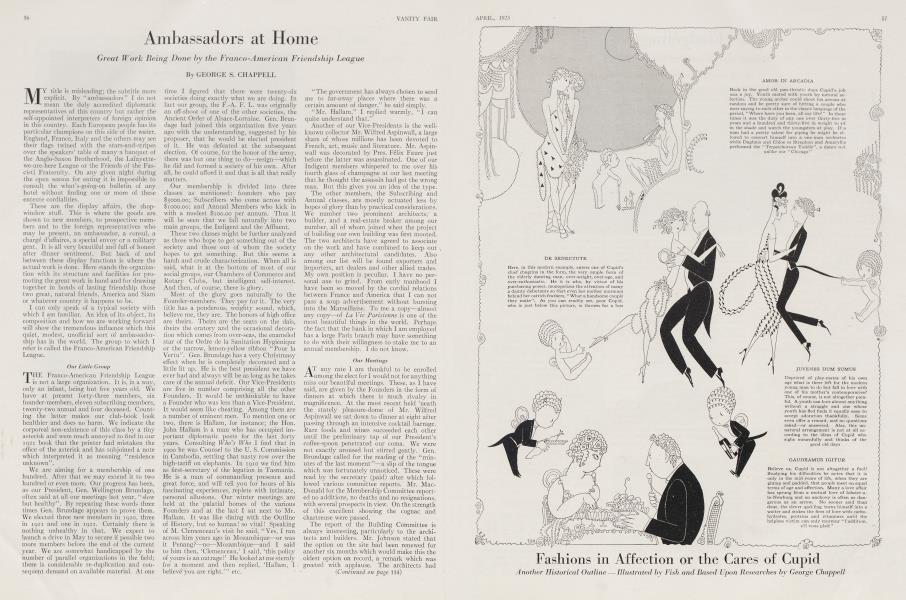
Great Work Bring Done by the Franco-American Friendship League
GEORGE S. CHAPPELL
MY title is misleading; the subtitle more explicit. By "ambassadors" I do not mean the duly accredited diplomatic representatives of this country but rather the self-appointed interpreters of foreign opinion in this country. Each European people has its particular champions on this side of the water. England, France, Italy and the others may see their flags twined with the stars-and-stripes over the speakers' table of many a banquet of the Anglo-Saxon Brotherhood, the Lafayettewe-are-here League or the Friends of the Fascist! Fraternity. On any given night during the open season for eating it is impossible to consult the what's-going-on bulletin of any hotel without finding one or more of these entente cordialities.
These are the display affairs, the shopwindow stuff. This is where the goods are shown to new members, to prospective members and to the foreign representatives who may be present, an ambassador, a consul, a charge d'affaires, a special envoy or a military gent. It is all very beautiful and full of honest after dinner sentiment. But back of and between these display functions is where the actual work is done. Here stands the organization with its structure and facilities for promoting the great work in hand and for drawing together in bonds of lasting friendship those two great, natural friends, America and Siam or whatever country it happens to be.
I can only speak of a typical society with which I am familiar. An idea of its object, its composition anti how we are working forward will show the tremendous influence which this quiet, modest, unofficial sort of ambassadorship has in the world. The group to which I refer is called the Franco-American Friendship League.
Our Little Group
THE Franco-American Friendship League is not a large organization. It is, in a way, only an infant, being but five years old. We have at present forty-three members, six founder-members, eleven subscribing members, twenty-two annual and four deceased. Counting the latter makes our club-book look healthier and does no harm. We indicate the corporeal non-existence of this class by a tiny asterisk and were much annoyed to find in our 1021 book that the printer had mistaken the office of the asterisk and has subjoined a note which interpreted it as meaning "residence unknown".
We are aiming for a membership of one hundred. After that we may extend it to two hundred or even more. Our progress has been, as our President, Gen. Wellington Brundage, often said at all our meetings last year, "slow but healthy". By repeating these words three times Gen. Brundage appears to prove them. We elected three new members in 1920, three in 1921 and one in 1922. Certainly there is nothing unhealthy in that. We expect to launch a drive in May to secure if possible two more members before the end of the current year. We are somewhat handicapped by the number of parallel organizations in the field; there is considerable re-duplication and consequent demand on available material. At one time I figured that there were twenty-six societies doing exactly what we are doing. In fact our group, the F.-A. F. L. was originally an off-shoot of one of the other societies, the Ancient Order of Alsace-Lorraine. Gen. Brundage had joined this organization five years ago with the understanding, suggested by his proposer, that he would be elected president of it. He was defeated at the subsequent election. Of course, for the honor of the army, there was but one thing to do—resign—which he did and formed a society of his own. After all, he could afford it and that is all that really matters.
Our membership is divided into three classes as mentioned: founders who pay $5000.00; Subscribers who come across with $1000.00; and Annual Members who kick in with a modest $100.00 per annum. Thus it will be seen that we fall naturally into two main groups, the Indigent and the Affluent.
These two classes might be further analyzed as those who hope to get something out of the society and those out of whom the society hopes to get something. But this seems a harsh and crude characterization. When all is said, what is at the bottom of most of our social groups, our Chambers of Commerce and Rotary Clubs, but intelligent self-interest. And then, of course, there is glory.
Most of the glory goes naturally to the Founder-members. They pay for it. The very title has a ponderous, weighty sound, which, believe me, they are. The honors of high office are theirs. Theirs are the seats on the dais, theirs the oratory and the occasional decoration which comes from over-seas, the enameled star of the Ordre de la Sanitation Hygienique or the narrow, lemon-yellow ribbon "Pour la Vertu". Gen. Brundage has a very Christmasy effect when he is completely decorated and a little lit up. Fie is the best president we have ever had and always will be as long as he takes care of the annual deficit. Our Vice-Presidents are five in number comprising all the other Founders. It would be unthinkable to have a Founder who was less than a Vice-President. It would seem like cheating. Among them are a number of eminent men. To mention one or two, there is Hallam, for instance; the Hon. John Hallam is a man who has occupied important diplomatic posts for the last forty years. Consulting Who's Who I find that in 1900 he was Counsel to the U. S. Commission in Cambodia, settling that nasty row over the high-tariff on elephants. In 1910 we find him as first-secretary of the legation in Tasmania. Fie is a man of commanding presence and great force, and will tell you for hours of his fascinating experiences, replete with intimate, personal allusions. Our winter meetings are held at the palatial homes of the various Founders and at the last I sat next to Mr. Hallam. It was like dining with the Outline of History, but so human! so vital! Speaking of M. Clemenceau's visit he said, "Yes, I ran across him years ago in Mozambique—or was it Penang?—no—Mozambique—and I said to him then, 'Clemenceau,' I said, 'this policy of yours is an outrage!' Fie looked at me sternly for a moment and then replied, 'Hallam, I believe you are right.'" etc.
"The government has always chosen to send me to far-away places where there was a certain amount of danger," he said simply.
"Mr. Hallam," I replied warmly, "I can quite understand that."
Another of our Vice-Presidents is the wellknown collector Mr. Wilfred Aspinwall, a large share of whose millions has been devoted to French, art, music and literature. Mr. Aspinwall was decorated by Pres. Félix Faure just before the latter was assassinated. One of our Indigent members whispered to me over his fourth glass of champagne at our last meeting that he thought the assassin had got the wrong man. But this gives you an idea of the type.
The other members, the Subscribing and Annual classes, are mostly actuated less by hopes of glory than by practical considerations. We number two prominent architects, a builder, and a real-estate broker among our number, all of whom joined when the project of building our own building was first mooted. The two architects have agreed to associate on the work and have combined to keep out v any other architectural candidates. Also among our list will be found exporters and importers, art dealers and other allied trades. My own position is peculiar. I have no personal axe to grind. From early manhood I have been so moved by the cordial relations between France and America that I can not pass a soup advertisement without bursting into the Marseillaise. To me a copy—almost any copy—of La Vie Parisienne is one of the most beautiful things in the world. Perhaps the fact that the bank in which I am employed has a large Paris branch may have something to do with their willingness to stake me to an annual membership. I do not know.
Our Meetings
AT any rate I am thankful to be enrolled among the elect for I would not for anything miss our beautiful meetings. These, as I have said, are given by the Founders in the form of dinners at which there is much rivalry in magnificence. At the most recent held 'neath the stately pleasure-dome of Mr. Wilfred Aspinwall we sat down to dinner at eight after passing through an intensive cocktail barrage. Rare foods and wines succeeded each other until the preliminary tap of our President's coffee-spoon penetrated our coma. We were not exactly aroused but stirred gently. Gen. Brundage called for the reading of the "minutes of the last moment"—a slip of the tongue which was fortunately unnoticed. These were read by the secretary (paid) after which followed various committee reports. Mr. MacDonald for the Membership Committee reported no additions, no deaths and no resignations, with several prospects in view. On the strength of this excellent showing the cognac and chartreuse were passed.
The report of the Building Committee is always interesting, particularly to the architects and builders. Mr. Johnson stated that the option on the site had been renewed for another six months which would make this the oldest option on record, a remark which was greeted with applause. The architects had prepared an attractive perspective which would later be fitted with floor-plans when the approximate estimate, $300,000, was in sight. At this point our buildermember Air. Alalone interrupted to say that this figure was made in 1912 and could not therefore be considered binding. The subsequent flurry ot discussion was calmed when the President called us to order and fresh cigars were distributed.
(Continued on page 114)
(Continued from page 56)
Perhaps our most important report was that of the Committee on Education which deals with our class in cabinet and metal work, aiming to introduce the perfection of French craftsmanship to the American shops. This is a night-class held in a loaned loft under the guidance of French artisans. Operation for the past year showed a deficit of $263.00 and an increase in enrollment from seven to eight. This caused a distinct burst of applause and scotch and rye were hurriedly circulated.
The Supreme Moment
THEN came the surprise of the evening, the election of a new Foundermember. No one was more surprised than the member himself. He was a benevolent looking old gentleman, a Mr. Horace Hudnut. Calling for silence, Gen. Brundage rose and addressed us, placing his hand caressingly on Mr. lludnut's shoulder.
"Gentlemen," he said, "I have an important announcement to make. Seated here on my right, in the place of honor, where he should be, is my old friend, Horace Hudnut. You will all recall that Air. Hudnut joined us as a subscribing member a year ago. Air. Hudnut has large interests in the silk-business in Lyons. Like us he has a lively love for la belle France which we honor in honoring ourselves."
Gen. Brundage didn't quite mean to say this but it went over big.
"A year has elapsed," he continued. Air. Hudnut has served his novitiate. He has been tried and found worthy to be one of us. I feel—and I venture to say that I speak for you gentlemen—that the time has come when my friend Hudnut should be enrolled as a Founder-member!
During this last sentence Air. Hudnut had been writhing uncomfortably. In a weak voice he managed to say, "B . . . b . . . but . . . I . . . gave . . . a . . . thousand dollars."
But the hand and voice of Brundage were inexorable.
"A Founder-member of the FrancoAmerican Friendship League! Gentlemen, could there be any prouder line in any man's obituary? And now I charge you, rise, gentlemen, and raise your glasses to our new Founder! Well, Air. Hudnut, what do you say?"
It was the supreme moment. We were all on our feet facing him. Not a man faltered. For a few seconds he tried to meet our eyes but I saw the celery-stalk in his left hand trembling violently.
"All right," he whispered and the room was in a uproar during which the waiters broke out a vast quantity of delicious champagne which had been dramatically reserved for this moment.
I can see the picture now, dimly, through the blue haze of cigar-smoke, as if it were all only a vain illusion, a bit of pageantry, an idea without substance or reality.
Subscribers have complete access to the archive.
Sign In Not a Subscriber?Join Now
