Sign In to Your Account
Subscribers have complete access to the archive.
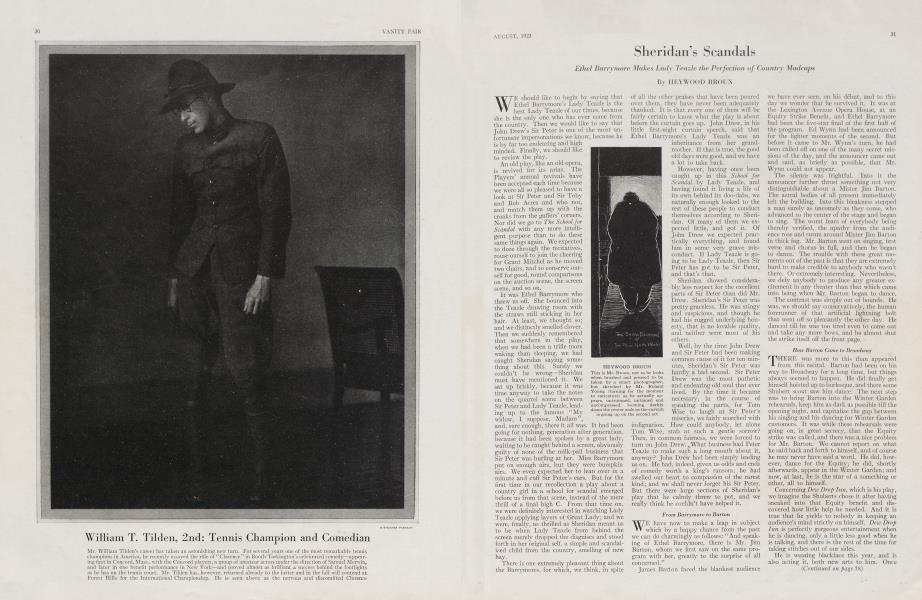
Sign In Not a Subscriber?Join NowSheridan's Scandals
HEYWOOD BROUN
Ethel Barrymore Makes Lady Teazle the Perfection of Country Madcaps
WE should like to begin by saying that Ethel Barrymore's Lady Teazle is the best Lady Teazle of our times, because she is the only one who has ever come from the country. Then we would like to say that John Drew's Sir Peter is one of the most unfortunate impersonations we know, because he is by far too endearing and high minded. Finally, we should like to review the play.
An old play, like an old opera, is revived for its arias. The Players' annual revivals have been accepted each time because we were all so pleased to have a look at Sir Peter and Sir Toby and Bob Acres and who not, and match them up with the croaks from the gaffers' comers. Nor did we go to The School for Scandal with any more intelligent purpose than to do these same things again. We expected to doze through the recitatives, rouse ourself to join the cheering for Grant Mitchel as he moved two chairs, and to conserve ourself for good, round comparisons on the auction scene, the screen scene, and so on.
It was Ethel Barrymore who threw us off. She bounced into the Teazle drawing room with the straws still sticking in her hair. At least, we thought so; and we distinctly smelled clover.
Then we suddenly remembered that somewhere in the play, when we had been a trifle more waking than sleeping, we had caught Sheridan saying something about this. Surely we couldn't be wrong—Sheridan must have mentioned it. We sat up briskly, because it was time anyway to take the notes on the quarrel scene between Sir Peter and Lady Teazle, leading up to the famous "My widow, I suppose, Madam", and, sure enough, there it all was. It had been going for nothing, generation after generation, because it had been spoken by a great lady, waiting to be caught behind a screen, obviously guilty of none of the milk-pail business that Sir Peter was hurling at her. Miss Barrymore put on enough airs, but they were bumpkin airs. We even expected her to lean over in a minute and cuff Sir Peter's ears. But for the first time in our recollection a play about a country girl in a school for scandal emerged before us from that scene, instead of the mere thrill of a final high C. From that time on, we were definitely interested in watching Lady Teazle applying layers of Great Lady; and we were, finally, as thrilled as Sheridan meant us to be when Lady Teazle from behind the screen merely dropped the disguises and stood forth in her original self, a simple and scandalized child from the country, smelling of new hay.
There is one extremely pleasant thing about the Barrymores, for which, we think, in spite of ail the other praises that have been poured over them, they have never been adequately thanked. It is that every one of them will be fairly certain to know what the play is about before the curtain goes up. John Drew, in his little first-night curtain speech, said that Ethel Barrymore's Lady Teazle was an inheritance from her grandmother. If that is true, the good old days were good, and we have a lot to take back.
However, having once been caught up in this School for Scandal by Lady Teazle, and having found it living a life of its own behind its doo-dabs, we naturally enough looked to the rest of these people to conduct themselves according to Sheridan. Of many of them we expected little, and got it. Of John Drew we expected practically everything, and found him in some very grave misconduct. If Lady Teazle is going to be Lady Teazle, then Sir Peter has got to be Sir Peter, and that's that.
Sheridan showed considerably less respect for the excellent parts of Sir Peter than did Mr. Drew. Sheridan's Sir Peter was pretty graceless. He was stingy and suspicious, and though he had his rugged underlying honesty, that is no lovable quality, and neither were most of his others.
Well, by the time John Drew and Sir Peter had been making common cause of it for ten minutes, Sheridan's Sir Peter was hardly a bad second. Sir Peter Drew was the most pathetic and endearing old soul that ever lived. By the time it became necessary, in the course of speaking the parts, for Tom Wise to laugh at Sir Peter's miseries, we fairly scorched with indignation. How could anybody, let alone Tom Wise, stab at such a gentle sorrow? Then, in common fairness, we were forced to turn on John Drew. What business had Peter Teazle to make such a long mouth about it, anyway? John Drew had been simply leading us on. He had, indeed, given us odds and ends of comedy worth a king's ransom; he had swelled our heart to compassion of the rarest kind; and we shall never forget his Sir Peter. But there were large sections of Sheridan's play that he calmly threw to pot, and we really think he couldn't have helped it.
From Barrymore to Barton
E have now to make a leap in subject which by a happy chance from the past we can do charmingly as follows: "And speaking of Ethel Barrymore, there is Mr. Jim Barton, whom we first saw on the same program with her, greatly to the surprise of all concerned."
James Barton faced the blankest audience we have ever seen, on his debut, and to this day we wonder that he survived it. It was at the Lexington Avenue Opera House, at an Equity Strike Benefit, and Ethel Barrymore had been the five-star final of the first half of the program. Ed Wynn had been announced for the lighter moments of the second. But before it came to Mr. Wynn's turn, he had been called off on one of the many secret missions of the day, and the announcer came out and said, as briefly as possible, that Mr. Wynn could not appear.
The silence was frightful. Into it the announcer further thrust something not very distinguishable about a Mister Jim Barton. The astral bodies of all present immediately left the building. Into this bleakness stepped a man surely as uncomely as they come, who advanced to the center of the stage and began to sing. The worst fears of everybody being thereby verified, the apathy from the audience rose and swam around Mister Jim Barton in thick fog. Mr. Barton went on singing, first verse and chorus in full, and then he began to dance. The trouble with these great moments out of the past is that they are extremely hard to make credible to anybody who wasn't there. Or extremely interesting. Nevertheless, we defy anybody to produce any greater excitement in any theater than that which came into being when Mr. Barton began to dance.
The contrast was simply out of bounds. He was, we should say conservatively, the human forerunner of that artificial lightning bolt that went off so pleasantly the other day. He danced till he was too tired even to come out and take any more bows, and he almost shut the strike itself off the front page.
How Barton Came to Broadway
HERE was more to this than appeared from this recital. Barton had been on his way to Broadway for a long time, but things always seemed to happen. He did finally get himself hoisted up to burlesque, and there some Shubert scout saw him dance. The next step was to bring Barton into the Winter Garden rehearsals, keep him as dark as possible till the opening night, and capitalize the gap between his singing and his dancing for Winter Garden customers. It was while these rehearsals were going on, in great secrecy, that -the Equity strike was called, and there was a nice problem for Mr. Barton. We cannot report on what he said back and forth to himself, and of course he may never have said a word. He did, however, dance for the Equity; he did, shortly afterwards, appear in the Winter Garden; and now, at last, he is the star of a something or other, all to himself.
Concerning Dew Drop Inn, which is his play, we imagine the Shuberts chose it after having sneaked into that Equity benefit and discovered how little help he needed. And it is true that he yields to nobody in keeping an audience's mind strictly on himself. Dew Drop Inn is perfectly gorgeous entertainment when he is dancing, only a little less good when he is talking, and there is the rest of the time for taking stitches out of our sides.
He is wearing blackface this year, and is also acting it, both new arts to him. Once upon a time he used to dance on the levee show boats, which put in along the Mississippi with about the regularity of life and performance that obtained on Huckleberry Finn's raft. From the levees Mr. Barton brought back a magnificent imitation of chuckle head and chuckle voice. His blackface goes deep, into all the melodious, lazy shiftlessness of type. It will still take time or a miracle to make him an actor, but what he can do at all he can do better than anybody else. Many a man has been called a genius for less.
(Continued on page 78)
(Continued from page 31)
His one perfect gift is still his dancing, the kind of burlesque dancing that gets its quality from the fact that at any given moment he can give off playing with it and do it straight just as beautifully. He has made his entire motor system an instrument, and has made himself its complete master. He can do a burlesque dance that keeps him spinning like a top around a full stage, and he can also do one with his left ear and one finger.
Anything he thinks he would like to pantomime he can pantomime. He can shade a burlesque so fine that you watch him like a hawk to make sure he isn't fooling you. Finally, there is some fine quality in the man himself, which we can point to but cannot define, by which he burlesques a dance or a dancer and still leaves the beauty of his original undisturbed. We would like to see, for instance, a program of alternating dances by James Barton and Isadora Duncan as she was twenty years ago. We do not believe that Barton's fooling would lessen either the dignity or the glory of Isadora, nor that even the superb beauty of her twenties would have made Barton seem shoddy in her company.
The tail end of the season brought two surprisingly good comedies to town. Sun Up, by Lula Vollmer, seemed within hailing distance of greatness. It began as a vivid and authentic comedy of American life in the mountains of North Carolina. But from our point of view it ended as shoddy, cheap and sentimental hokum.
It seemed to us that the playwright had taken to heart a phrase which has ruined many an aspiring author. Unquestionably, she had heard some one speak of "character development". Now this is frequently interpreted by authors, and by a good many others, as an obligation to make all the important characters participate in a running broad jump. Generally, the custom is that the jump shall be toward the right and reformation. Thus, if a character is presented as a bank robber in the first act, the playwright feels much inclined to show him as a self-sacrificing and devoted missionary to China just before the final curtain. There is a feeling that if a character displays certain traits at the beginning of a play and maintains them all the way through to the end, the audience has been cheated in some way. It has not had a run for its money.
And that is precisely what Miss Vollmer has done. She has begun by drawing with great fidelity a stern, rebellious and thoroughly hard boiled old mountain woman. Suddenly, to our amazement and dismay, this splendid character simpered and grew sweet. It was all accomplished with one whopping coincidence and a brief spell of spirit voices. We never believed it for a moment. To us it seemed that the author had been guilty of wanton treachery to a character. More than that, she imposed a terrific handicap upon Lucille La Verne, who gave one of the finest performances of the year in the role of the mountain woman.
The other surprise comedy which came and remained is Aren't We All with Cyril Maude. This is very pleasant foolery indeed, with Mr. Maude playing a middleaged scamp and having a fine time of it. To be sure, he does point some of his humorous lines rather hard; but after all his aim is excellent, and he never misses. The play provides one of the merriest entertainments in town.
Subscribers have complete access to the archive.
Sign In Not a Subscriber?Join Now
