


Sign In to Your Account
Subscribers have complete access to the archive.
Sign In Not a Subscriber?Join NowEuropean Motoring
A Few Reflections on Natural Tastes in Motor Coachwork
JOHN PRIOLEAU
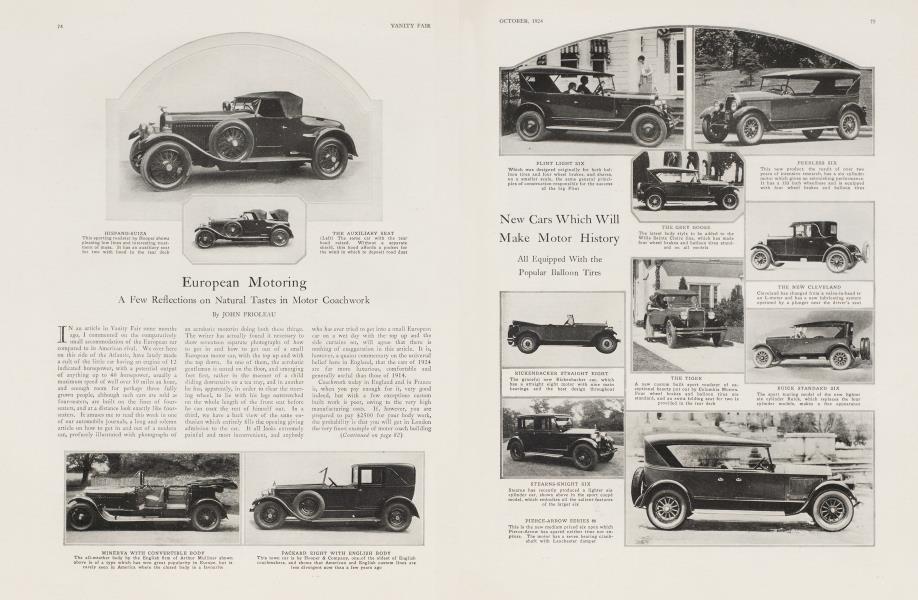
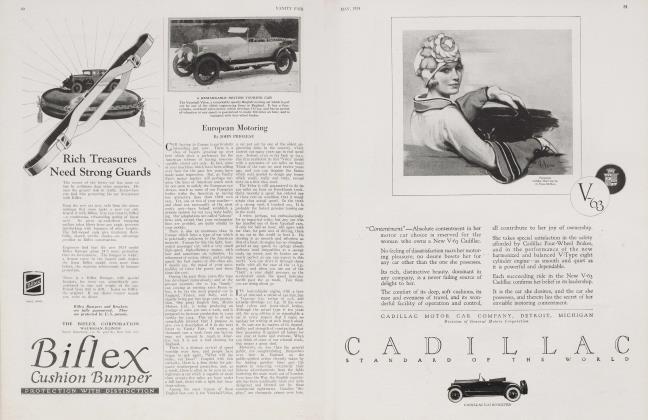
IN an article in Vanity Fair some months ago, I commented on the comparatively small accommodation of the European car compared to its American rival. We over here on this side of the Atlantic, have lately made a cult of the little car having an engine of 12 indicated horsepower, with a potential output of anything up to 40 horsepower, usually a maximum speed of well over 50 miles an hour, and enough room for perhaps three fully grown people, although such cars are sold as four-seaters, arc built on the lines of four-seaters, and at a distance look exactly like four-seaters. It amuses me to read this week in one of our automobile journals, a long and solemn article on how to get in and out of a modern car, profusely illustrated with photographs of an acrobatic motorist doing both these things. The writer has actually found it necessary to show seventeen separate photographs of how to get in and how to get out of a small European motor car, with the top up and with the top down. In one of them, the acrobatic gentleman is seated on the floor, and emerging feet first, rather in the manner of a child sliding downstairs on a tea tray, and in another he has, apparently, in order to clear the steering wheel, to lie with his legs outstretched on the whole length of the front scat before he can coax the rest of himself out. In a third, we have a back view of the same enthusiast which entirely fills the opening giving admission to the car. It all looks extremely painful and most inconvenient, and anybody who has ever tried to get into a small European car on a wet day with the top up and the side curtains set, will agree that there is nothing of exaggeration in this article. It is, however, a quaint commentary on the universal belief here in England, that the cars of 1924 are far more luxurious, comfortable and generally useful than those of 1914.
Coachwork today in England and in France is, when you pay enough for it, very good indeed, but with a few exceptions custom built work is poor, owing to the very high manufacturing costs. If, however, you are prepared to pay $2500 for your body work, the probability is that you will get in London the very finest example of motor coach building obtainable in the world today.
(Continued on Page 82)
(Continued from Page 74)
There is an aristocratic grace (to use a horrible expression) which to my mind stamps the work of the leading English coach-builders; an indefinable quality which I have not found in the work of their rivals elsewhere.
There are some very remarkable examples of the very highest class of motor coachwork to be seen in London just now at the height of the season.
I do not mean what are now super-luxurious bodies fitted with all manner of accessories, the sole claim of which to notice is the price which is charged for them, but the kind of body which is quite perfectly made of the very best material possible by the most highly skilled workmen, and which has been designed by a man who is above all an artist.
IT puzzles my American friends to see in the course of a morning's walk on Piccadilly, Bond Street, Regent Street and in Hyde Park, say fifty examples of the Rolls Royce, the Napier, the Lanchester, the Vauxhall, the Daimler, no two of which have similar bodies. That is how the Englishman likes his car. If there is one thing of which he has a greater horror than anything else, it is a suggestion that his car resembles that of his neighbour. To every Englishman his car must be characteristic of either itself or himself, and every keen driver of my acquaintance will in some way or another make his machine different from the next fellow's. I have known cases in which a car which has cost $1500, new, equipped with everything that mortal man can desire, has had another $500 spent on it for a new top, new lamps, special disc wheels, a new steering wheel, a new hood — generally of burnished aluminum—anything so long as Jones's car will look as little like Smith's as possible. It is no matter for surprise that the foreigner cannot understand us; I do not think we understand ourselves.
The typical Frenchman, on the other hand, much more closely resembles the American in his indifference to outward appearance. Unless he has paid pretty heavily for his body, fitted to an expensive chassis, he does not seem to care so much whether his car is the exact duplicate of Dupont's or Duval's, but he makes a considerable amount of trouble if the mechanism of his car will not stand up to pretty furious driving over the wreck which is all that is left of French roads today, and he is pretty keen on having waterproof tops and on devices for keeping himself more or less free from dust. But you can paint his car and the cars of thousands of friends of his who use the same make, black or grey and make them all as like as one hen's egg to another and he won't even notice what you are doing. He takes great personal interest and pride in his car as a car, and in that way he resembles the Englishman, but that pride is taken solely in the mechanism and in the performance of the car— very seldom in its outward appearance.
ITALIAN AND GERMAN CARS
THE German's taste in coach-work on the other hand, seemed to me the last time I was in that country, to be remarkable for its crudity. While there is not that similarity between cars which you find in either France or the United States, the cars of Germany, at any rate those which are moderate in price, have one thing in common—their extreme hideousness. Anything uglier to English or American eyes than the average German touring car, can hardly be conceived. That famous car, the Mercedes, is now being tentatively sold in this country—at a very high price, be it remarked—but it is very seldom indeed that you see one of them fitted with an imported body.
Italy, too, is often a sinner in the aesthetic respect, although of course her transgressions do not begin to approach those of Germany. Italian custom built bodies are not attractive in any way as a rule, but they have the merit of being solidly built.
Subscribers have complete access to the archive.
Sign In Not a Subscriber?Join Now
