


Sign In to Your Account
Subscribers have complete access to the archive.
Sign In Not a Subscriber?Join NowEuropean Motoring
JOHN PRIOLEAU
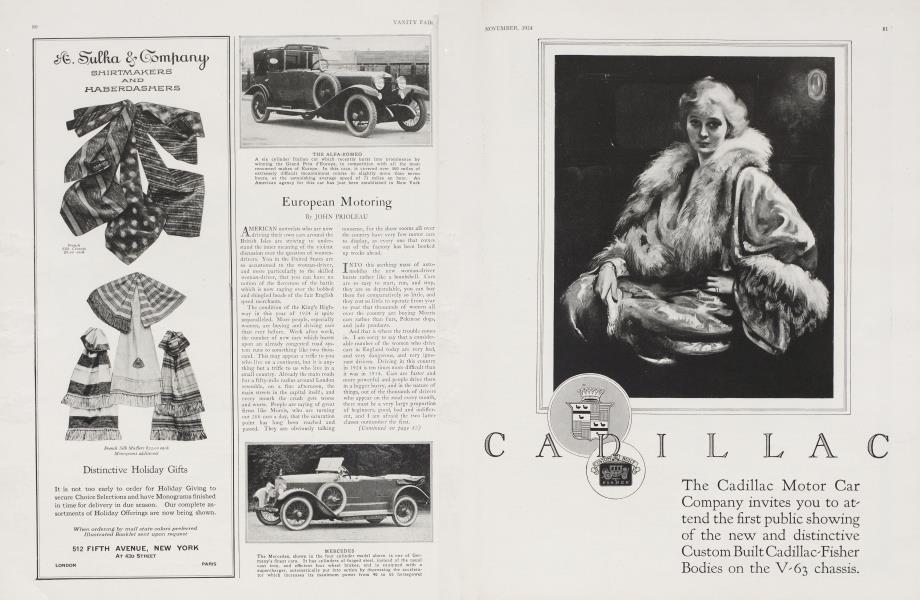
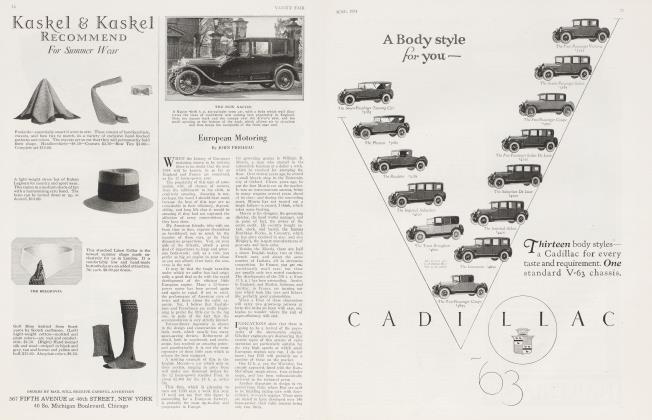
AMERICAN motorists who arc now driving their own cars around the British Isles are striving to understand the inner meaning of the violent discussion over the question of wotnendrivers. You in the United States are so accustomed to the woman-driver, and more particularly to the skilled woman-driver, that you can have no notion of the fierceness of the battle which is now raging over the bobbed and shingled heads of the fair English speed merchants.
The condition of the King's Highway in this year of 1924 is quite unparalleled. More people, especially women, are buying and driving cars than ever before. Week after week, the number of new cars which bursts upon an already congested road system runs to something like two thousand. This may appear a trifle to you who live on a continent, but it is anything but a trifle to us who live in a small country. Already the main roads for a fifty-mile radius around London resemble, on a fine afternoon, the main streets in the capital itself; and every month the crush gets worse and worse. People are saying of great firms like Morris, who are turning out 200 cars a day, that the saturation point has long been reached and passed. They are obviously talking nonsense, for the show rooms all over the country have very few motor cars to display, as every one that comes out of the factory has been booked up weeks ahead.
INTO this seething mass of automobiles the new woman-driver bursts rather like a bombshell. Cars are so easy to start, run, and stop, they are so dependable, you can buy them for comparatively so little, and they cost so little to operate from year to year that thousands of women all over the country are buying Morris cars rather than furs, Pekinese dogs, and jade pendants.
And that is where the trouble comes in. I am sorry to say that a considerable number of the women who drive cars in England today are very bad, and very dangerous, and very ignorant drivers. Driving in this country in 1924 is ten times more difficult than it was in 1914. Cars are faster and more powerful and people drive them in a bigger hurry, and in the nature of things, out of the thousands of drivers who appear on the road every month, there must be a very large proportion of beginners, good, bad and indifferent, and I am afraid the two latter classes outnumber the first.
Continued on page 82
Continued from page 80
American motorists touring about England this fall will find the roads satisfyingly good in practically every country. The Midlands, near big factory towns like Birmingham, Coventry, and Sheffield, are places to avoid, not only because they are in themselves unpleasant to visit except strictly on business, but because their road surfaces have been destroyed by thousands of trucks. Anywhere else, however, your path will be very smooth.
And here a warning—that path may easily be too smooth. There is a serious agitation at the moment (it has already reached the point of discussion in Parliament) on the question of the new road repairing material. All highways are now repaired and rebuilt with such astonishingly smooth surfaces that, after a shower of rain, they become dangerously slippery and a large number of more or less serious accidents have occurred owing to skidding. Once your car starts side-slipping on this new road stuff, nothing but the expiry of its momentum will stop it. The magnificent new Great West Road, which has been built to relieve the westbound traffic from London, is a serious sinner in this respect. Its concrete surface is like a billiard table for smoothness, and its width is approximately that of Brooklands Race Track. You could not conceive a safer road. Yet the other day I was forced to keep to a trembling ten miles an hour along it because of the insane desire of my car to waltz on no provocation at all. Remember this, America, when you visit us. It is a warning which you will find useful.
Subscribers have complete access to the archive.
Sign In Not a Subscriber?Join Now
