

Sign In to Your Account
Subscribers have complete access to the archive.
Sign In Not a Subscriber?Join NowEuropean Motoring
JOHN PRIOLEAU
NOW that the principal European motor exposition is a thingof the past and the prophets have been either confuted or supported by their predictions, I have had time to make careful study of the general trend of the design of the cars which we shall be using in 1926 over here. With the help of a most admirable composite chassis drawing issued by the Autocar, I can now reveal to American readers just what the chief European tendencies arc.
To begin at the most interesting end, you in the United States, where the six cylinder car, in all except the lowest price classes, has practically abolished the four, will be surprised to hear that no less than 70 per cent, of European engines have four cylinders, 22 per cent six, 5 per cent eight and 3 per cent two. I must confess that at first these figures astonished me, as the cult of the six seemed to have developed so rapidly in the past twelve months that I expected at least 50 per cent of the new cars to be of that type. But one has to remember that there is an enormous number of four cylinder light cars of about 12 h.p. on the English and continental markets, a kind of car, I understand, which, is slowly being brought to the point of production in America, and these must weigh heavily in the balance. Nearly every make of importance in Europe has at least one six on its price list.
Engine cooling is nearly equally divided between thermo-syphon and pump, the proportions being 44 to 54 per cent, with 1 l/z per cent left to air. Valves are even more nearly level, the side by side or L-head type numbering 45 per cent and the overhead type 44. Sleeve-valves account for 6.5 per cent and the balance are miscellaneous.
In ignition systems the magneto is easily first, with 81, coil being second with 15 and dual third with 4. One and a half per cent of the starters are mechanical, the rest being electric. Four speed gcarsets score with 70 per cent against 28 per cent for three speeds, and four wheel brakes number exactly three times as many as the two wheel sets. Gearshift levers are set in the centre or at the side in about equal proportions. Disc clutches preponderate, but the single-plate type is gaining rapidly in favour, owing to the remarkably easy gear-changing it allows, and I fancy that next year will see a large majority of cars so fitted.
Suspension is mostly by semielliptic springs on both axles, only 18 per cent of the systems being cantilever to the rear. The remainder is divided between quarter-elliptic, all round and miscellaneous designs. Finally, the spiral bevel drive to the rear axle beats the worm, the straight bevel and miscellaneous by 85%.
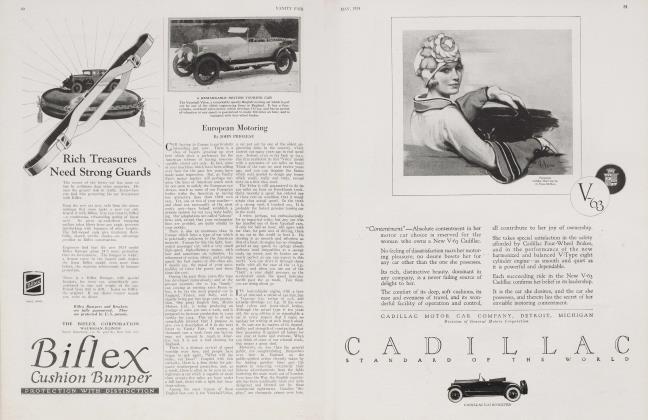
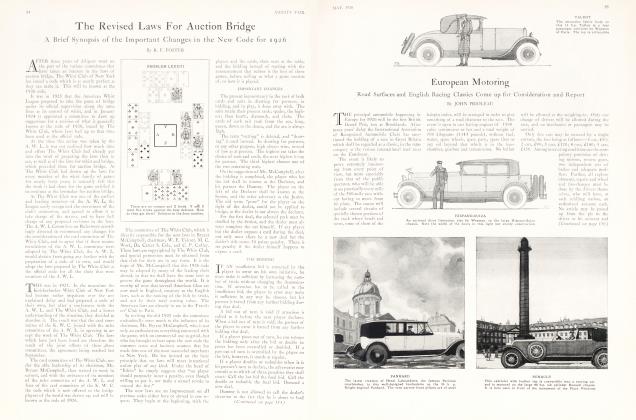
Coachwork of the best class has improved very greatly, as can be seen by the accompanying photographs, the saloon type being far more popular than it was last year. Finish in general is extremely good, but few cars yet built should compare with the body built by Windovers for the Rajah Kumer of Vizianagarum. This tourer is of pure aluminum with gold and silver fittings, having three windscreens, one front, one in the centre and one in the rear, supplemented by two tops, which are concealed. In addition to the usual dashboard fittings there is a gold cigar-box, walnut and gold smoking sets, barometer, thermometer, gradient meter, cigar lighters, ice chest, fresh water tank, a canteen for four people, three decanters, a champagne-holder, a syphon-holder and numerous inlaid cabinets and cupboards, and a silver baggage grid. The only rival to this car I know of is the Maharajah of Patiala's thirtyfive thousand dollar Lanchester, which, with a similar equipment, has a steering-wheel of pure ivory. As ivory cannot be bent, it would be interesting to know how many elephants contributed their tusks to the making of this unique wheel. The Maharajah of Cooch Behar's car, camouflaged to look like the jungle at night, is to be used by its owner in big-game stalking by motor.
Continued on page 118
Continued, front page 116
A truly remarkable display.
The most strenuous road-trial ever organised is to be held during 1926 on the Continent, to be called the International Alpine Cup, the preliminaries of which have been arranged between France, Italy, Austria, Germany and Switzerland. The course will extend to over 3,000 miles and will be almost entirely over mountains. The circuit must be completed in seven days, making an average of 444 miles a day—surely the longest daily run ever planned in such a contest. Five countries, France, Switzerland, Italy, Germany and Austria will all be traversed and there is little doubt that the trial will be of the greatest interest to every motorist. Considered as a spectacle alone, the climbing of the Alpine passes is worth a very long journey to watch.
Subscribers have complete access to the archive.
Sign In Not a Subscriber?Join Now
