

Sign In to Your Account
Subscribers have complete access to the archive.
Sign In Not a Subscriber?Join NowEuropean Motoring
JOHN PRIOLEAU
Europe is Enjoying Lower Prices and Improved Designs
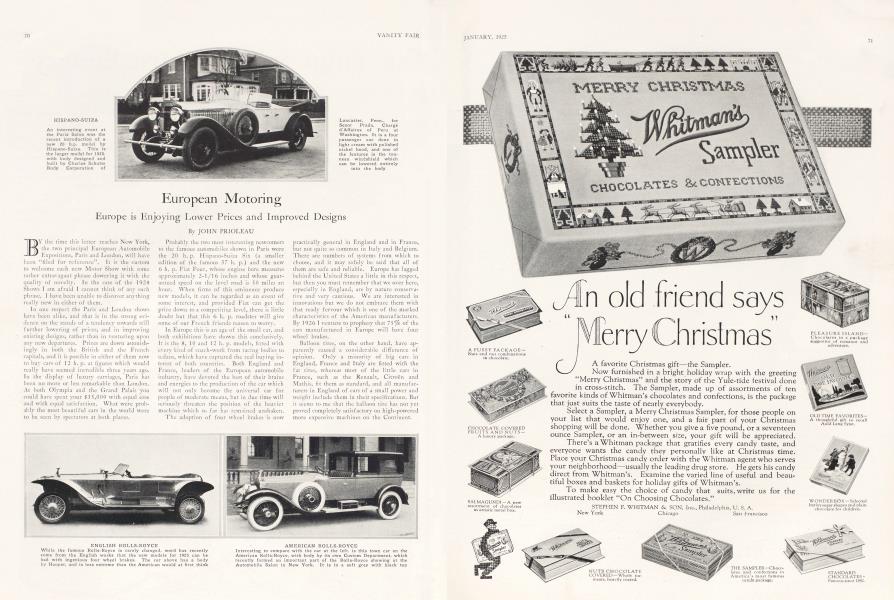
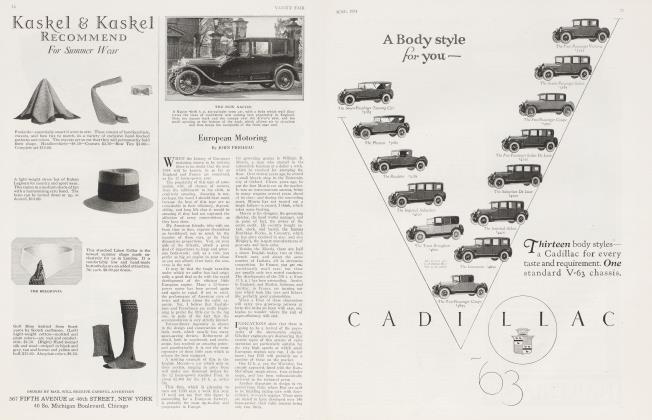
BY the time this letter reaches New York, the two principal European Automobile Expositions, Paris and London, will have been "filed for reference". It is the custom to welcome each new Motor Show with some rather extravagant phrase dowering it with the quality of novelty. In the case of the 1924 Shows I am afraid I cannot think of any such phrase. I have been unable to discover anything really new in cither of them.
In one respect the Paris and London shows have been alike, and that is in the strong evidence on the stands of a tendency towards still further lowering of prices, and in improving existing designs, rather than in venturing upon any new departures. Prices are down astonishingly in both the British and the French capitals, and it is possible in either of them now to buy cars of 12 h. p. at figures which would really have seemed incredible three vears ago. In the display of luxury carriages, Paris has been no more or less remarkable than London. At both Olympia and the Grand Palais you could have spent your $1 5,000 with equal ease and with equal satisfaction. What were probably the most beautiful cars in the world were to be seen by spectators at both places.
Probably the two most interesting newcomers to the famous automobiles shown in Paris were the 20 h. p. Hispano-Suiza Six (a smaller edition of the famous 3 7 h. p.) and the new 6 h. p. Fiat Four, whose engine bore measures approximately 2-1/16 inches and whose guaranteed speed on the level road is 5 0 miles an hour. When firms of this eminence produce new models, it can be regarded as an event of some interest, and provided Fiat can get the price down to a competitive level, there is little doubt but that this 6 h. p. roadster will give some of our French friends reason to worry.
In Europe this is an age of the small car, and both exhibitions have shown this conclusively. It is the 8, 10 and 12 h. p. models, fitted with every kind of coach-work from racing bodies to sedans, which have captured the real buying interest of both countries. Both England and France, leaders of the European automobile industry, have devoted the best of their brains and energies to the production of the car which will not only become the universal car for people of moderate means, but in due time will seriously threaten the position of the heavier machine which so far has remained unshaken.
The adoption of four wheel brakes is now practically general in England and in France, but not quite so common in Italy and Belgium. There arc numbers of systems from which to choose, and it may safely be said that all of them arc safe and reliable. Europe has lagged behind the United States a little in this respect, but then you must remember that we over here, especially in England, are by nature conservative and very cautious. We are interested in innovations but we do not embrace them with that ready fervour which is one of the marked characteristics of the American manufacturers. By 1926 I venture to prophesy that 75% of the cars manufactured in Europe will have four wheel brakes.
Balloon tires, on the other hand, have apparently caused a considerable difference of opinion. Only a minority of big cars in England, France and Italy are fitted with the fat tires, whereas most of the little cars in France, such as the Renault, Citroen and Mathis, fit them as standard, and all manufacturers in England of cars of a small power and weight include them in their specifications. But it seems to me that the balloon tire has not yet proved completely satisfactory on high-powered more expensive machines on the Continent.
Subscribers have complete access to the archive.
Sign In Not a Subscriber?Join Now