Sign In to Your Account
Subscribers have complete access to the archive.
Sign In Not a Subscriber?Join NowEuropean Motoring
General Reflections on Motor Shows and the Trends They Disclose
JOHN PRIOLEAU
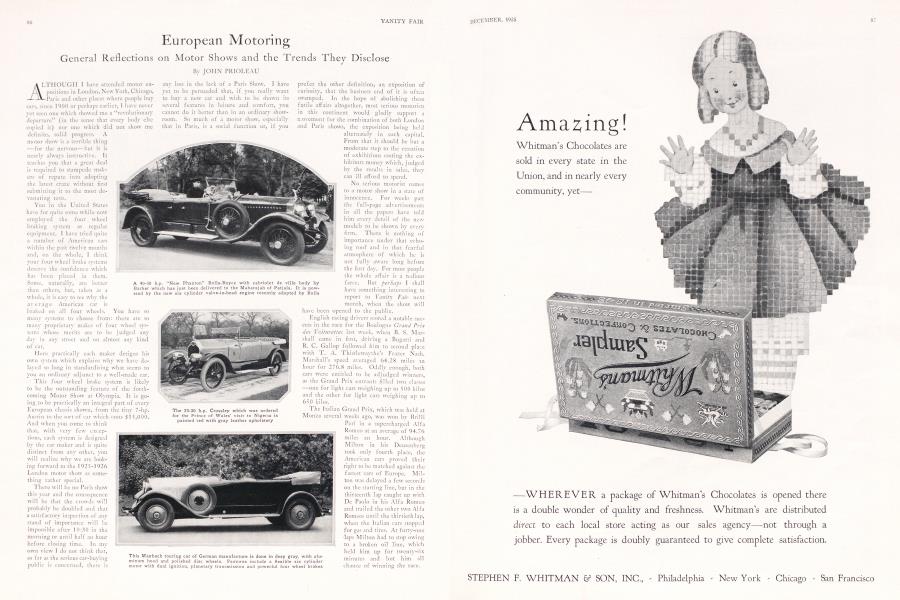
ALTHOUGH I have attended motor cxpositions in London, New York, Chicago, Paris and other places where people buy cars, since 1900 or perhaps earlier, 1 have never yet seen one which showed me a "revolutionary departure" (in the sense that every body else copied it) nor one which did not show me definite, solid progress. A motor show is a terrible thing —for the nervous—but it is nearly always instructive. It teaches you that a great deal is required to stampede makers of repute into adopting the latest craze without first submitting it to the most devastating tests.
You in the United States have for quite some while now employed the four wheel braking system as regular equipment. I have tried quite a number of American cars within the past twelve months and, on the whole, I think your four wheel brake systems deserve the confidence which has been placed in them.
Some, naturally, are better than others, but, taken as a whole, it is easy to see why the average American car is braked on all four wheels. You have so many systems to choose from: there are so many proprietary makes of four wheel systems whose merits are to be judged any day in any street and on almost any kind of car.
Here practically each maker designs his own system which explains why we have delayed so long in standardising what seems to you an ordinary adjunct to a well-made car.
This four wheel brake system is likely to be the outstanding feature of the forthcoming Motor Show at Olympia. It is going, to be practically an integral part of every European chassis shown, from the tiny 7-hp. Austin to the sort of car which costs $1 5,000. And when you come to think that, with very few exceptions, each system is designed by the car maker and is quite distinct from any other, you will realize why we are looking forward to the 192 5-1926 London motor show as something rather special.
There will be no Paris show this year and the consequence will be that the crowds will probably be doubled and that a satisfactory inspection of any stand of importance will be impossible after 10:30 in the morning or until half an hour before closing time. In my own view I do not think that, so far as the serious car-buving public is concerned, there is any loss in the lack of a Paris Show. I have yet to be persuaded that, if you really want to buy a new car and wish to be shown its several features in leisure and comfort, you cannot do it better than in an ordinary showroom. So much of a motor show, especially that in Paris, is a social function or, if you prefer the other definition, an exposition of curiosity, that the business end of it is often swamped. In the hope of abolishing these futile affairs altogether, most serious motorists in this continent would gladly support a movement tor the combination of both London and Paris shows, the exposition being held alternately in each capital. From that it should be but a moderate step to the cessation of exhibitions costing the exhibitors money which, judged by the results in sales, they can ill afford to spend.
No serious motorist comes to a motor show in a state of innocence. For weeks past the full-page advertisements in all the papers have told him every detail of the new models to be shown by everv firm. There is nothing of importance under that echoing roof and in that fearful atmosphere of which he is not fully aware long before the first day. For most people the whole affair is a tedious farce. But per haps I shall have something interesting to report to Vanity Fair next month, when the show will have been opened to the public.
English racing drivers scored a notable success in the race for the Boulogne Grand Prix des Voiturettes last week, when B. S. Marshall came in first, driving a Bugatti and R. C. Gallop followed him to second place with T. A. Thistlewaythe's Frazer Nash. Marshall's speed averaged 64.28 miles an hour for 276.8 miles. Oddly enough, both cars were entitled to be adjudged winners, as the Grand Prix entrants filled two classes —one for light cars weighing up to 500 kilos and the other for light cars weighing up to 650 kilos.
The Italian Grand Prix, which was held at Monza several weeks ago, was won bv Brilli Peri in a supercharged Alfa Romeo at an average of 94.76 miles an hour. Although Milton in his Deuscnbcrg took only fourth place, the American cars proved their right to be matched against the fastest cars of Europe. Milton was delayed a few seconds on the starting line, but in the thirteenth lap caught up with De Paolo in his Alfa Romeo and trailed the other two Alfa Romeos until the thirtieth lap, when the Italian cars stopped for gas and tires. At forty-one laps Milton had to stop owing to a broken oil line, which held him up for twenty-six minutes and lost him all chance of winning the race.
Subscribers have complete access to the archive.
Sign In Not a Subscriber?Join Now