

Sign In to Your Account
Subscribers have complete access to the archive.
Sign In Not a Subscriber?Join NowEuropean Motoring
News of the Olympia Show
JOHN PRIOLEAU
HIS past Autumn saw the opening of the greatest Motor Show the world lias ever known. As it was impossible to hold the usual salon in Paris, owing to the Grand Palais being wanted for other purposes, the London Show became, for 1925, at least, unique.
It is, of course, impossible to give anything like a detailed description of each exhibit, but some idea may be gathered of what the Show looks like from the fact that there are over six hundred automobiles displayed, while the double galleries upstairs where the accessories arc shown give you the opportunity for a considerable walk.
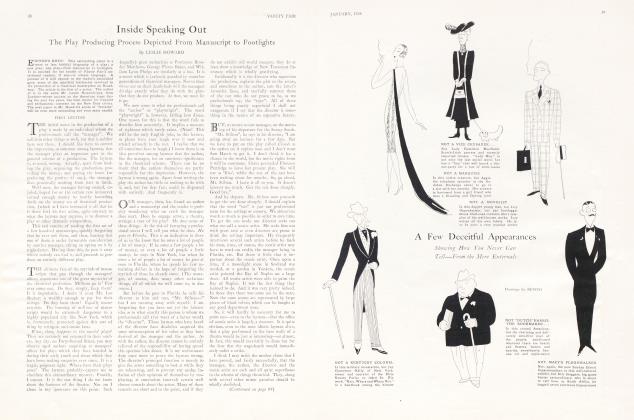
Speaking generally, the tendencies in the past year in practically all European factories have been towards the development of the very small six cylinder car. There arc some absolutely tiny engines to be found here and there, several of which have a cubic content of less than a litre and a half. These wonderful little chassis, which very often have four-speed gear sets, are nearly always shown fitted with saloon bodies, which arc not necessarily of the Weymann type. Compared with the size of the average American engine, one can hardly believe that these little motors would have the power to carry the weight of a roadster. As a matter of fact, most of them develop well over 30 horse-power and arc perfectly capable of 45. miles an hour.
Of real novelties there arc rather more than I expected. Daimler, for example, a make which I think is fairly well known in the United States, have redesigned the whole of their sleeve-valvcd engines and transformed them from good, but dull and sluggish, largesized cars into some of the fastest things on the road. The 20-70 h. p. Daimler is credited with 70 miles an hour with a large saloon body, its engine only paying a tax of £ 19, which means that the bore of the cylinders is scarcely more than 70 millimetres or 2.8 inches.
The makers of the famous Vauxhall, one of the finest cars built in England, or for that matter in the world, have abandoned a 16 year old practice of devoting their entire attention to the production of the perfect fourcylinder car, and have produced a single sleeve six-cylinder engine on the Bcrt-McCallum principle. It is one of the finest pieces of engineering work in the Show. The merger of Vauxhall with General Motors has caused considerable sensation in English motoring circles. It is understood that there will not be any fundamental changes in the Vauxhall product.
Continued on page 86
Continued from page 82
Two other novelties are the new Three Litre and Straight Eight turned out by Sunbeam, both of which are said to be easily capable of reaching 90 miles an hour.
Among the French firms there is very little novelty, but Rochet-Schneider, Delage, Hotchkiss, Panhard, and Delaunay-Belleville exhibit some very nice looking cars.
The two cars which drew most attention to the Italian stands were the 15-45 horse-power O. M., an extraordinarily fine two-litre six cylinder engined light touring car, and the new seven horsepower Fiat.
Germany is not allowed to show any cars, but Austria is staging two excellent makes, one, the AustroDaimler, whose six cylinder nineteen horsepower rated engine, I believe to be the most perfectly finished motor engine in the world; while the general finish of the chassis and the equipment are quite astonishing, even in this exposition of cars for the super-rich. The other Austrian make is the Steyr.
Subscribers have complete access to the archive.
Sign In Not a Subscriber?Join Now
