


Sign In to Your Account
Subscribers have complete access to the archive.
Sign In Not a Subscriber?Join NowThe Flooded Island
A Little Tragedy of the Springtime, Treating Tender Emotion With Irony
FERENC MOLNAR
MRS. LANGE ELDER, a doctor's widow, sat up in bed and called:
"Julia, open the window, I'm suffocating!"
They lived in a hotel on the island in two adjoining rooms, Mrs. Langfelder, a patient, and Julia, her servant.
It was half past ten; the stars were not visible in the sky as clouds were floating restlessly across it—now they hurried all in one direction, like a crowd, now they slowed down and moved about in the quiet darkness.
Julia opened the window.
"Cover me up," said the old lady.
"Yes, ma'am" replied Julia softly and drew the clothes around the old lady. She went to the window and leaned out, looking for a moment at the Danube.
"Ma'am."
"Well ? "
"So much water is coming down from the mountains. The Danube is flooding like I've never seen before." Julia again looked out of the window. Down below at the water's edge, torches were burning, in a row up to where the island finished in the shape of a large ship. One could sec soldiers moving about between the torches. The management of the baths had been waiting for these soldiers for days. They were working day and night to build a dam. They were moving quietly. The soldiers were now simply workmen.
A SLIGHT breeze was blowing in from the Danube.
"Julia," said the old lady, "shut the window, I'll catch cold."
Julia shut the window and went into the other room.
The old lady switched off the light, but did not sleep. The poor woman was ill and old, too stout, and too tired of life. She did not even care about the water which was rushing down from the mountains. She lay in bed with open eyes. Her night's "rest". From the other room came a quiet, slight sound. Julia had opened the window and was staring out at the Danube, which now fascinated her. And the slight breeze which came from there, blew, too, from the mountains, on which the snow had just melted. The wind blowing over their ridges filled itself with a tepid, earthly smell, with the scent of rich roots, with that breath, faintly reminiscent of violets which passes tepid and languid across one's face. This is the wind for which one says, "Spring is here," as one closes one's eyes.
"Soldiers . . ." Julia said in a serious tone to herself.
She leaned so daringly out of the window, as only servants do, that half of her body seemed out in the air. Now, suddenly, she saw the whole row of torches, shining in the night, and many soldiers, thronging and digging and wheeling the soil in barrows at the water's edge. She was a city-bred girl, sixteen years old. The slight breeze blew into her cars and breathed gently into her little nostrils which were trembling just a trifle. She closed her eyes and softly called into the night, to the big Danube, to the whole world:
"What a night."
She quickly closed the window and slunk to the wardrobe in the darkness. She undressed, and listened at the old lady's door. The old lady was asleep. Why should I make a secret of it?—she was snoring soundly. If she had not been asleep, perhaps Julia would have gone to bed. She opened her wardrobe and took out a white dress. When she was dressed in her Sunday clothes she turned on the light and tidied her hair. She pulled the table drawer open, felt around inside and took out a big cigar. She had kept it there ever since the soldiers first appeared on the island. She took the cigar and fled with it out of the room.
She hurried down the two flights of stairs and aroused the porter.
"Where are you going, Missy?"
"To the chemist's".
A lump rose in her throat at this lie, then, like a young filly, she rushed out into the night.
The Danube was restlessly tossing about. It hissed, and snorted furiously in its turbulence and when Julia went near to the low dam and looked across, she heard the boom of the infuriated waters. The slight breeze which upstairs, at the window had fanned Julia's face lightly was blowing a little more vigorously here, floating pleasantly, softly, almost warm from the water.
"Where you going, Miss?" asked one of the sweating soldiers.
The blood rushed to Julia's face. She made no answer and began running along the dam amongst the torches, where the soldiers looked up wondcringly and passed deprecatory remarks. Her white dress flashed, as th£ torches shone on it, and the merry, yellow-looking faces of the soldiers kept grinning at her.
"Where you going, Miss?" they called.
She suddenly realized that she really did not know where she was going. She would have liked to have run along the dam till all the soldiers were left behind, to the very end, to the very last torch, there to stop—later to return home by a round-about way. She began to regret ever having come down at all. She clutched the cigar tightly in her hand and ran as fast as her small feet could carry her. The soldiers reached for her, but she was too quick. The moment they noticed her, she had vanished. At the end of the dam, a few paces beyond the last torch, she stopped.
"There are no more soldiers here," she thought, and sighed with relief. At this end, the dam was finished. It was a low dam made of beaten soil—here and there were protruding stakes, and where it was wider, sand bags. Julia sat down and meditated on her adventure. She seemed to have left behind her the old invalid, the groanings, the medicines, the monotonous days and the nights. She was enraptured by her surroundings: life vibrated about her . . . soldiers, . . . torches, the raging torrent which was the Danube . . . the scented breeze of a Spring night . . . the gathering clouds, this thrilling and dangerous hurrying in the night, full of anxiety and staving off of the flood, . . . soldiers, young, ruddy lads with laughing faces . . . soldiers . . . soldiers . . .
"Hello, girlie". A voice was near her.
SHE started. It was a sentry on point duty, with a rifle over his shoulder, who had climbed up from beyond the dam. He was a small, fair sturdy lad. He scrutinized Julia closely.
"What are you doing here, kid?"
"Nothing," Julia said.
"What if I were to take a shot at you?"
Julia laughed.
"You wouldn't".
Then the old, old question.
"Where do you come from?"
"Pest."
"Me, too."
"So we are both from Pest . . ."
Julia very quietly and breathlessly offered him the cigar.
Her heart beat fast.
"What's that?"
"A cigar."
"For me?"
"Yes, for you."
"What shall I give you in exchange?"
Julia could feel her heart beating fast and loud, like a drum pounding her breast. She laughed constrainedly—a sort of bashfulness overcame her and she almost cried.
"Soldier," she said in a sweet coaxing careless tone, "Kiss me. On my lips."
'Ehe soldier really did not expect this. He held his rifle in his left hand and with his right arm he pressed the girl's head close to him.
(Continued on page 98)
(Continued front page 48)
"Darling ..." he said with love, but without love, only because the girl was young and looked so strange, so devoted, she seemed transfigured—her soul seemed to look towards Heaven when she whispered so passionately "On my lips . . ."
"Darling . . . what is your name?"
"Julia."
She threw her arms awkwardly around his neck . . . This was the first soldier, the first man's neck,, the first strange young man she had ever embraced. The soldier, however, could not realize this. But as he looked closely into the girl's eyes, he pitied her as a poor creature. Her small, thin trembling lips, her slender arms, her little soul of the servant-girl, yearned to him at this moment.
"What will become of me?" the girl whispered into the soldier's ear.
The soldier bent down and kissed her. They embraced each other passionately. When the girl's mouth was free again, she said, swooning with desire. "Your lips . . . burn . . . how hot your lips are . . ."
And then, quite bewildered, with half-closed eyes, smiling, flirting:
"You should be a Hussar . . ."
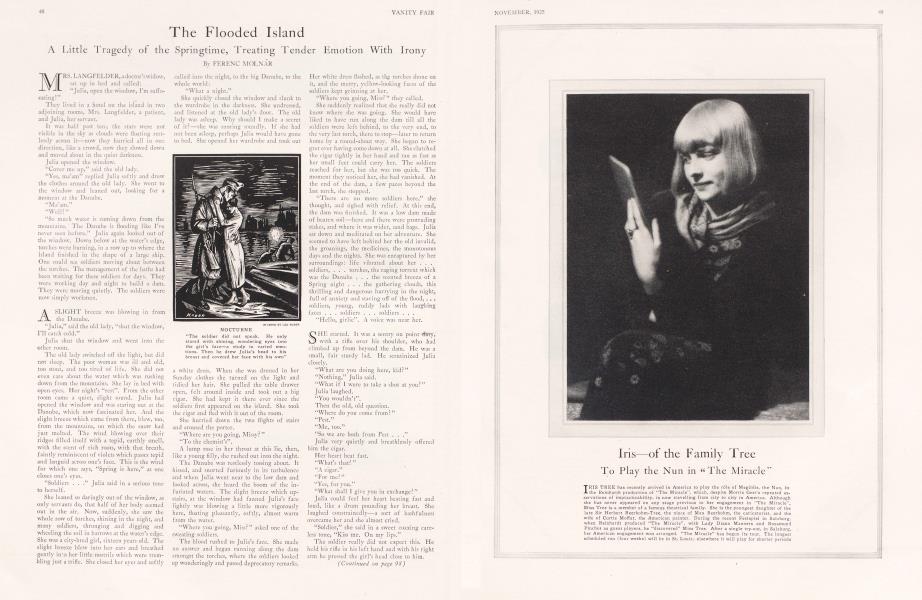
The soldier did not speak. He only | stared with shining, wondering eyes into the girl's face—a study in varied emotions. Then he drew Julia's head to his breast and covered her face with his own.
"Why aren't you a Hussar?" whispered the poor bewildered girl. He wanted to reply, but suddenly he raised his head. A roar echoed f rom the point of the island. The girl looked up, startled.
"What's that?"
The soldier let go of the girl and looked towards the point of the island. The poor lad knew what had happened. It was the water, the big yellow water which had come down from the mountains. His orders were to watch the dam and to fire a shot as a signal as soon as the water began to gnaw away the beaten earth. He had done patrol duty since two o'clock in the afternoon. Twice the wall of the dam began to give way, he had signaled with his rifle. Then the soldiers had run with spades and mended the breaks. But now he gave no signal.
The water was oozing out. The cracks in the dam shone in large patches in the darkness. Here and there was a muffled splashing and sputtering. Large pieces fell off the dam into the water. The shrill hissing noise became gradually louder. Suddenly the dam gave way and the water broke through, carrying everything before it. It swept away the stakes and sand bags, then rushed over the island, dashing forward as if the whole Danube wanted to devour this small piece of land.
The girl screamed and ran away from the path of the torrent. The soldier turned his head, a moment, in the direction where she had disappeared. The girl fled like a white butterfly towards the torches. There was sudden confusion. One could hear the officers' voices above the gradually lessening roar of the waters. "Run, run . . ." The soldiers hurried towards the hotel, the white butterfly amongst them. The hero of the little romance was standing like a stone figure. He was to blame for everything.
He muttered something to himself, as the water began to circle around his ankles. He still could have run away, but did not.
He remained obstinately there, the rising water began to sway him. He lost his balance and fell face down in the muddy water. "The girl ran away," was his only and bitter thought. He began to fight against the flood, but it caught him, and tossed him about like a bobbing cork.
He cried weakly for help and tried to struggle to his feet. The water struck him down again and again. For a moment lie was completely submerged. Then his head appeared again. He shouted:
"Girlie—I am dying, girlie!"
Another rush of water overpowered him and he did not come up any more. This was fresh, violent, cold, hard, water from the mountains. One could not trifle with it. It rushed on.
"Julia, Julia," called the old woman, "what's the matter?"
As Julia entered, she said simply:
"The island is flooded."
The old lady began to cry from fright. Julia opened the window and gazed out.
The hotel was surrounded in a sea of water. The soldier was being slowly moved about at the bottom of it, with his eyes open, amid stone and gravel, with a rifle gripped in his hand.
Julia trembled, thinking of his lips.
"He is dead. I shall die, too," she said, and hot tears ran down her face.
At daybreak she was still gazing at the big water. She grew suddenly tired, for she was young and healthy, and fell asleep until it was time to make breakfast. There were no longer any soldiers on the island; they had returned to the barracks. The old ladv drank her chocolate and spread butter and honey on her bread. But Julia was ironing a white linen blouse in the next room, which she had received from the old lady's daughter, as a present for looking after her charge so well. She dropped a few tears onto the blouse, but erased them immediately with the hot iron. Then there was no trace. And how little water this was when compared to that which came from the mountains!
And yet even that dries up.
Subscribers have complete access to the archive.
Sign In Not a Subscriber?Join Now
