Sign In to Your Account
Subscribers have complete access to the archive.
Sign In Not a Subscriber?Join NowThe Ultimate Fat-Head, the Most Important Man in the World
Our Special Investigators Report that He Does not Actually Exist
LUCIEN BLUPHOCKS
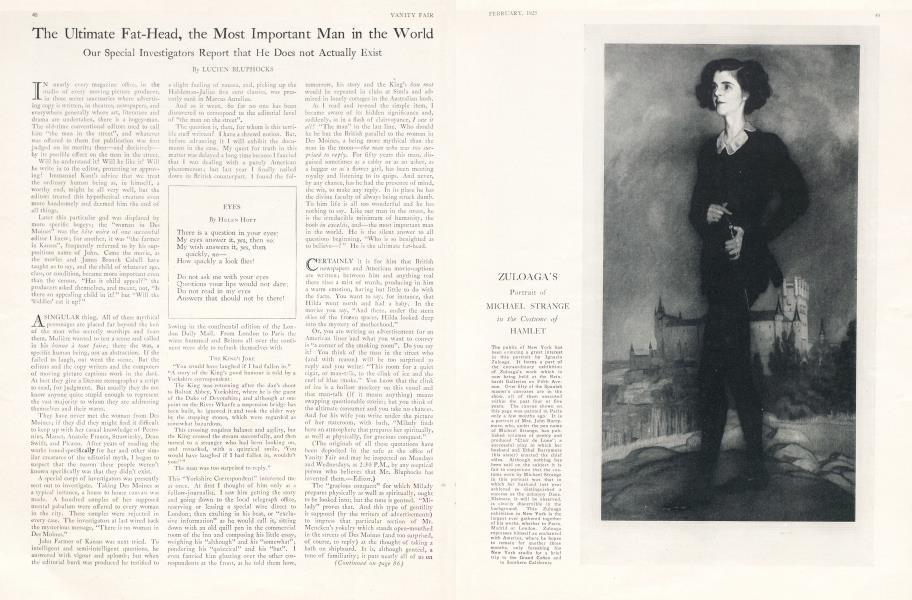
IN nearly every magazine office, in the studio of every moving picture producer, in those secret sanctuaries where advertising copy is written, in theatres, newspapers, and everywhere generally where art, literature and drama are undertaken, there is a bogey-man. The old-time conventional editors used to call him "the man in the street", and whatever was offered to them for publication was first judged on its merits; then—and decisively— by its possible effect on the man in the street.
Will he understand it? Will he like it? Will he write in to the editor, protesting or approving? Immanuel Kant's advice that we treat the ordinary human being as, in himself, a worthy end, might be all very well, but the editors treated this hypothetical creature even more handsomely and deemed him the end of all things.
Later this particular god was displaced by more specific bogeys; the "woman in Des Moines" was the bete noire of one successful editor I knew; for another, it was "the farmer in Kansas", frequently referred to by his suppositious name of John. Came the movie, as the movies and James Branch Cabell have taught us to say, and the child of whatever age, class, or condition, became more important even than the censor. "Has it child appeal?" the producers asked themselves, and meant, not, "Is there an appealing child in it?" but "Will the 'kiddies' eat it up?"
A SINGULAR thing. All of these mythical personages are placed far beyond the ken of the man who secretly worships and fears them. Molière wanted to test a scene and called in his bonne a tout faire; there she was, a specific human being, not an abstraction. If she failed to laugh, out went the scene. But the editors and the copy writers and the composers of moving picture captions work in the dark. At best they give a literate stenographer a script to read, for judgment. But usually they do not know anyone quite stupid enough to represent the vast majority to whom they are addressing themselves and their wares.
They have never met the woman from Des Moines; if they did they might find it difficult to keep up with her casual knowledge of Petronius, Manet, Anatole France, Strawinsky, Dean Swift, and Picasso. After years of reading the works issued specifically for her and other similar creatures of the editorial myth, I began to suspect that the reason these people weren't known specifically was that they didn't exist.
A special corps of investigators was presently sent out to investigate. Taking Des Moines as a typical instance, a house to house canvass was made. A hundred samples of her supposed mental pabulum were offered to every woman in the city. These samples were rejected in every case. The investigators at last wired back the mysterious message, "There is no woman in Des Moines."
John Farmer of Kansas was next tried. To intelligent and semi-intelligent questions, he answered with vigour and aplomb; but when the editorial bunk was produced he testified to a slight feeling of nausea, and, picking up the Haldeman-Julius five cent classics, was presently sunk in Marcus Aurelius.
And so it went. So far no one has been discovered to correspond to the editorial level of "the man on the street".
The question is, then, for whom is this terrible stuff written? I have a shrewd notion. But, before advancing it I will exhibit the documents in the case. My quest for truth in this matter was delayed a long time because 1 fancied that I was dealing with a purely American phenomenon; but last year I finally nailed down its British counterpart. I found the following in the continental edition of the London Daily Mail. From London to Paris the wires hummed and Britons all over the continent were able to refresh themselves with
THE KING'S JOKF.
"You would have laughed if I had fallen in." "A story of the King's good humour is told by a Yorkshire correspondent:
The King was returning after the day's shoot to Bolton Abbey, Yorkshire, where he is the guest of the Duke of Devonshire; and although at one point on the River Wharfe a suspension bridge has been built, he ignored it and took the older way bv the stepping stones, which were regarded as somewhat hazardous.
This crossing requires balance and agility, but the King crossed the stream successfully, and then turned to a stranger who had been looking on, and remarked, with a quizzical smile, 'You would have laughed if I had fallen in, wouldn't you?'"
The man was too surprised to reply."
This "Yorkshire Correspondent" interested me at once. At first I thought of him only as a fellow-journalist. I saw him getting the story and going down to the local telegraph office, reserving or leasing a special wire direct to London; then exulting in his beat, or "exclusive information" as he would call it, sitting down with an old quill pen in the commercial room of the inn and composing his little essay, weighing his "although" and his "somewhat"; pondering his "quizzical" and his "but". I even fancied him gloating over the other correspondents at the front, as he told them how, tomorrow, his story and the King's bon mot would be repeated in clubs at Simla and admired in lonely cottages in the Australian bush.
As I read and re-read the simple item, I became aware of its hidden significance and, suddenly, as in a flash of clairvoyance, I sazv it all! "The man" in the last line. Who should he be but the British parallel to the woman in Des Moines, a being more mythical than the man in the moon—the man who was too surprised to reply. For fifty years this man, disguised sometimes as a cabby or as an usher, as a beggar or as a flower girl, has been meeting royalty and listening to its quips. And never, by any chance, has he had the presence of mind, the wit, to make any reply. In its place he has the divine faculty of always being struck dumb. To him life is all too wonderful and he has nothing to say. Like our man in the street, he is the irreducible minimum of humanity, the boob in excelsis, and—the most important man in the world. He is the silent answer to all questions beginning, "Who is so benighted as to believe—?" He is the ultimate fat-head.
CERTAINLY it is for him that British newspapers and American movie-captions are written; between him and anything real there rises a mist of words, producing in him a warm emotion, having but little to do with the facts. You want to say, for instance, that Hilda went north and had a baby. In the movies you say, "And there, under the stern skies of the frozen spaces, Hilda looked deep into the mystery of motherhood."
Or, you are writing an advertisement for an American liner and what you want to convey is "a corner of the smoking room". Do you say it? You think of the man in the street who (and with reason) will be too surprised to reply and you write: "This room for a quiet cigar, or man-t?lk, to the clink of ice and the curl of blue smoke." You know that the clink of ice is a hollow mockery on this vessel and that man-talk (if it means anything) means swapping questionable stories; but you think of the ultimate consumer and you take no chances. And for his wife you write under the picture of her stateroom, with bath, "Milady finds here an atmosphere that prepares her spiritually, as well as physically, for gracious conquest."
(The originals of all these quotations have been deposited in the safe at the office of Vanity Fair and may be inspected on Mondays and Wednesdays, at 2:30 P.M., by any sceptical person who believes that Mr. Bluphocks has invented them.—Editor.)
The "gracious conquest" for which Milady prepares physically as well as spiritually, ought to be looked into; but the tone is genteel. "Milady" proves that. And this type of gentility is supposed (by the writers of advertisements) to impress that particular section of Mr. Mencken's yokelry which stands open-mouthed in the streets of Des Moines (and too surprised, of course, to reply) at the thought of taking a bath on shipboard. It is, although genteel, a tone of familiarity; it puts nearly all of us on a par with movie queens and realtors who always have a suite on their Voyages. It is related to the equally entertaining highfalutin advertisements in which the catch is that you never call anything by its right name, in which two pieces of ground for a building become "our plottage", in which apartments are not vulgarly "for rent", but "available"; and the box in which Milady's perfume is packed becomes a "container". Nor is it limited to the luxury trade. There is a tailor in New York who advertises "Prince of Wales Modes 2-Pants Suits".
(Continued on page 86)
(Continued, from page 48)
The Yorkshire correspondent and the man who doesn't recognize shoddy, if it is in the Prince of Wales modes, are brothers in the editorial mythology; and they can be reached through all sorts of different channels. Take, for a change, this sporting note from the austere London Times:
No horse looked better than London Cry, and, in spite of the fact that he had 181 lbs. more to carry than he had when he won the corresponding race last year, there was evidence of considerable confidence in his ability to score again. The race was run at a very slow pace—the time was much slower than that recorded by London Cry last year—and he could not match the sprinting ability of others in the last quarter of a mile. Had the gallop been a true one throughout, the leaders would have been coming back to him at this period, while his own superior stamina would have been asserting itself.
Now if, in the welter of hads and would-haves, this means anything at all, it means that the horse came in a bad fourth out of sheer contempt for the three horses which beat him—he simply couldn't be bothered to win from such inferior horses. You can hardly imagine the owner of London Cry evolving such a silly excuse. Yet the man who is too surprised to reply is supposed to require and accept this excuse—because the horse is owned by that same King whose ready wit has already been noted.
It seems to be the fortune of British Royalty to be attended, both at home and abroad, by correspondents endowed with this particular kind of fatheadedness. For, of course, neither the King nor the Prince is responsible for the slush that is printed about them. Here, for a final sample, is the Prince arriving in New York and having a good time kidding the reporters. And it comes out thus in the British papers:
Major Solbert and others had intended to act as buffers between the Prince and the interviewers; but the Prince stepped from the cabin so briskly that he left them behind. Emerging on deck, the Prince found himself surrounded by reporters, each with questions, many of which were absurd. One asked him whether he knew anybody who would take the place of Sir Thomas Lipton as the challenger for the America's Cup. Another asked the inevitable question, whether the Prince was engaged.
Throughout the ordeal the Prince did not loose (sic) his charming smile. Only once did he show a flash of royal dignity. That was when someone asked about the report that he was anxious to learn poker. Still with a smile, the Prince replied, "Now you cut that out."
If cast-iron pincushions and celluloid fire-tongs are being given away, the man who thought out the phrase about royal dignity in connection with the Prince's remark is in line for a prize. Yet he and his editor both believe that millions of patriotic Britons would be pleased to regard the Prince in a noble light because of a dignified rebuke to an impertinent American. He and his editor cling to the illusion of the man who is too surprised to reply, just as our editors cling to the illusion of the woman in Des Moines. They have to.
American newspapers are a bit more sophisticated. During the recent campaign I ran across an enchanting story about Coolidge giving Henry Ford an old oaken bucket and Ford saying that this was the best thing he had got since he got Mrs. Ford. But in general you have to go elsewhere to get the appeal to the fathead in all its fatuity. Here is a specimen page from a house organ issued by a large New York manufacturing company. It begins:
"This is a special coloured number. We like coloured folks; we want their vote and we want their trade. We want our coloured friends to laugh with us at these coloured jokes", the thing goes on with fifteen pages of "coloured jokes", of which this is the first:
"Mandy, what fo' does you-all buy another box of shoe polish? You done buy one yesterday."
"Sho' chile, dat ain't shoe polish. Dat's mah face cream."
Well, this story must have appealed to some one or it would not have been published. It is supposed to appeal to the woman in Des Moines; the lady who simply doesn't exist. It is supposed to make millions laugh, but they don't. It, and the other items in my list, point inevitably to one conclusion. As I said, I have an answer; I can offer a really adequate answer to the question; "For whom are these things published? "
The answer is,—for the editors themselves. They are their own critics. They pretend to be worried about these mythical readers and buyers and patrons; but, at bottom, they have no knowledge that these people exist. They know only their own minds. They are themselves the man in the street, the woman in Des Moines, openmouthed and too surprised to reply to their own witticisms. And, by pleasing themselves they may eventually succeed in creating the kind of public which they can now only imagine.
Subscribers have complete access to the archive.
Sign In Not a Subscriber?Join Now
