
Sign In to Your Account
Subscribers have complete access to the archive.
Sign In Not a Subscriber?Join NowWine: A Tribute
The Need for Discrimination in Vintages in the Interest of Elegant Accomplishment
A. B. WALKLEY
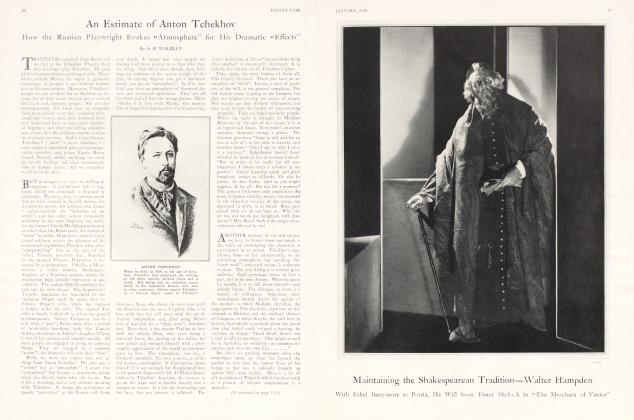
AFTER months of sick-room I have just been allowed my first sip of wine. Red ine I mean, the juice of the grape (to be precise, the renowned Pinot grape) a Gorton Clos du Roi, bought at the last Hospices de Beaune auction-sale in the fair country of France. Only a sip, but the Burgundians say their fine wines should always be sipped, which seems to justify my doctor, who can hardly, however, have practised what he preached, as he coolly finished the rest of the bottle. But what a combination of sensations in that sip! Que de choses dans un moment! And not merely physical sensations, but purely aesthetic impressions, for the wise man never drinks a fine wine just to slake his thirst or, indeed, solely to gratify his palate, but to enjoy the literary and historic associations that cluster round any really "great" wine. The wise man, I say, but how few men have this wine-wisdom, how few merely the Socratic wisdom to know when they are ignorant! Men suppose themselves to be drinking Burgundy because that name is on the bottle coupled with that of some Californian or Australian source, which is obviously off the French map. It would be no bad thing if a little wine-geography could be taught in our schools, for future use.
ONE might early learn the situation of the Cote de Dijon, the Cote de Beaune, and the Cote d'Or. The future joys of travelling, not to mention wine-bibbing, would be all the sweeter for such preliminary knowledge. I motored through Burgundy the year before the war, and saw those historic Cotes and the Clos at whose gates the pining French regiment stands to arms and salutes, and wandered, an enchanted vagrant, over all that pleasant countryside, using as a point de repere the Hotel de la Cloche at Dijon. And there I heard a story of an American tourist who naively asked the landlord whether he preferred Claret or Burgundy—this in the very heart of Burgundy itself!—and was answered in terms not suitable for print:
But the most peculiar charm of my experience was not the vinosity of it, so to speak, but the blend of that with so many other ajsociations, mainly bookish, of course, as a bookman's are apt to be, which spiritualized the mere flavour of the grape. We had passed by the ruins of Buffon's chateau and tower at Montbard—Buff on, who openly preferred the petits vins of his own cote to all the illustrious vintages that grew further south—and noted the spot, not a whit less sacred to me—where the Abbe Coignard fell under the dagger of the Jew Mo'ise in Anatole France's most characteristic book. We journeyed on, always through vine-clad hills, to Semur-en-Auxois, celebrated for memories of Mme. de Sevigne and her cousin Bussy, till we found in a chateau hard by one of those American friends who, settling down in Europe, become just a little more European than the natives, plus Arabes que PArabic, and who, in this choice instance, speedily got to know more about Burgundy wines than the Burgundians themselves—or would have you think so—but I must not give my friend away. At Dijon I drank, upon his advice, an incomparable Mo?itrachet, surely one of the finest of white wines, and carefully refrained from troubling mine host of the Cloche with inopportune comparisons of Burgundy and Claret.
. . . Heigh ho! Those things happened in the year before the war—an incredibly happy time. I never sip Burgundy now without seeing in my mind's eye the pepper-box towers of Semur-en-Auxois and hearing the cheery tones of my Gallicised American friend.
I have not been digressing. My journey was through what is the classic Province of France for nearly all expert wine-drinkers (though truth compels me to add that, with the exception of Chablis, the very first crus of the classic Province are found southward ol my route, i.e. between Dijon and Beaune— among them that Greves jpnfant Jesus which is surely the very choicest of red Burgundies and can still, I rejoice to think, be brought to table at the Athenaeum in Pall Mall).
But it is time, someone will say, I ceased celebrating full-flavoured Burgundy and paid my tribute to the tamer, many will say, but perhaps more delicate delights of Claret. Far be it from me to undervalue those delights. The poet Keats used to cover his tongue with pepper, the better, he said, to taste the flavour of "cool, delicious ClaretWell, poets have queer notions of wine. For mere prosers, peppering the tongue is not perhaps the best preparation for the palate. Nor is the "coolness" of Claret, except in the dogdays, a recommendation. Let it be of the temperature of the room, and have stood in it for, say, twenty-four hours before being brought to table—also, see that the wine-waiter doesn't omit to bring you the cork with the decanted wine. That will be absolutely trustworthy evidence of the wine's origin and birth-year, for French law on the subject is admirably strict. Talking of the wily wine-waiter, I remember one of them bringing with pompous parade of care a bottle of Burgundy in its "cradle" in a Boulevard restaurant to another American friend (what, another, you say! Yes, I am fortunate enough to possess many American friends) who solemnly proceeded to shake the bottle! To the wine-waiter's protests he merely replied, "Why, haven't you been shaking it yourself all the way up from the cellar?" This tribute to the virtue of perfect sincerity, I may add, hardly made up to me for the shaken wine.
"Claret for boys," said Dr. Johnson, in an age when Claret was probably thinner than now, being less well cared for (and largely drunk by Scotchmen, who were not particularly good judges), "port for men, brandy for heroes!" There is something in this comparison of port with brandy—of which, indeed, it for the most part consists—but nothing in that of Claret with either. Claret is notoriously freer from alcohol than any other fermented juice of the grape. My titular subject is wine—to which questions of alcoholic value are wholly irrelevant. Just there is the distinction between the connoisseur of wine and the wine guzzler. The one drinks, or rather sips, to gratify his palate, and at the same time his aesthetic tastes, he judiciously combines the spiritual with the material in his pleasures, further, he is deliberately carrying on a great world-tradition, "older than any history that is written in any book", the tradition of wine-wisdom, whereas the other is merely drinking for drink's sake, seeking alcoholic excitement like the fool that he is. Men of sense and good will, all the world over, ought to bind themselves together to revive that indispensable pendant to Fidding's Art of Polite Eating which is the Art of Polite Drinking before it has passed away among the lost arts. The world is now being given over to vulgar guzzlers and other such lewd fellows of the baser sort. There is of course a tacit combination already, where men meet together in Clubs and Regimental Messes and College Commons Rooms and drink wisely with a certain ritual befitting the antiquity of their potations. What I should like to see would be the democratisation of this quasiacademic wisdom—in the interest of rational pleasure and elegant accomplishment—to shame the topers.
(Continued on page 110)
Continued from page 81
Subscribers have complete access to the archive.
Sign In Not a Subscriber?Join Now
