
Sign In to Your Account
Subscribers have complete access to the archive.
Sign In Not a Subscriber?Join NowA Little Supper with Miss Smith
A Record of the Most Famous Poisoning Case in Scottish Judicial History
EDMUND PEARSON
THE recipe for a successful murder, for which I am often besought, is this: you should live, up to the time of the commission of the murder, an absolutely correct and moral life. More than that, you should be eminent for good works. Make no ingenious plans for concealment, nor for an alibi; procure the implements openly.
There is an alternative method: take care to be a pretty woman, and let the victim be a man,—any man you choose. If you can, in some degree, combine these two plans you need worry not at all.
Consider the case of Miss Madeleine Smith, and remember that it occurred not in sentimental America of today, but in the practical and religious Scotland of 1857.
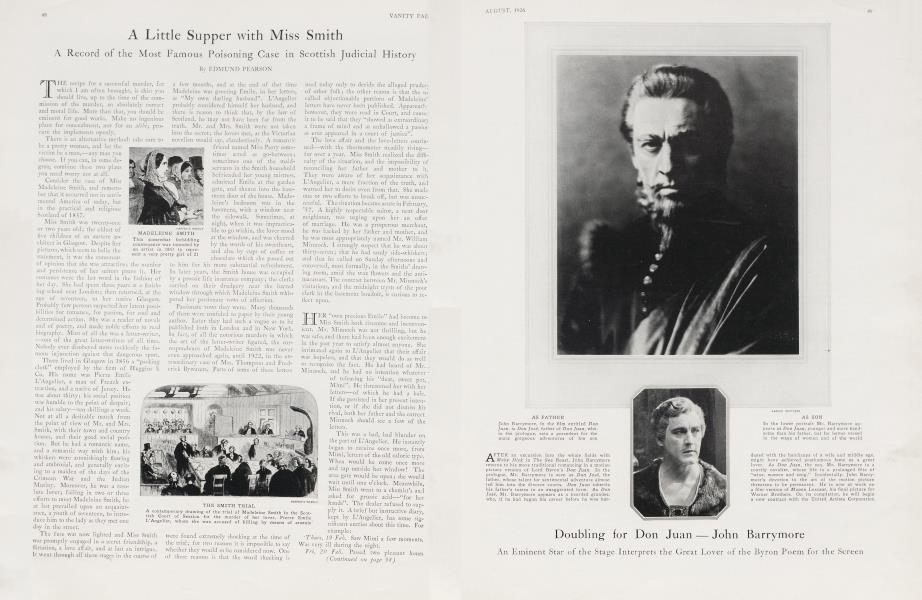
Miss Smith was twenty-one or two years old; the eldest of five children of an austere architect in Glasgow. Despite her pictures, which seem to belie the statement, it was the consensus of opinion that she was attractive; the number and persistence of her suitors prove it. Her costumes were the last word in the fashion of her day. She had spent three years at a finishing school near London; then returned, at the age of seventeen, to her native Glasgow. Probably few persons suspected her latent possibilities for romance, for passion, for cool and determined action. She was a reader of novels and of poetry, and made noble efforts to read biography. Most of all she was a letter-writer, —one of the great letter-writers of all time. Nobody ever disobeyed more recklessly the famous injunction against that dangerous sport.
There lived in Glasgow in 1856 a "packing clerk" employed by the firm of Huggins & Co. His name was Pierre Emile L'Angelier, a man of French extraction, and a native of Jersey. He was about thirty; his social position was humble to the point of despair; and his salary—ten shillings a week.
Not at all a desirable match from the point of view of Mr. and Mrs. Smith, with their town and country houses, and their good social position. Rut he had a romantic name, and a romantic way with him; his whiskers were astonishingly flowing and ambrosial, and generally exciting to a maiden of the days of the Crimean War and the Indian Mutiny. Moreover, he was a resolute lover; failing in two or three efforts to meet Madeleine Smith, he at last prevailed upon an acquaintance, a youth of seventeen, to introduce him to the lady as they met one day in the street.
The fuse was now lighted and Miss Smith was promptly engaged in a secret friendship, a flirtation, a love affair, and at last an intrigue. It went through all these stages in the course of a few months, and at the end of that time Madeleine was greeting Emile, in her letters, as "My own darling husband". L'Angelier probably considered himself her husband, and there is reason to think that, by the law of Scotland, he may not have been far from the truth. Mr. and Mrs. Smith were not taken into the secret; the lovers met, as the Victorian novelists would say, clandestinely. A romantic friend named Miss Perry sometimes acted as go-between; sometimes one of the maidservants in the Smith household befriended her young mistress, admitted Emile at the garden gate, and thence into the basement door of the house. Madeleine's bedroom was in the basement, with a window near the sidewalk. Sometimes, at night, when it was impracticable to go within, the lover stood at the window, and was cheered by the words of his sweetheart, and also by cups of coffee or chocolate which she passed out to him for his more substantial refreshment. In later years, the Smith house was occupied by a prosaic life insurance company; the clerks carried on their drudgery near the barred window through which Madeleine Smith whispered her passionate vows of affection.
Passionate vows they were. Many thousands of them were confided to paper by their young author. Later they had such a vogue as to be published both in London and in New York. In fact, of all the notorious murders in which the art of the letter-writer figured, the correspondence of Madeleine Smith was never even approached again, until 1922, in the extraordinary case of Mrs. Thompson and Frederick Bywaters. Parts of some of these letters were found extremely shocking at the time of the trial; for two reasons it is impossible to say whether they would so be considered now. One of these reasons is that the word shocking is used today only to deride the alleged pruden of other folk; the other reason is that the so called objectionable portions of Madeleine' letters have never been published. Apparently however, they were read in Court, and causec it to be said that they "showed as extraordinary a frame of mind and as unhallowed a passion as ever appeared in a court of justice".
The love affair and the love-letters continued—with the thermometer steadily rising— for over a year. Miss Smith realized the difficulty of the situation, and the impossibility of reconciling her father and mother to it. They were aware of her acquaintance with L'Angelier, a mere fraction of the truth, and warned her to desist even from that. She made one or two efforts to break off, but was unsuccessful. The situation became acute in February, '57. A highly respectable suitor, a next door neighbour, was urging upon her an offer of marriage. He was a prosperous merchant, he was backed by her father and mother, and he was most appropriately named Mr. William Minnoch. I strongly suspect that he was about thirty-seven; that he had sandy side-whiskers; and that he called on Sunday afternoons and conversed, most formally, in the Smiths' drawing room, amid the wax flowers and the antimacassars. The contrast between Mr. Minnoch's visitations, and the midnight trysts of the poor clerk in the basement boudoir, is curious to reflect upon.
HER "own precious Emile" had become to Miss Smith both tiresome and inconvenient. Mr. Minnoch was not thrilling, but he was safe, and there had been enough excitement in the past year to satisfy almost anyone. She intimated again to L'Angelier that their affair . was hopeless, and that they would do as well to recognize the fact. He had heard of Mr. . Minnoch, and he had no intention whatever of releasing his "dear, sweet pet, Mimi". He threatened her with her letters—of which he had a bale. If she persisted in her present intention, or if she did not dismiss his rival, both her father and the correct Minnoch should see a few of the letters.
This was a bad, bad blunder on the part of L'Angelier. He instantly began to receive once more, from Mimi, letters of the old caloric type. When would he come once more and tap outside her window? The area gate would be open; she would wait until one o'clock. Meanwhile, Miss Smith went to a chemist's and asked for prussic acid—"for her hands". The dealer refused to supply it. A brief but instructive diary, kept by L'Angelier, has some significant entries about this time. For example:
'Thurs. 19 Feb. Saw Mimi a few moments. Was very ill during the night.
Fri. 20 Feb. Passed two pleasant hours Conutinued on page 98 with M. in the Drawing Room.
Continued from page 48
Sat. 21 Feb. Don't feel well.
Sun. 22 Feb. Saw Mimi in Drawing Room. Promised me French Bible. Taken very ill.
Miss Smith made at least two calls upon a chemist in Glasgow, to buy arsenic for the confusion of these rats. There was a little delay, but not much; she signed the book at the chemist's, with her own name, and was allowed the poison.
Mrs. Jenkins, L'Angelier's landlady, began to be concerned about him. He would go out of an evening, apparently to make a call—he was understood to be courting a young lady— and would be found by Mrs. Jenkins toward two or three o'clock the next morning writhing in pain on his bedroom floor.
On March 18, Miss Smith made a third purchase of arsenic. A few days later Mrs. Jenkins was awakened by her lodger's ring. L'Angelier came in, and he was in a terribly bad way. About nine o'clock, he was dead. Madeleine's letters were discovered in his room. That young lady fled to the country, but was brought back to Glasgow by her brother. L'Angelier's body contained an enormous amount of arsenic, —enough to kill twenty men.
Legally, the proceedings were a triumph, because the verdict was in accordance with the evidence. The diary of L'Angelier was excluded. The dates of all the purchases of arsenic could not be connected with her lover's illnesses in a thoroughly satisfactory fashion (although some of them were) ; and on the last night of all it could not be proven that Mimi and Emile had actually been together. He was traced to within a hundred yards of the house; nobody on earth doubts that they met, nor how Mimi had flavoured the chocolate on that occa.ii.u,—but the law is the law.
Subscribers have complete access to the archive.
Sign In Not a Subscriber?Join Now
