Sign In to Your Account
Subscribers have complete access to the archive.
Sign In Not a Subscriber?Join NowOur Debt to Hollywood
What the Inferior Races Learn of White Civilization from Motion Pictures
ALDOUS HUXLEY
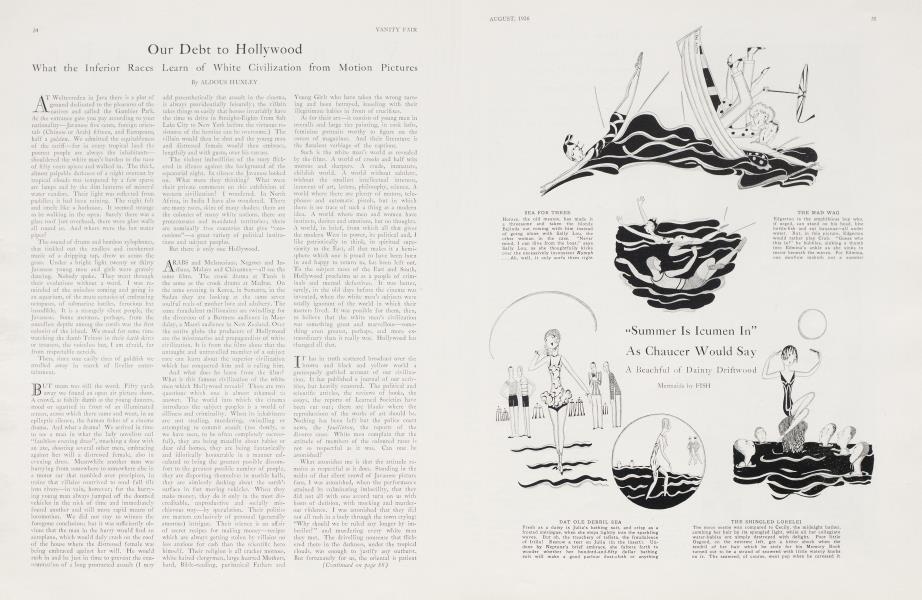
AT Weltevreden in Java there is a plot of ground dedicated to the pleasures of the natives and called the Gambier Park. At the entrance gate you pay according to your nationality—Javanese five cents, foreign orientals (Chinese or Arab) fifteen, and Europeans, half a gulden. We admitted the equitablencss of the tariff—for in every tropical land the poorest people are always the inhabitants— shouldered the white man's burden to the tune of fifty cents apiece and walked in. The thick, almost palpable darkness of a night overcast by tropical clouds was tempered by a few sparse arc lamps and by the dim lanterns of mineral water vendors. Their light was reflected from puddles; it had been raining. The night felt and smelt like a hothouse. It seemed strange to be walking in the open. Surely there was a glass roof just overhead, there were glass walls all round us. And where were the hot water pipes?
The sound of drums and bamboo xylophones, that tinkled out the endless and incoherent music of a dripping tap, drew us across the grass. Under a bright light twenty or thirty Javanese young men and girls were gravely dancing. Nobody spoke. They went through their evolutions without a word. I was reminded of the noiseless coming and going in an aquarium, of the mute ecstasies of embracing octopuses, of submarine battles, ferocious but inaudible. It is a strangely silent people, the Javanese. Some merman, perhaps, from the soundless depths among the corals was the first colonist of the island. We stood for some time watching the dumb Tritons in their batik skirts or trousers, the voiceless but, I am afraid, far from respectable nercids.
Then, since one easily tires of goldfish we strolled away in search of livelier entertainment.
BUT mum was still the word. Fifty yards away we found an open air picture show. A crowd, as fishily dumb as the young dancers, stood or squatted in front of an illuminated screen, across which there came and went, in an epileptic silence, the human fishes of a cinema drama. And what a drama! We arrived in time to see a man in what the lady novelists call "faultless evening dress", smashing a door with an axe, shooting several other men, embracing against her will a distressed female, also in evening dress. Meanwhile another man was hurrying from somewhere to somewhere else in a motor car that tumbled over precipices, in trains that villains contrived to send full tilt into rivers—in vain, however; for the hurrying young man always jumped off the doomed vehicles in the nick of time and immediately found another and still more rapid means of locomotion. We did not stay to witness the foregone conclusion; but it was sufficiently obvious that the man in the hurry would find an aeroplane, which would duly crash on the roof of the house where the distressed female was being embraced against her will. He would rush in and be just in time to prevent the consummation of a long protracted assault (I may add parenthetically that assault in the cinema, is always providentially leisurely; the villain takes things so easily that heroes invariably have the time to drive in Straight-Eights from Salt Lake City to New York before the virtuous resistance of the heroine can be overcome.) The villain would then be shot and the young man and distressed female would then embrace, lengthily and with gusto, over his carcass.
The violent imbecilities of the story flickered in silence against the background of the equatorial night. In silence the Javanese looked on. What were they thinking? What were their private comments on this exhibition of western civilization? I wondered. In North Africa, in India I have also wondered. There are many races, skins of many shades; there are the colonies of many white nations, there are protectorates and mandated territories; there are nominally free countries that give "concessions"—a great variety of political institutions and subject peoples.
But there is only one Hollywood.
ARABS and Melanesians, Negroes and Indians, Malays and Chinamen—all see the same films. The crook drama at Tunis is the same as the crook drama at Madras. On the same evening in Korea,, in Sumatra, in the Sudan they are looking at the same seven soulful reels of mother love and adultery. The same fraudulent millionaires are swindling for the diversion of a Burmese audience in Mandalay, a Maori audience in New Zealand. Over the entire globe the producers of Hollywood are the missionaries and propagandists of white civilization. It is from the films alone that the untaught and untravelled member of a subject race can learn about the superior civilization which has conquered him and is ruling him.
And what docs he learn from the films? What is this famous civilization of the white men which Hollywood reveals? These arc two questions which one is almost ashamed to answer. The world into which the cinema introduces the subject peoples is a world of silliness and criminality. When its inhabitants are not stealing, murdering, swindling or attempting to commit assault (too slowly, as we have seen, to be often completely successful), they are being maudlin about babies or dear old homes, they are being fantastically and idiotically honourable in a manner calculated to bring the greatest possible discomfort to the greatest possible number of people, they are disporting themselves in marble halls, they are aimlessly dashing about the earth's surface in fast moving vehicles. When they make money, they do it only in the most discreditable, unproductive and socially mischievous way—by speculation. Their politics arc matters exclusively of personal (generally amorous) intrigue. Their science is an affair of secret recipes for making money—recipes which are always getting stolen bv villains no less anxious for cash than the scientific hero himself. Their religion is all cracker mottoes, white haired clergymen, large hearted Mothers, hard, Bible-reading, puritanical Fathers and Young Girls who have taken the wrong turning and been betrayed, kneeling with their illegitimate babies in front of crucifixes.
As for their art—it consists of young men in overalls and large ties painting, in cock lofts, feminine portraits worthy to figure on the covers of magazines. And their literature is the flatulent verbiage of the captions.
Such is the white man's world as revealed by the films. A world of crooks and half wits morons and sharpers. A crude, immature, childish world. A world without subtlety, without the smallest intellectual interests, innocent of art, letters, philosophy, science. A world where there are plenty of motors, telephones and automatic pistols, but in which there is no trace of such a thing as a modern idea. A world where men and women have instincts, desires and emotions, but no thoughts. A world, in brief, from which all that gives the modern West its power, its political and, I like patriotically to think, its spiritual superiority to the East, all that makes it a hemisphere which one is proud to have been born in and happy to return to, has been left out. To the subject races of the East and South, Hollywood proclaims us as a people of criminals and mental defectives. It was better, surely, in the old days before the cinema was invented, when the white men's subjects were totally ignorant of the world in which their masters lived. It was possible for them, then, to believe that the white men's civilization was something great and marvellous—something even greater, perhaps, and more extraordinary than it really was. Hollywood has changed all that.
IT has in truth scattered broadcast over the brown and black and yellow world a grotesquely garbled account of our civilization. It has published a journal of our activities, but heavily censored. The political and scientific articles, the reviews of books, the essays, the reports of Learned Societies have been cut out; there are blanks where the reproductions of the works of art should be. Nothing has been left but the police court news, the feuilleton, the reports of the divorce cases. White men complain that the attitude of members of the coloured races is not so respectful as it was. Can one be astonished?
What astonishes me is that the attitude remains as respectful as it does. Standing in the midst of that silent crowd of Javanese picture fans, I was astonished, when the performance attained its culminating imbecility, that they did not all with one accord turn on us with hoots of derision, with mocking and murderous violence. I was astonished that they did not all rush in a body through the town crying: "Why should we be ruled any longer by imbeciles?" and murdering every white man they met. The drivelling nonsense that flickered there in the darkness, under the tropical clouds, was enough to justify any outburst. But fortunately for us, the oriental is patient and long-suffering. He is also cautious; for he knows, in the words of Hilaire Belloc, that Whatever happens, we have got The Maxim gun, and they have not— "we" being the whites.
Continued on page 88
Continued from page 34
Maxim guns can check actions, but they cannot control thoughts. The coloured peoples think a great deal less of us than they did, even though they may be too cautious to act on their opinions. For this state of affairs the motion pictures are not, of course, alone responsible. The spread of native education, the unedifying spectacle of the World War, the talk about self-determination and the sacredness of nationality, with the promises of liberation made and never carried into effect—these have done much, perhaps most. But the share of Hollywood in lowering the white man's prestige is by no means inconsiderable. A people whose own propagandists proclaim it to be mentally and morally deficient, cannot expect to be looked up to. If films were really true to life, the whole of Europe and America would deserve to be handed over as mandated territories to the Basutos, the Papuans and the Andaman pygmies. Fortunately, they are not true. We who were born in the West and live there, know it. But the untutored mind of the poor Indian does not know it. He sees the films, he thinks they represent western reality, he cannot see why he should be ruled by criminal imbeciles. As we turned, disgusted, from the idiotic spectacle and threaded our way out of the crowd, that strange aquarium silence of the,Javanese was broken by a languid snigger of derision. Nothing more. Just a little laugh, a word or two of mocking comment in Malay and then, once more, the silence as of fish. A few more years of Hollywood's propaganda, and perhaps we shall not get out of an oriental crowd quite so easily.
Subscribers have complete access to the archive.
Sign In Not a Subscriber?Join Now
