Sign In to Your Account
Subscribers have complete access to the archive.
Sign In Not a Subscriber?Join Now"While We Were Marching Through Java"
Some Notes from an Itinerant Iconoclast in the Romantic, if Dutch, East Indies
COREY FORD
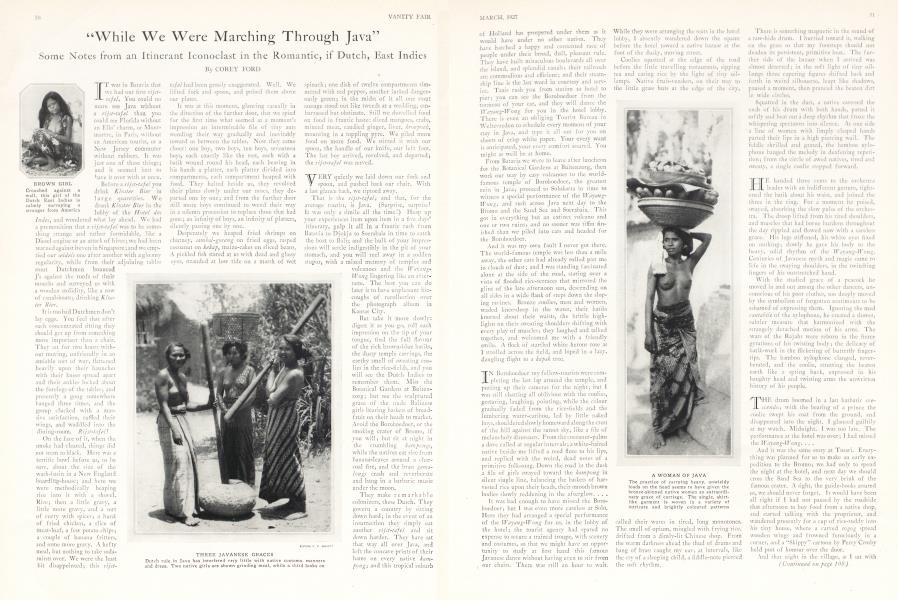
IT was in Batavia that we had our rijst-tafel. You could no more see Java without a rijst-tafel than you could see Florida without an Elks' charm, or Montmartre, in Paris, without an American tourist, or a New Jersey commuter without rubbers. It was just one of those things; and it seemed best to have it over with at once.
Before a rijst-tafel you drink Kloster Bier in large quantities. We drank Kloster Bier in the lobby of the Hotel des hides, and wondered what lay ahead. We had a premonition that a rijst-tafel was to be something strange and rather formidable, like a Diesel engine or an attack of hives; we had been warned against it even in Singapore; and we emptied our seidels one after another with a gloomy regularity, while from their adjoining tables stout Dutchmen bounced J's against the roofs of their mouths and surveyed us with a wooden stolidity, like a row of canal-boats; drinking Kloster Bier.
It is too bad Dutchmen don't lay eggs. You feel that after such concentrated sitting they should get up from something more important than a chair. They sat for two hours without moving, unfriendly in an amiable sort of way, flattened heavily upon their haunches with their knees spread apart and their ankles locked about the forelegs of the tables; and presently a gong somewhere banged three times, and the group clucked with a massive satisfaction, ruffled their wings, and waddled into the dining-room. Rijst-tafel!
On the face of it, when the smoke had cleared, things did not seem so black. Here was a terrific bowl before us, to be sure, about the size of the wash-basin in a New England boarding-house; and here we were methodically heaping rice into it with a shovel. Rice; then a little gravy, a little more gravy, and a sort of curry with spices; a hunk of fried chicken, a slice of meat-loaf, a few potato chips; a couple of banana fritters, and some more gravy. A hefty meal, but nothing to take soda-mints over. We were the least bit disappointed; this rijst- tafel had been grossly exaggerated. Well. We lifted fork and spoon, and poised them above our plates.
It was at this moment, glancing casually in the direction of the further door, that we spied for the first time what seemed at a moment's impression an interminable file of tiny ants wending their way gradually and inevitably toward us between the tables. Now they came closer: one boy, two boys, ten boys, seventeen boys, each exactly like the rest, each with a batik wound round his head, each bearing in his hands a platter, each platter divided into compartments, each compartment heaped with food. They halted beside us, they revolved their plates slowly under our noses, they departed one by one; and from the further door still more boys continued to wend their way in a solemn procession to replace those that had gone; an infinity of boys, an infinity of platters, silently passing one by one.
Desperately we heaped fried shrimps on chutney, sambal-goreng on fried eggs, rasped cocoanut on kekap, maize-cakes on sliced beans. A pickled fish stared at us with dead and glassy eyes, stranded at low tide on a marsh of wet spinach; one dish of twelve compartments simmered with red pepper, another lurked dangerously green; in the midst of it all one stout sausage stood out like tweeds at a wedding, embarrassed but obstinate. Still we shovelled food or. food in frantic haste: sliced mangoes, crabs, minced meat, candied ginger, liver, kroepoek, mounting in a toppling pyre. We piled more food on more food. We stirred it with our spoon, the handle of our knife, our left foot. The last boy arrived, revolved, and departed; the rijst-tafel was served.
VFRY quietly we laid down our fork and V spoon, and pushed back our chair. With a last glance back, we tiptoed away.
That is the rijst-tafel; and that, for the average tourist, is Java. (Surprise, surprise! It was only a simile all the time!) Heap up your experiences item upon item in a five days' itinerary, gulp it all in a frantic rush from Batavia to Djokja to Soerabaia in time to catch the boat to Bali; and the bulk of your impressions will settle indigestibly in the pit of your stomach, and you will reel away in a sodden stupor, with a mixed memory of temples and volcanoes and the Wayang-Wong lingering like an aftertaste. The best you can do later is to have unpleasant hiecoughs of recollection over the photograph album in Kansas City.
But take it more slowly: digest it as you go, roll each impression on the tip of your tongue, find the full flavour of the rich brown-blue batiks, the dusty temple carvings, the earthy smell of sweating coolies in the rice-fields, and you will sec the Dutch Indies to remember them. Miss the Botanical Gardens at Buitenzorg; but see the sculptured grace of the nude Balinese girls bearing baskets of breadfruit on their heads to market. Avoid the Borobocdocr, or the smoking crater of Bromo, if you will; but sit at night in the crumbling kam pongs, while the natives cat rice from banana-leaves around a charcoal fire, and the brass gamalongs crash and reverberate and bang in a barbaric music under the moon.
They make remarkable colonizers, these Dutch. They govern a country by sitting down hard; in the event of an insurrection they simply eat another rijst-tafel and sit down harder. They have sat that way all over Java, and left the concave prints of their hams on every native hampong-, and this tropical suburb of Holland has prospered under them as it would have under no other nation. They have hatched a happy and contented race of people under their broad, dull, pleasant rule. They have built miraculous boulevards all over the island, and splendid canals; their railroads are commodious and efficient; and their steamship line is the last word in courtesy and service. Taxis rush you from station to hotel to pier; you can see the Borobocdoer from the tonneau of your car, and they will dance the Wayang-Wong for you in the hotel lobby. There is even an obliging Tourist Bureau in Weltevrcden to schedule every moment of your stay in Java, and type it all out for you on sheets of crisp white paper. Your every want is anticipated, your every comfort assured. You might as well be at home.
From Batavia we were to leave after luncheon for the Botanical Gardens at Buitcnzorg, then work our way by easy volcanoes to the worldfamous temple of Borobocdoer, the greatest ruin in Java; proceed to Solokarta in time to witness a special performance of the WayangWong; and rush across Java next day to the Bromo and the Sand Sea and Soerabaia. This got in everything but an extinct volcano and one or two ruins; and no sooner was tiffin finished than we piled into cars and headed for the Borobocdoer.
And it was my own fault I never got there. The world-famous temple was less than a mile away, the other cars had already rolled past me in clouds of dust; and I was standing fascinated alone at the side of the road, staring over a vista of flooded rice-terraces that mirrored the glint of the late afternoon sun, descending on all sides in a wide flank of steps down the sloping ravines. Bronze coolies, men and women, waded knee-deep in the water, their batiks knotted about their waists, the brittle highlights on their sweating shoulders shifting with every play of muscles; they laughed and talked together, and welcomed me with a friendly smile. A flock of startled white herons rose as I strolled across the field, and loped in a lazy, dangling flight to a kapak tree.
IN Borobocdoer my fellow-tourists were completing the last lap around the temple, and putting up their cameras for the night; but I was still chatting all oblivious with the coolies, gesturing, laughing, pointing, while the colour gradually faded from the rice-fields and the lumbering water-caribou, led by little naked bovs, shouldered slowly homeward along the crest of the hill against the sunset sky, like a file of melancholy dinosaurs. From the cocoanut-palms a dove called at regular intervals; a white-haired native beside me lifted a reed flute to his lips, and replied with the weird, dead notes of a primitive folk-song. Down the road in the dusk a file of girls swayed toward the kampong in silent single line, balancing the baskets of harvested rice upon their heads, their smooth brown bodies slowly reddening in the afterglow. . . .
It was bad enough to have missed the Boroboedoer; but I was even more careless at Solo. Here they had arranged a special performance of the Wayang-Wong for us, in the lobby of the hotel; the tourist agency had spared no expense to secure a trained troupe, with scenery and costumes, so that we might have an opportunity to study at first hand this famous Javanese dance without having even to stir from our chairs. There was still an hour to wait. While they were arranging the seats in the hotel lobby, I absently wandered down the square before the hotel toward a native bazaar at the foot of the dusky, moving street.
Coolies squatted at the edge of the road before the little travelling restaurants, sipping tea and eating rice by the light of tiny oil-lamps. Native fruit-venders, on their way to the little grass huts at the edge of the city, called their wares in tired, long monotones. The smell of opium, mingled with frying rice, drifted from a dimly-lit Chinese shop. From the warm darkness ahead the thud of drums and bang of brass caught my ear; at intervals, like the cry of a sleeping child, a fiddle-note pierced the soft rhythm.
'There is something magnetic in the sound of a raw-hide drum. I hurried toward it, walking on the grass so that my footsteps should not deaden its persistent, primitive beat. The further side of the bazaar when I arrived was almost deserted; in the soft light of tiny oil-lamps three capering figures shifted back and forth in weird silhouette, leapt like shadows, paused a moment, then pranced the beaten dirt in wide circles.
Squatted in the dust, a native caressed the ends of his drum with both hands, patted it softly and beat out a deep rhythm that froze the whispering spectators into silence. At one side a line of women with limply clasped hands parted their lips in a high piercing wail. The fiddle shrilled and grated, the bamboo xylophone banged the melody in deafening repetition; from the circle of awed natives, tired and sweaty, a single coolie stepped forward.
HE handed three cents to the orchestra leader with an indifferent gesture, tightened the batik about his waist, and joined the three in the ring. For a moment he poised, swayed, absorbing the slow pulse of the orchestra. The droop lifted from his tired shoulders, and muscles that had borne burdens throughout the day rippled and flowed now with a careless grace. His legs stiffened, his white eyes fixed on nothing; slowly he gave his body to the heavy, solid rhythm of the Wayang-Wong. Centuries of Javanese myth and magic came to life in the swaying shoulders, in the twitching fingers of his outstretched hand.
With the studied grace of a peacock he moved in and out among the other dancers, unconscious of his poor clothes, too deeply moved by the symbolism of forgotten sentiments to be ashamed of expressing them. Ignoring the mad cantabile of the xylophone, he created a slower, subtler measure that harmonized with the strangely detached motion of his arms. The wars of the Rajahs were reborn in the fierce gyrations of his twisting body; the delicacy of batik-work in the flickering of butterfly fingertips. File bamboo xylophone clanged, reverberated, and the coolie, strutting the beaten earth like a spring buck, expressed in his haughty head and twisting arms the unwritten history of his people.
THE drum boomed in a last barbaric crescendo; with the bearing of a prince the coolie swept his coat from the ground, and disappeared into the night. I glanced guiltily at my watch. Midnight. I was too late. The performance at the hotel was over; I had missed the Wayang-Wong. . . .
And it was the same story at Tosari. Everything was planned for us to make an early expedition to the Bromo; we had only to spend the night at the hotel, and next day we should cross the Sand Sea to the very brink of the famous crater. A sight, the guide-books assured us, we should never forget. It would have been all right if I had not paused by the roadside that afternoon to buy food from a native shop, and started talking with the proprietor, and wandered presently for a cup of rice-toddv into his tiny house, where a carved togog spread wooden wings and frowned ferociously in a corner, and a "Skippy" cartoon by Percy Crosby held post of honour over the door.
And that night in the village, as l sat with my host in the thatched council-room of the kampong, the dull chant of village boys sounded far-off. Before us about their charcoal fires the women sold rice-pellets wrapped in banana leaves, and the older men stroked and petted their fighting-cocks, and timid girls with frangipani blossoms in their dark hair drew their sarons about their breasts and smiled back from the shadows; and the dim village-square pulsed with the absorbed, earthy life of native Java that the tourist, wandering rapidly down a long museum of volcanoes and old statuary, never knows by day. . . .
Continued on page 108
Continued from page 51
In the lobby of the Oranje at Socrabaia, on our way to Bali, we met a group of American tourists who had just finished doing Java; and after we had discovered that we both subscribed to the Ne-M York Times and read the Daily Mirror (which made us first cousins, at least) we compared notes over a seidel of Kloster Bier on our journey through the Dutch East Indies. They were very shocked to find I had not seen the Boroboedoer. They had seen the Boroboedoer, they assured me. Was it the Boroboedoer, now? Yes, of course it was the Boroboedoer. See, here was the entry in their diary: "Saw the Boroboedoer. Hotel fair, excellent roads. Leaving tomorrow Djokjakarta. . . ."
And they could not understand how I had missed the Bromo. Of course they had seen the Bromo; they had a snap of it somewhere, taken from their car. The Bromo was that volcano, wasn't it? Yes. And hadn't I seen the Botanical Gardens at Buitenzorg? Boy, O, boy, I sure missed something there; I'd have liked the Botanical Gardens at Buitenzorg. They're the biggest in the world, it says. But of course I must have done the Sultan's Palace at Djokja? No? The Sand Sea? Papandajan?
They looked at me with puzzled expressions. No volcanoes; no temples. Hell, man, I hadn't seen Java. Think of coming all this way and then missing the Boroboedoer! Ha. They shook their heads, and emptied their seidels of Kloster Bier; and presently a gong somewhere banged three times, and the group clucked with a massive satisfaction, ruffled their wings, and waddled into the dining-room.
Rijst-tafel!
Subscribers have complete access to the archive.
Sign In Not a Subscriber?Join Now

