Sign In to Your Account
Subscribers have complete access to the archive.
Sign In Not a Subscriber?Join NowThe New Comfort
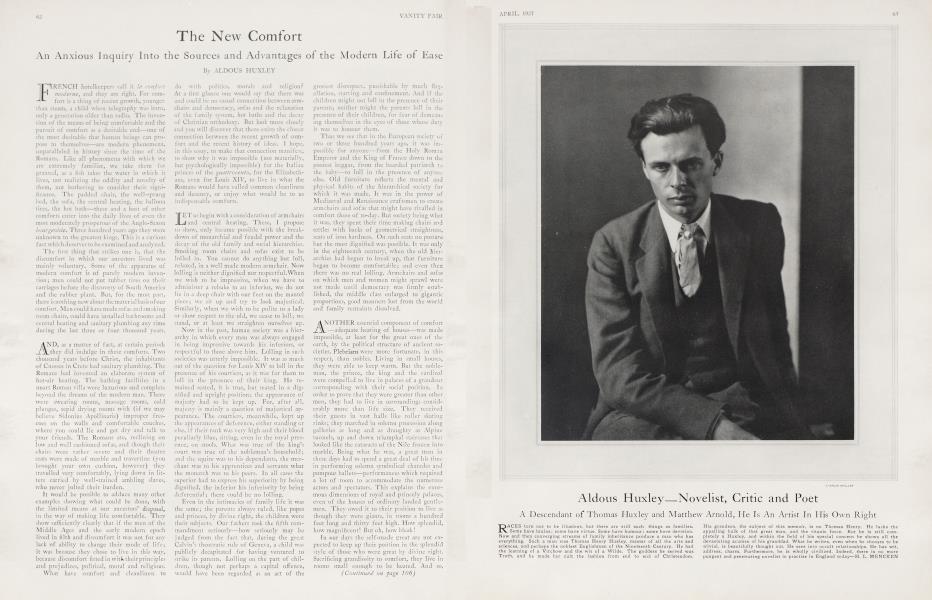
An Anxious Inquiry Into the Sources and Advantages of the Modern Life of Ease
ALDOUS HUXLEY
FRENCH hotelkeepers call it le confort moderne, and they arc right. For comfort is a thing of recent growth, younger than steam, a child when telegraphy was born, only a generation older than radio. The invention of the means of being comfortable and the pursuit of comfort as a desirable end—one of the most desirable that human beings can propose to themselves—are modern phenomena, unparalleled in history since the time oi the Romans. Like all phenomena with which we are extremely familiar, we take them for granted, as a fish takes the water in which it lives, not realizing the oddity and novelty of them, not bothering to consider their significance. The padded chair, the well-sprung bed, the sofa, the central heating, the balloon tires, the hot bath—these and a host of other comforts enter into the daily lives of even the most moderately prosperous of the Anglo-Saxon bourgeoisie. Three hundred years ago they were unknown to the greatest kings. This is a curious fact which deserves to be examined and analyzed.
The first thing that strikes one is, that the discomfort in which our ancestors lived was mainly voluntary. Some of the apparatus of modern comfort is of purely modern invention; men could not put rubber tires on their carriages before the discovery of South America and the rubber plant. But, for the most part, there is nothing new about the material basis of our comfort. Men could have made sofas and smoking room chairs, could have installed bathrooms and central heating and sanitary plumbing any time during the last three or four thousand years.
AND, as a matter of fact, at certain periods they did indulge in these comforts. Two thousand years before Christ, the inhabitants of Cnossos in Crete had sanitary plumbing. The Romans had invented an elaborate system of hot-air heating. The bathing facilities in a smart Roman villa were luxurious and complete beyond the dreams of the modern man. There were sweating rooms, massage rooms, cold plunges, tepid drying rooms with (if we may believe Sidonius Apollinaris) improper frescoes on the walls and comfortable couches, where you could lie and get dry and talk to your friends. The Romans ate, reclining on low and well cushioned sofas, and though their chairs were rather severe and their theatre seats were made of marble and travertine (you brought your own cushion, however) they travelled very comfortably, lying down in litters carried by well-trained ambling slaves, who never jolted their burden.
It would be possible to adduce many other examples showing what could be done, with the limited means at our ancestors' disposal, in the way of making life comfortable. They show sufficiently clearly that if the men of the Middle Ages and the early modern epoch lived in filth and discomfort it was not for any lack of ability to change their mode of life; it was because they chose to live in this way, because discomfort fitted in with their principles and prejudices, political, moral and religious.
What have comfort and cleanliness to do with politics, morals and religion? At a first glance one would say that there was and could be no casual connection between armchairs and democracy, sofas and the relaxation of the family system, hot baths and the decay of Christian orthodoxy. But look more closely and you will discover that there exists the closest connection between the recent growth of comfort and the recent history of ideas. I hope, in this essay, to make that connection manifest, to show why it was impossible (not materially, but psychologically impossible) for the Italian princes of the quattrocento, for the Elizabethans, even for Louis XIV, to live in what the Romans would have called common cleanliness and decency, or enjoy what would be to us indispensable comforts.
LET us begin with a consideration of armchairs and central heating. These, 1 propose to show, only became possible with the breakdown of monarchial and feudal power and the decay of the old family and social hierarchies. Smoking room chairs and sofas exist to be lolled in. You cannot do anything but loll, relaxed, in a well made modern armchair. Now lolling is neither dignified nor respectful.When we wish to be impressive, when we have to administer a rebuke to an inferior, we do not lie in a deep chair with our feet on the mantel piece; we sit up and try to look majestical. Similarly, when we wish to be polite to a lady or show respect to the old, we cease to loll; we stand, or at least we straighten ourselves up.
Now in the past, human society was a hierarchy in which every man was always engaged in being impressive towards his inferiors, or respectful to those above him. Lolling in such societies was utterly impossible. It was as much out of the question for Louis XIV to loll in the presence of his courtiers, as it was for them to loll in the presence of their king. He remained seated, it is true, but seated in a dignified and upright position; the appearance of majesty had to be kept up. For, after all, majesty is mainly a question of majestical appearance. The courtiers, meanwhile, kept up the appearances of deference, either standing or else, if their rank was very high and their blood peculiarly blue, sitting, even in the royal presence, on stools. What was true of the king's court was true of the nobleman's household; and the squire was to his dependants, the merchant was to his apprentices and servants what the monarch was to his peers. In all cases the superior had to express his superiority by being dignified, the inferior his inferiority by being deferential; there could be no lolling.
Even in the intimacies of family life it was the same; the parents always ruled, like popes and princes, by divine right, the children were their subjects. Our fathers took the fifth commandment seriously—how seriously may be judged from the fact that, during the great Calvin's theocratic rule of Geneva, a child was publicly decapitated for having ventured to strike its parents. Lolling on the part of children, though not perhaps a capital offence, would have been regarded as an act of the grossest disrespect, punishable by much flagellation, starving and confinement. And if the children might not loll in the presence of their parents, neither might the parents loll in the presence of their children, for fear of demeaning themselves in the eyes of those whose duty it was to honour them.
Thus we see that in the European society of two or three hundred years ago, it was impossible for anyone—from the Holy Roman Emperor and the King of France down to the poorest beggar, from the bearded patriarch to the baby—to loll in the presence of anyone else. Old furniture reflects the mental and physical habits of the hierarchical society for which it was made. It was in the power of Mediaeval and Renaissance craftsmen to create armchairs and sofas that might have rivalled in comfort those of to-day. But society being what it was, they spent their time making chairs and settles with backs of geometrical straightness, seats of iron hardness. On such seats no posture but the most dignified was possible. It was only in the eighteenth century, when the old hierarchies had begun to break up, that furniture began to become comfortable; and even then there was no real lolling. Armchairs and sofas on which men and women might sprawl were not made until democracy was firmly established, the middle class enlarged to gigantic proportions, good manners lost from the world and family restraints dissolved.
ANOTHER essential component of comfort —adequate heating of houses—was made impossible, at least for the great ones of the earth, by the political structure of ancient societies. Plebeians were more fortunate, in this respect, than nobles. Living in small houses, they were able to keep warm. But the nobleman, the prince, the king and the cardinal were compelled to live in palaces of a grandeur corresponding with their social position. In order to prove that they were greater than other men, they had to live in surroundings considerably more than life size. They received their guests in vast halls like roller skating rinks; they marched in solemn procession along galleries as long and as draughty as Alpine tunnels, up and down triumphal staircases that looked like the cataracts of the Nile frozen into marble. Being what he was, a great man in those days had to spend a great deal of his time in performing solemn symbolical charades and pompous ballets—performances which required a lot of room to accommodate the numerous actors and spectators. This explains the enormous dimensions of royal and princely palaces, even of the houses of ordinary landed gentlemen. They owed it to their position to live as though they were giants, in rooms a hundred feet long and thirty feet high. How splendid, how magnificent! But oh, how bleak!
In our days the self-made great are not expected to keep up their position in the splendid style of those who were great by divine right. Sacrificing grandiosity to comfort, they live in rooms small enough to be heated. And so, when they were off duty, did the great in the past; most old palaces contain a series of tiny apartments to which their owners retired when the charades of state were over. But the charades were long-drawn affairs, and the unhappy princes of old days had to spend a great deal of time being magnificent in icy audience chambers and among the whistling draughts of interminable galleries.
(Continued on page 106)
(Continued front page 62)
Driving in the environs of Chicago, I had the house of a man who was reputed to be one of the richest of the city pointed out to me. It was a medium-sized house of perhaps a dozen or fifteen smallish rooms. I looked at it in astonishment.
It is to the decay of monarchy, aristocracy and the ancient social hierarchies that we owe the two components of modern comfort hitherto discussed. The third great component— the bath—must, I think, be attributed to the decay of Christian morals. There are still, on the continent of Europe and, for all I know, elsewhere, convent schools in which young ladies are brought up to believe that human bodies are objects of so impure and obscene a character, that it is sinful for them to see, not merely other people's nakedness, but even their own. Baths, when they are permitted to take them (every alternate Saturday) must be taken in a chemise descending well below the knees. And they are even taught a special technique of dressing, which guarantees them from catching so much as a glimpse of their own skin. These schools arc now, happily, exceptional; but there was a time, not so long ago, when they were the rule. Theirs is the great Christian ascetic tradition which has flowed on in majestic continuity from the time of St. Anthony and the unwashed, underfed, sex-starved monks of the The baid, through the centuries, almost to the present day. It is to the weakening of that tradition that we owe the luxury of frequent bathing—a luxury unknown in the West since the time of the Romans who lived before the early Christians had imposed their ideas of asceticism and decency on the peoples of Europe. Each time we get into our heath we ought to thank Voltaire for his mockeries, to bless the nineteenth century men of science for their ponderous and, as we now see, quite unphilosophical materialism; for it is to them that we arc indebted for this most delicious of modern comforts. If they had never lived to undermine the tradition of the convent school, we should still he as dirty, and as pious, as were our ancestors three hundred years ago and even more recently. Nor must we forget the War as a great destroyer of tradition.
When women began to do war work they found that the traditional modesty in dress was incompatible with efficiency. They ceased to he modest, according to the convent school standards, and having discovered the advantages of immodesty, they have remained immodest ever since, to the great improvement of their health and increase of their personal comfort. Modern fashions are probably the most comfortable that women have ever worn—more comfortable even than the fashions of the ancient Greeks, whose under-tunic was as rational a garment as you could wish for, hut whose outer robe was simply a piece of stuff wound round the body and fastened precariously with safety pins. No woman whose appearance depended on safety pins can ever have felt perfectly comfortable.
Having traced the spiritual origins of modern comfort, we must consider its effects. One cannot have something for nothing, and the achievement of comfort has been, generally speaking, accompanied by a compensating loss of other equally, or perhaps more, valuable things. A man of means who builds a house to-day will be concerned primarily with the comfort of his future residence. He will spend much (for comfort is expensive) on bathrooms, heating, luscious furnishings and so forth. His counterpart in an earlier age would have been primarily concerned with the impressiveness and magnificence of his dwelling—the beauty, in a word, rather than comfort. The money our contemporary would spend on baths and central heating would have been spent, in the past, on marble staircases, a grand façade, frescoes, huge suites of gilded rooms, pictures, statues. Sixteenth century Popes lived in a discomfort that a modern bank manager would consider unbearable; hut they had Raphael's frescoes, they had the Sistine chapel, they had their galleries of ancient sculpture. Must we pity them for the absence from the Vatican of bathrooms, central heating and smoking room chairs?
I am inclined to think that our present passion for comfort is a little exaggerated. Though I personally enjoy comfort, I have lived very happily in houses devoid of almost everything that Anglo-Saxons deem indispensable. Orientals and even South Europeans, who know not comfort and live very much as our ancestors lived centuries ago, seem to get on very well without our elaborate and costly apparatus of padded luxury. I am old fashioned enough to believe in higher and lower things and can see no point in material progress except in so far as it subserves thought. I like labour saving devices, because they economize time and energy which may be devoted to mental labour; I like rapid and easy transport because, by enlarging the world in which men can live it enlarges their minds. Comfort has a similar justification; discomfort handicaps thought and it is difficult when the body is cold and aching to use the mind. Comfort is a means to an end. The modern world seems to regard it as an end in itself, an absolute good. One day, perhaps, the earth will have been turned into one vast feather-bed, with man's body dozing on top of it, and his mind underneath, like Desdemona, smothered.
Subscribers have complete access to the archive.
Sign In Not a Subscriber?Join Now
