Sign In to Your Account
Subscribers have complete access to the archive.
Sign In Not a Subscriber?Join NowWhat Is the Matter With the Farmer?
An Investigation of the Farmer's Complaints and the Government's Responsibility
CLARENCE HARROW
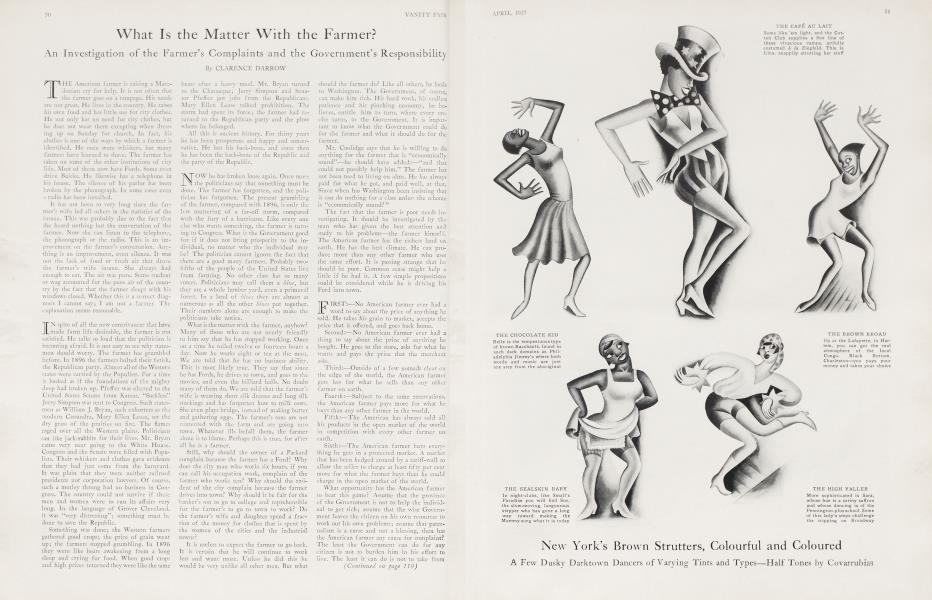
THE American farmer is raising a Macedonian cry for help. It is not often that the farmer goes on a rampage. His needs are not great. He lives in the country. He raises his own food and has little use for city clothes. He not only has no need for city clothes, hut he does not wear them excepting when dre-.sing up on Sunday for church. In fact, his clothes is one of the ways by which a farmer is identified. He once wore whiskers, but many farmers have learned to shave. The farmer has taken on some of the other institutions of city life. Most of them now have Fords. Some even drive Buicks. He likewise has a telephone in his house. The silence of his parlor has been broken by the phonograph. In some cases even a radio has been installed.
It has not been so very long since the farmer's wife led all others in the statistics of the insane. This was probably due to the fact that she heard nothing but the conversation of the farmer. Now she can listen to the telephone, the phonograph or the radio. This is an improvement on the farmer's conversation. Anything is an improvement, even silence. It was not the lack of food or fresh air that drove the farmer's wife insane. She always had enough to eat. The air was pure. Some student or wag accounted for the pure air of the country by the fact that the farmer sleeps with his windows closed. Whether this is a correct diagnosis I cannot say; I am not a farmer. The explanation seems reasonable.
IN spite of all the new contrivances that have II made farm life desirable, the farmer is rot satisfied. He talks so loud that the politician is becoming afraid. It is not easy to sec why statesmen should worry. The farmer has grumbled before. In 1896 the farmers bolted their fetish, the Republican party. Almost all of the Western states were carried by the Populists. For a time it looked as if the foundations of the mighty deep had broken up. Pfeffer was elected to the United States Senate from Kansas. "Sockless" Jerry Simpson was sent to Congress. Such statesmen as William J. Bryan, such exhorters as the modern Cassandra, Mary Ellen Lease, set the dry grass of the prairies on fire. 'The flames raged over all the Western plains. Politicians ran like jack-rabbits for their lives. Mr. Bryan came very near going to the White House. Congress and the Senate were filled with Populists. Their whiskers and clothes gave evidence that they had just come from the barnyard. It was plain that they were neither railroad presidents nor corporation lawyers. Of course, such a motley throng had no business in Congress. The country could not survive if these men and women were to run its affairs very long. In the language of Grover Cleveland, it was "very distressing"; something must be done to save the Republic.
Something was done; the Western farmers gathered good crops; the price of grain went up; the farmers stopped grumbling. In 1896 they were like bears awakening from a long sleep and crying for food. When good crops and high prices returned they were like the same bears alter a heavy meal. Mr. Bryan turned to the Chatauqua; Jerry Simpson and Senator PfefTer got jobs from the Republicans. Mary Ellen Lease talked prohibition. The storm had spent its force; the farmer had returned to the Republican party and the plow where he belonged.
All this is ancient history. For thirty years he has been prosperous and happy and conservative. He lost his back-bone, and since then he has been the back-bone of the Republic and the party of the Republic.
NOW he has broken loose again. Once more the politicians say that something must be done. The farmer has forgotten, and the politician has forgotten. The present grumbling of the farmer, compared with 1 896, is only the few muttering of a far-off storm, compared with the fury of a hurricane. Like every one else who wants something, the farmer is turning to Congress. What is the Government good for if it does not bring prosperity to the individual, no matter who the individual may be? The politician cannot ignore the fact that there are a good many farmers. Probably two fifths of the people of the United States live from farming. No other class has so many voters. Politicians may call them a bloc, but they are a whole lumber yard, even a primeval forest. In a land of blocs they arc almost as numerous as all the other blocs put together. Their numbers alone are enough to make the politicians take notice.
What is the matter with the farmer, anyhow? Many of those who arc not overly friendly to him say that he has stopped working. Once on a time he toiled twelve or fourteen hours a day. Now he works eight or ten at the most. We are told that he has no business ability. This is most likely true. They say that since he has Fords, he drives to town, and goes to the movies, and even the billiard halls. No doubt many of them do. We are told that the farmer's wife is wearing short silk dresses and long silk stockings and has forgotten how to milk cows. She even plays bridge, instead of making butter and gathering eggs. The farmer's sons arc not contented with the farm and are going into town. Whatever ills befall them, the farmer alone is to blame. Perhaps this is true, for after all he is a farmer.
Still, why should the owner of a Packard complain because the farmer has a Ford? Why does the city man who works six hours, if you can call his occupation work, complain of the farmer who works ten? Why should the resident of the city complain because the farmer drives into town? Why should it be fair for the banker's son to go to college and reprehensible for the farmer's to go to town to work? Do the farmer's wife and daughter spend a fraction of the money for clothes that is spent by the women of the cities and the industrial towns?
It is useless to expect the farmer to go back. It is certain that he will continue to work less and want more. Unless he did this he would be very unlike all other men. But what should the farmer do? Like all others, he looks to Washington. The Government, of course, can make him rich. His hard work, his endless patience and his pinching economy, he believes, entitle him to turn, where every one else turns, to the Government. It is important to know what the Government could do for the farmer and what it should do for the farmer.
Mr. Coolidge says that he is willing to do anything for the farmer that is "economically sound"—he should have added:—"and that could not possibly help him." The farmer has not been used to living on alms. He has always paid for what he got, and paid well, at that. Since when has Washington been insisting that it can do nothing for a class unless the scheme is "economically sound?"
The fact that the farmer is poor needs investigating. It should be investigated by the man who has given the best attention and study to his problems—the farmer himself. The American farmer has the richest land on earth. He has the best climate. He can produce more than any other farmer who uses the same effort. It is passing strange that he should be poor. Common sense might help a little if he had it. A few simple propositions could be considered while he is driving his Ford into town.
FIRST:—No American farmer ever had a JT word to say about the price of anything he sold. He takes his grain to market, accepts the price that is offered, and goes back home.
Second:—No American farmer ever had a thing to say about the price of anything he bought. He goes to the store, asks for what he wants and pays the price that the merchant asks.
Third:—Outside of a few nomads clear on the edge of the world, the American farmer gets less for what he sells than any other farmer on earth.
Fourth:—Subject to the same reservations, the American farmer pays more for what he buys than any other farmer in the world.
Fifth:—The American has always sold all his products in the open market of the world in competition with every other farmer on earth.
Sixth:—The American farmer buys everything he gets in a protected market. A market that has been hedged around by a tariff-wall to allow the seller to charge at least fifty per cent more for what the farmer buys than he could charge in the open market of the world.
What opportunity has the American farmer to beat this gamer Assume that the province of the Government is not to help the individual to get rich; assume that the wise Government leaves the citizen on his own resources to work out his own problems; assume that paternalism is a curse and not a blessing, then has the American farmer any cause for complaint? The least the Government can do for any citizen is not to burden him in his effort to live. The least it can do is not to take from one citizen to help another. What has the Government done to the farmer for the last sixty years: The Government has never insisted that any aid given shall conform to "economic law". It cares nothing whatever for economic law. It confers its bounties upon those who are strong enough to make and enforce demands. The Government has long and persistently aided the powerful and left the weak to get along as best they could.
(Continued on page 110)
(Continued from page 50)
What could Congress do for the farmer: Ever since the origin of the American farmer, he has sold his products in Europe on the world market. He gets for his grain and meat the European price, less the cost of sending it abroad. If the farmer is to increase his wealth, then the increase must be made up by the difference between what he gets for his produce and the amount he pays for his goods. The American farmer sells his grain and meat in Europe, but the Government will not permit him to buy his wares where he sells his produce. He must bring his money back to America and pay from 2 5% to 100% more than he would pay if he could buy where lie sells. Most of the American stuff that he buys in America is sold in Europe and South America cheaper than in the United States.
So long as the American farmer has anything to sell he must send it abroad. This will be the case for the next hundred years, at least, for only a small fraction of the tillable land of America has ever been developed. It is idle to talk of any Government aid that will give the farmer more for what he sells. Our farming area is greater and more fertile than any other in the world, and our farm products can be produced for less labor than those of any other land. We do not buy grain; we sell it; when the farmer asks for help, Congress gives him a tariff on wheat. A tariff on the farmer's wheat is only a reflection on the farmer's brains. Some farmers are made to believe that they need protection from Canada, but Canada ships more wheat to Europe in proportion to its crop than the United States. If now and then a carload of hard wheat is shipped to Minneapolis to supplement the hard wheat of the Red River valley, then it leaves «the same extra amount of American wheat or flour to be shipped to Europe because the Canadian wheat came here. Canada likewise will continue to increase constantly its shipping as time goes on. If Congress wanted to help the farmer, it could do so by giving a direct bounty for every bushel of wheat the farmer sells. Bounties are not new, and however they violate "economic law", they are cheaper than tariffs, on the whole, and go directly to the beneficiary. The bounty is not increased by profits of commission-men and merchant's. If I the politician is really in earnest about helping the farmer at the expense 0f other industries, bounties are cheaper and better than tariffs.
It is strange that even farmers could be lured by the absurd agitation for co-operative marketing by Government aid. Excepting in a few in. significant perishable products, the farmer's commodity must be sold as it is produced. All the world competes with the American farmer, and in every month of the year some farmers are sending food to market.
One simply needs to imagine the extent of the warehouse facilities that would take care of the farmers' corn and wheat and cotton and cattle, and hogs, to understand the folly of any such proposal. Of course, the warehousing scheme could be aided by putting the storage houses near the yards and pens for cattle and hogs. This would allow the cattle and hogs to eat the grain while they were waiting to get killed.
As the United States can raise grain cheaper than any other land, so they can produce iron and steel cheaper than any other. No other countries have the resources from which manufactured articles are made. The tariff simply permits its beneficiaries to set their own prices on what is sold at home.
If the farmer bloc, with two-fifths of the vote in the United States, should insist on trade being governed by natural law they would not be begging Congress for alms.
No other American citizen needs to restore economic law as the farmer needs it. Aside from giving him a chance to buy, it would help, to some extent, the price for which he sells. This is true, because our narrow and exclusive policy has driven all countries to give preference in trade to any one except the United States. Then, too, big business can protect itself, if too much is produced for the market to take, it can close its mills until the demand overcomes the supply.
There is no danger of competition from foreign wars; the governmen: has taken care of that. Even the wage worker protects himself by his unions, and will not produce unless wages are fair. There are too many farmers and they are too poor to do what big business docs, or even what labor has done. Each farmer stands alone, unprotected by Government or unions, taking what he is offered and paying what he is asked. He pays wages to laborers who indirectly arc protected by the unions of industrial workers, and he buys goods from monopolies who fix prices by the aid of the Government, which should grant favors to none. The farmer, like all others, has only himself to rely on, and that is why his prospect is dark. Before he can have a chance he must learn to think. He must also separate himself from old traditions. So far he has never shown any capacity or inclination to do either.
Subscribers have complete access to the archive.
Sign In Not a Subscriber?Join Now
