Sign In to Your Account
Subscribers have complete access to the archive.
Sign In Not a Subscriber?Join NowLast Night's Folly
Several Hours in the Life of a Woman Who Did Not Know Exactly What She Wanted
MADDY VEGTEL
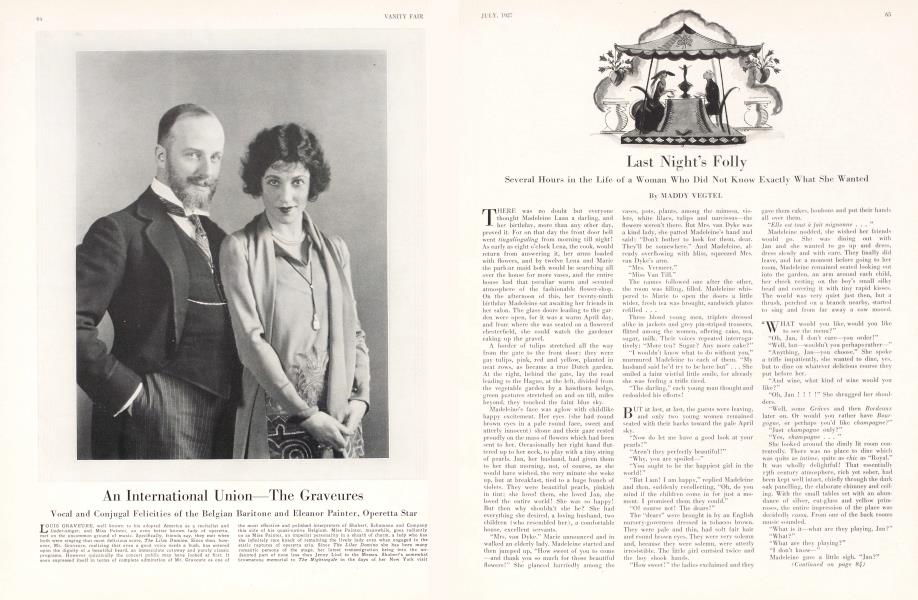
THERE was no doubt but everyone thought Madeleine Laan a darling, and her birthday, more than any other day, proved it. For on that day the front door bell went tingalingaling from morning till night! As early as eight o'clock Lena, the cook, would return from answering it, her arms loaded with flowers, and by twelve Lena and Marie the parlour maid both would he searching all over the house for more vases, and the entire house had that peculiar warm and scented atmosphere of the fashionable flower-shop. On the afternoon of this, her twenty-ninth birthday Madeleine sat awaiting her friends in her salon. The glass doors leading to the garden were open, for it was a warm April day, and from where she was seated on a flowered chesterfield, she could watch the gardener raking up the gravel.
A border of tulips stretched all the way from the gate to the front door: they were gay tulips, pink, red and yellow, planted in neat rows, as became a true Dutch garden. At the right, behind the gate, lay the road leading to the Hague, at the left, divided from the vegetable garden by a hawthorn hedge, green pastures stretched on and on till, miles beyond, they touched the faint blue sky.
Madeleine's face was aglow with childlike happy excitement. Her eyes (she had round brown eyes in a pale round face, sweet and utterly innocent) shone and their gaze rested proudly on the mass of flowers which had been sent to her. Occasionally her right hand fluttered up to her neck, to play with a tiny string of pearls. Jan, her husband, had given them to her that morning, not, of course, as she would have wished, the very minute she woke up, but at breakfast, tied to a huge bunch of violets. They were beautiful pearls, pinkish in tint; she loved them, she loved Jan, she loved the entire world! She was so happy! But then why shouldn't she be? She had everything she desired, a loving husband, two children (who resembled her), a comfortable house, excellent servants.
"Mrs. van Dyke." Marie announced and in walked an elderly lady. Madeleine started and then jumped up, "How sweet of you to come —and thank you so much for those beautiful flowers!" She glanced hurriedly among the vases, pots, plants, among the mimosa, violets, white lilacs, tulips and narcissus—the flowers weren't there. But Mrs. van Dyke was a kind lady, she patted Madeleine's hand and said: "Don't bother to look for them, dear. They'll be somewhere." And Madeleine, already overflowing with bliss, squeezed Mrs. van Dyke's arm.
"Mrs. Vermeer."
"Miss Van Till."
The names followed one after the other, the room was filling, filled. Madeleine whispered to Marie to open the doors a little wider, fresh tea was brought, sandwich plates refilled . . .
Three blond young men, triplets dressed alike in jackets and grey pin-striped trousers, flitted among the women, offering cake, tea, sugar, milk. Their voices repeated interrogatively: "More tea? Sugar? Any more cake?"
"1 wouldn't know what to do without you," murmured Madeleine to each of them. "My husband said he'd try to be here hut" . . . She smiled a faint wistful little smile, for already she was feeling a trifle tired.
"The darling," each young man thought and redoubled his efforts!
BUT at last, at last, the guests were leaving, and only two young women remained seated with their backs toward the pale April sky.
"Now do let me have a good look at your pearls!"
"Aren't they perfectly beautiful!"
"Why, you are spoiled—"
"You ought to be the happiest girl in the world! "
"But 1 am! I am happy," replied Madeleine and then, suddenly recollecting, "Oh, do you mind if the children come in for just a moment. I promised them they could."
"Of course not! The dears!"
The "dears" were brought in by an English nursery-governess dressed in tobacco brown. They were pale and thin, had soft fair hair and round brown eyes. They were very solemn and, because they were solemn, were utterly irresistible. The little girl curtsied twice and the boy shook hands.
"How sweet!" the ladies exclaimed and they gave them cakes, bonbons and put their hands all over them.
"Elle est tout à fait mignonne..."
Madeleine nodded, she wished her friends would go. She was dining out with Jan and she wanted to go up and dress, dress slowly and with care. They finally did leave, and for a moment before going to her room, Madeleine remained seated looking out into the garden, an arm around each child, her cheek resting on the boy's small silky head and covering it with tiny rapid kisses. The would was very quiet just then, hut a thrush, perched on a branch nearby, started to sing and from far away a cow mooed.
"WHAT would you like, would you like to see the menu?"
"Oh, Jan, I don't care—you order!"
"Well, but—wouldn't you perhaps rather—"
"Anything, Jan—you choose." She spoke a trifle impatiently, she wanted to dine, yes, but to dine on whatever delicious course they put before her.
"And wine, what kind of wine would you like?"
"Oh, Jan ! ! ! !" She shrugged her shoulders.
"Well, some Graves and then Bordeaux later on. Or would you rather have Bourgogne, or perhaps you'd like champagne?"
"Just champagne only?"
"Yes, champagne ..."
She looked around the dimly lit room contentedly. There was no place to dine which was quite as intime, quite as chic as "Royal." It was wholly delightful! That essentially 17th century atmosphere, rich yet sober, had been kept well intact, chiefly through the dark oak panelling, the elaborate chimney and ceiling. With the small tables set with an abundance of silver, cut-glass and yellow primroses, the entire impression of the place was decidedly cossu. From one of the back rooms music sounded.
"What is it—what are they playing, Jan?"
"What?"
"What are they playing?"
"I don't know—"
Madeleine gave a little sigh. "Jan?"
(Continued on page 84)
(Continued from page 65)
"Yes?"
"Oil, Jan, do he a little gay, darling. I feel so happy. Now do talk a little—"
"Well, what do you want me to say?" he smiled at her, kindly, lovingly, hut as at a child.
"Oh, well." She made a little discontented move.
A man following his friends to a table near by passed them, gave a glance at Jan's face and then stopped. "Why, Laan, how are you?"
"How-do-you-do?" Jan shook the outstretched hand cordially, "Madeleine, I want you to meet Mr. Echague." Mr. Echague bowed.
"Who is he?" she asked Jan as soon as the gentleman had seated himself at a table not far away, and facing them.
"One of the Spanish embassy chaps."
"Well tell me more—he is awfully good looking."
"There isn't any more to tell."
Then suddenly Madeleine made up her mind not to speak another word till Jan spoke, but as Jan did not speak they ate in silence, and Madeleine felt no longer happy. It was Jan's fault, she thought. He spoilt everything by being like that—silent, dull, Dutch! Her thoughts went to Mr. Echague-of-the-Spanish-embassy. She gave a glance in his direction—he was talking to one of his friends, talking rapidly. Then suddenly he stopped and as if he knew she was watching him, glanced at her.
What after all was life but a very dull every-day existence—Jan, what, after all, Was Jan but a dull, quiet man? Did she really love him? Could she live without him? Of course she could. She no longer trembled when he kissed her, she no longer felt like killing herself when he praised another woman, as once she had.
"Let's go home," she said suddenly.
"Home? Already? Why what's the matter?"
"Nothing, I want to go home."
They got up. On their way to the door they passed Mr. Echague. He turned his face fully towards them, and in response to the nod Madeleine gave him, he gave her a strange complicated smile, a smile of pity, admiration, understanding, a smile wholly charming and promising.
"Jan," she said an hour later, seated on a leather couch in her husband's room, "Jan! !"
"Yes, dear?" He was looking over some letters.
"Jan, I think I'd like to go away for a while."
"What?" asked Jan who wasn't listening. ⅜
"I want to go away for a while."
"Well, darling, if you want to, that's all right."
Oh God! didn't he understand anything at all?
"I mean I'd like to separate."
Jan looked up. "What are you talking about?" he asked sternly. "What's the matter with you this evening?"
"I want to go away. I don't love you. Why should I stay with you? You don't love me . . ."
"Don't be ridiculous."
"I am not ridiculous."
"Well, I think you'd better go to bed."
"Go to bed! I don't want to go to bed. I want to go away. I don't want to see you any more."
"But, Madeleine, what's the matter, what have I done?" He put a hand on her shoulder, but she pushed it off, rudely.
"Leave me—leave me, I can't stand you, you just sit and sit, you make me crazy, you're dull."
"Poor little girl!"
"Be quiet."
"Now go up to bed. I don't want to listen any longer."
"You're dull, dull, dull!"
"All right, but now go to bed."
She got up from the couch. "Oh you think I don't know what I am saying —but I do. I am going away. Why, there are hundreds of men—I know one now who. ..." That smile, that promising exciting smile—but how w'as Jan to know about it?
"Goodnight, Madeleine!"
"Sit! Sit! Sit! That's all you can do; just sit and say nothing."
"Goodnight!"
She awoke next morning with a start. Jan, dressed to go out, stood beside her bed, a cup of tea in one hand and a pack of letters in the other.
"Why, what time is it? You are dressed already?"
"It's just nine, dear." He put the letters and the tea down on a table beside her and then looked at her quizzically.
"Kiss me," she said.
He sat down on the edge of the bed and put bis arms around her.
Suddenly she remembered. They had quarreled! And she had said she was going away—how had she come to say that? She leaned back in her pillow and regarded Jan.
What a dear he was—smiling at her in that kind, tender, loving way.
"I love you," she murmured.
"Of course you do," said Jan.
Subscribers have complete access to the archive.
Sign In Not a Subscriber?Join Now
