Sign In to Your Account
Subscribers have complete access to the archive.
Sign In Not a Subscriber?Join NowThe American Game Which Sprang From English Rugby Now Threatens to Return to It
The American Game Which Sprang From English Rugby Now Threatens to Return to It
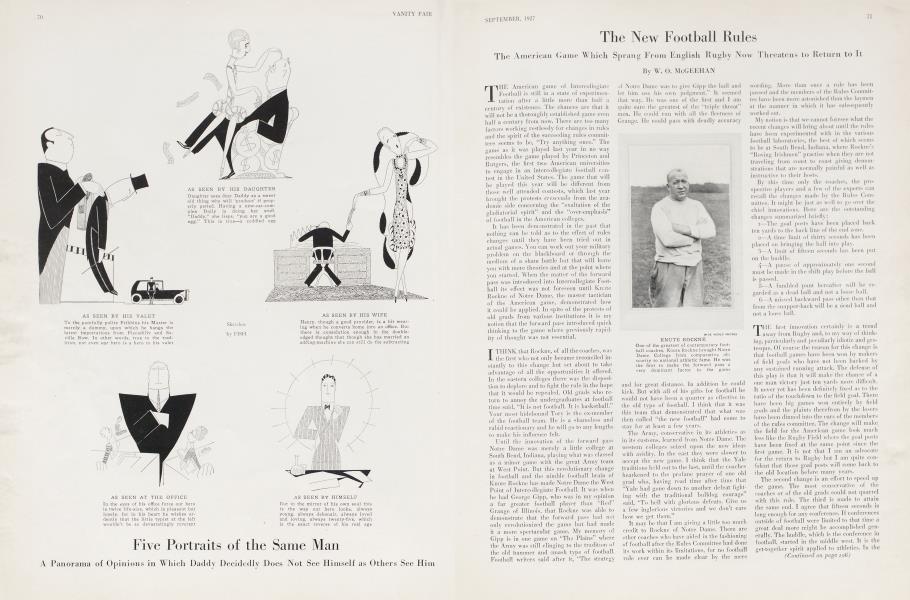
THE American game of Intercollegiate Football is still in a state of experimentation after a little more than half a century of existence. The chances are that it will not be a thoroughly established game even half a century from now. There are too many factors working restlessly for changes in rules and the spirit of the succeeding rules committees seems to be, "Try anything once." The game as it was played last year in no way resembles the game played by Princeton and Rutgers, the first two American universities to engage in an intercollegiate football contest in the United States. The game that will be played this year will be different from those well attended contests, which last year brought the protests crescendo from the academic side concerning the "exaltation of the gladiatorial spirit" and the "over-emphasis" of football in the American colleges.
It has been demonstrated in the past that nothing can be told as to the effect of rules changes until they have been tried out in actual games. You can work out your military problem on the blackboard or through the medium of a sham battle but that will leave you with mere theories and at the point where you started. When the matter of the forward pass was introduced into Intercollegiate Football its effect was not foreseen until Knute Rockne of Notre Dame, the master tactician of the American game, demonstrated how it could be applied. In spite of the protests of old grads from various institutions it is my notion that the forward pass introduced quick thinking to the game where previously rapidity of thought was not essential.
I THINK that Rockne, of all the coaches, was the first who not only became reconciled instantly to this change but set about to take advantage of all the opportunities it offered. In the eastern colleges there was the disposition to deplore and to fight the rule in the hope that it would be repealed. Old grads who return to annoy the undergraduates at football time said, "It is not football. It is basketball." Your most hidebound Tory is the ex-member of the football team. He is a shameless and rabid reactionary and he will go to any lengths to make his influence felt.
Until the innovation of the forward pass Notre Dame was merely a little college at South Bend, Indiana, playing what was classed as a minor game with the great Army team at West Point. But this revolutionary change in football and the nimble football brain of Knute Rockne has made Notre Dame the West Point of Intercollegiate Football. It was when he had George Gipp, who was in my opinion a far greater football player than "Red" Grange of Illinois, that Rockne was able to demonstrate that the forward pass had not only revolutionized the game but had made it a more spectacular game. My memory of Gipp is in one game on "The Plains" where the Army was still clinging to the tradition of the old hammer and smash type of football. Football writers said after it, "The strategy of Notre Dame was to give Gipp the ball and let him use his own judgment." It seemed that way. He was one of the first and I am quite sure the greatest of the "triple threat" men. He could run with all the fleetness of Grange. He could pass with deadly accuracy and for great distance. In addition he could kick. But with all of his gifts for football he would not have been a quarter as effective in the old type of football. I think that it was this team that demonstrated that what was then called "the new football" had come to stay for at least a few years.
The Army, conservative in its athletics as in its customs, learned from Notre Dame. The western colleges seized upon the new ideas with avidity. In the east they were slower to accept the new game. I think that the Yale traditions held out to the last, until the coaches hearkened to the profane prayer of one old grad who, having read time after time that "Yale had gone down to another defeat fighting with the traditional bulldog courage" said, "To hell with glorious defeats. Give us a few inglorious victories and we don t care how we get them."
It may be that I am giving a little too much credit to Rockne of Notre Dame. There are other coaches who have aided in the fashioning of football after the Rules Committee had done its work within its limitations, for no football rule ever can be made clear by the mere wording. More than once a rule has been passed and the members of the Rules Committee have been more astonished than the laymen at the manner in which it has subsequently worked out.
My notion is that we cannot foresee what the recent changes will bring about until the rules have been experimented with in the various football laboratories, the best of which seems to be at South Bend, Indiana, where Rockne's "Roving Irishmen" practise when they are not traveling from coast to coast, giving demonstrations that are normally painful as well as instructive to their hosts.
By this time only the coaches, the prospective players and a few of the experts can recall the changes made by the Rules Committee. It might be just as well to go over the chief innovations. Here are the outstanding changes summarized briefly:
1—The goal posts have been placed back ten yards to the back line of the end zone.
2—A time limit of thirty seconds has been placed on bringing the ball into play.
3—A limit of fifteen seconds has been put on the huddle.
4—A pause of approximately one second must be made in the shift play before the ball is passed.
5—A fumbled punt hereafter will be regarded as a dead ball and not a loose ball.
6—A missed backward pass other than that from the snapper-back will be a dead ball and not a loose ball.
THE first innovation certainly is a trend away from Rugby and, to my way of thinking, particularly and peculiarly idiotic and grotesque. Of course the reason for this change is that football games have been won by makers of field goals who have not been backed by any sustained running attack. The defense of this play is that it will make the chance of a one man victory just ten yards more difficult. It never yet has been definitely fixed as to the ratio of the touchdown to the field goal. There have been big games won entirely by field goals and the plaints there from by the losers have been dinned into the ears of the members of the rules committee. The change will make the field for the American game look much less like the Rugby Field where the goal posts have been fixed at the same point since the first game. It is not that I am an advocate for the return to Rugby but I am quite confident that those goal posts will come back to the old location before many years.
The second change is an effort to speed up the game. The most conservative of the coaches or of the old grads could not quarrel with this rule. The third is made to attain the same end. I agree that fifteen seconds is long enough for any conference. If conferences outside of football were limited to that time a great deal more might be accomplished generally. The huddle, which is the conference in football, started in the middle west. It is the get-together spirit applied to athletics. In the east they said it was the chamber of commerce idea brought to the gridiron but when the huddlers began to beat a few of the "big teams" the huddle system was adopted generally.
The fourth change will bring dismay to tile officials. In addition to knowing all of the rules and variations thereof and to watching twenty-two football players the officials will have to attain some of the proficiency of the old time prizefight referees in gauging seconds. This may in time necessitate the addition of a new official, a special time-keeper who will be stationed on the side lines with a watch in hand trying to synchronize the shifts and the seconds. Even then the officials will be charged with giving this or that team a short count, as they say in prizefight circles, in the matter of shifts and seconds.
The fifth rule will prevent a spectacular melodrama which has been staged now and then in the game. Picture it yourself. The score is tied. The blue team starts a march to the red goal. They are held on the ten yard line by the reds. The red fullback punts. The red ends swoop down after the ball. The blue back catches it and just as he does one red end tackles him "so that his teeth rattle." He is tackled so hard that he drops the ball. The other red end scoops it up and rushes across the line for a touchdown with only a few seconds to go.
Of course if the game has been fairly even up to this point it is tough on the blue team. But I am for keeping the gamble in football just as the gamble always will remain in warfare. When you take away the penalty for a fumble and detract from the value of desperation or inspiration in the game you soften it and make it duller. When the game becomes duller so do the players.
It is the sixth change that indicates the trend back to Rugby. It encourages the use of the backward pass (not the lateral pass as it is commonly interpreted for no apparent reason) by minimizing the penalty for this pass. The rule reads, "If any such pass made on the first, second or third down strikes the ground within the field of play or even out of bounds, either before or after having been touched by a player of either side, it shall belong to the side which made the pass at the point where it first strikes the ground within the field of play, or if it goes out of bounds before striking the ground at the point where it crosses the sidelines; on the fourth down the ball shall go to the opponents at the same point. The pass from the snapper-back to put the ball into play is exempt from the rule."
Certainly this would seem to call for an adaptation of the principles of Rugby through the offer of a gamble without a penalty. It was this inducement that brought the forward pass into favour. Until last year there was no penalty whatever for the failure of the gamble which was the forward pass. Even now the penalty is so slight that a losing and desperate team will resort to the forward pass as a long chance when everything else is gone.
Until the game emerges from the football laboratories where they are experimenting with this rule in particular it will be hard to tell just how far the trend back to Rugby will go. Many students of football look forward to a faster game with a passing attack similar to that in the English game. I am with those who anticipate a change of rhythm in the American game. There will be fewer long pauses following each concentrated effort. Even the minor changes, the limiting of the stops between plays, make for faster effort. Of course there will be a storm of protest from the conservatives if it should work out this way. They will insist that all of the efforts to bring about a distinct American game of football have been in vain and will insist bitterly that the American colleges might just as well have held to the Rugby type of game from the start.
Everything will depend upon what is developed in the opening games this fall. When the game was opened up through the medium of the forward pass there were old football men who came to mourn or to scoff but who remained to admit that the change had made a better game.
The American intercollegiate game has passed through some radical stages since the first game between Princeton and Rutgers. In fact there have been almost as many changes in the tactics of this game as there have been in methods of warfare over a period of several centuries. Certainly the game as it was played thirty years ago was a dull and unsightly game as compared with the present game. It is my notion that the Rugby trend will make it an even more spectacular game.
Mr. Knute Rockne, to whom the football experts are looking for the clearest demonstration of what the new rules will bring to the game, particularly the last one, was non-committal when he read the changes. "The new rules? I'm well pleased with everything. The only exception might be the backward pass. It seems that the rule will only make officiating more complicated. It's only an experiment, but I may be wrong. Don't forget that."
The forward pass was regarded as only an experiment when the Rules Committee first introduced it but it was one of those experiments that became a fixture. I have a notion that the backward pass also has come to stay. Even as Mr. Rockne made his comment on the new rules I am quite sure that he was speculating as to what could be done with the backward pass rule by a fast moving backfield. I am convinced that he was even then devising mental pictures of a new and more bewildering form of attack which would be made possible by this variation.
Some of the critics of football are demanding to know when this "tinkering" with the rules will stop and when American Intercollegiate football will be established as a distinct game without the necessity for annual changes in the rules. They must remember that, as a game, intercollegiate football is a mere infant. It takes a matter of centuries to fix a game beyond the necessity for rules changes.
Subscribers have complete access to the archive.
Sign In Not a Subscriber?Join Now
