Sign In to Your Account
Subscribers have complete access to the archive.
Sign In Not a Subscriber?Join NowThe Man Who Had Seen Napoleon
Concerning the Hazards of Meeting Celebrities and Ways of Keeping Famous People in Focus
HAROLD NICOLSON
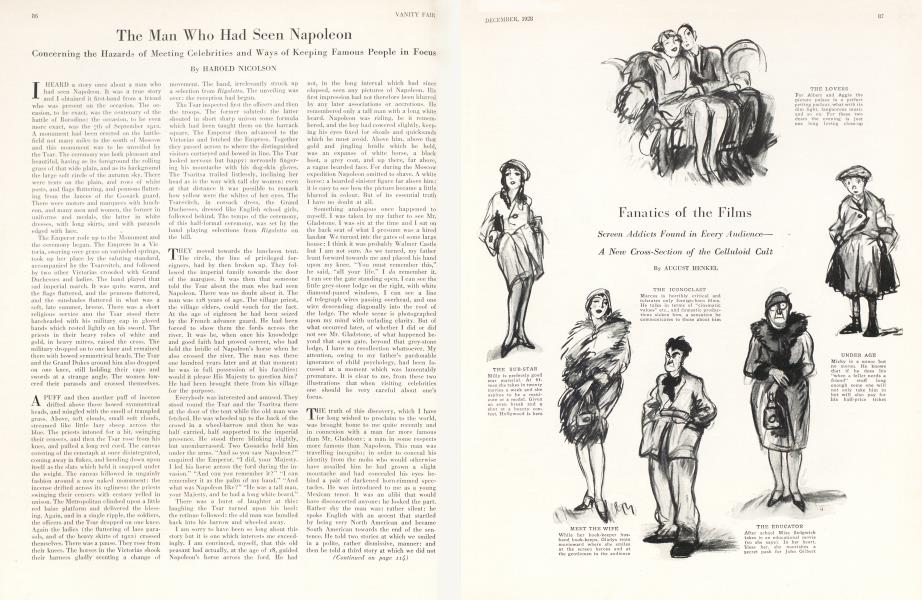
I HEARD a story once about a man who had seen Napoleon. It was a true story and I obtained it first-hand from a friend who was present on the occasion. The occasion, to be exact, was the centenary of the battle of Borodino: the occasion, to be even more exact, was the 7th of September 1912. A monument had been erected on the battlefield not many miles to the south of Moscow and this monument was to be unveiled by the Tsar. The ceremony was both pleasant and beautiful, having as its foreground the rolling grass of that wide plain, and as its background the large soft circle of the autumn sky. There were tents on the plain, and rows of white posts, and flags fluttering, and pennons fluttering from the lances of the Cossack guard. There were motors and marquees with luncheon, and many men and women, the former in uniforms and medals, the latter in white dresses, with long skirts, and with parasols edged with lace.
The Emperor rode up to the Monument and the ceremony began. The Empress in a Victoria, swaying over grass on varnished springs, took up her place by the saluting standard, accompanied by the Tsarevitch, and followed by two other Victorias crowded with Grand Duchesses and ladies. The band played that sad imperial march. It was quite warm, and the flags fluttered, and the pennons fluttered, and the sunshades fluttered in what was a soft, late summer, breeze. There was a short religious service ana the Tsar stood there bareheaded with his military cap in gloved hands which rested lightly on his sword. The priests in their heavy robes of white and gold, in heavy mitres, raised the cross. The military dropped on to one knee and remained there with bowed symmetrical heads. The Tsar and the Grand Dukes around him also dropped on one knee, still holding their caps and swords at a strange angle. The women lowered their parasols and crossed themselves.
A PUFF and then another puff of incense drifted above those bowed symmetrical heads, and mingled with the smell of trampled grass. Above, soft clouds, small soft clouds, streamed like little lazy sheep across the blue. The priests intoned for a bit, swinging their censers, and then the Tsar rose from his knee, and pulled a long red cord. The canvas covering of the cenotaph at once disintegrated, coming away in flakes, and bending down upon itself as the slats which held it snapped under the weight. The canvas billowed in ungainly fashion around a now naked monument: the incense drifted across its ugliness: the priests swinging their censers with ecstasy yelled in unison. The Metropolitan climbed upon a little red baize platform and delivered the blessing. Again, and in a single ripple, the soldiers, the officers and the Tsar dropped on one knee. Again the ladies (the fluttering of lace parasols, and of the heavy skirts of 1912) crossed themselves. There was a pause. They rose from their knees. The horses in the Victorias shook their harness gladly scenting a change of movement. The band, irrelevantly struck up a selection from Rigoletto. The unveiling was over: the reception had begun.
The Tsar inspected first the officers and then the troops. The former saluted: the latter shouted in short sharp unison some formula which had been taught them on the barrack square. The Emperor then advanced to the Victorias and fetched the Empress. Together they passed across to where the distinguished visitors curtseyed and bowed in line. The Tsar looked nervous but happy: nervously fingering his moustache with his dog-skin gloves. The Tsaritsa trailed listlessly, inclining her head as is the way with tall shy women: even at that distance it was possible to remark how yellow were the whites of her eyes. The Tsarevitch, in cossack dress, the Grand Duchesses, dressed like English school girls, followed behind. The tempo of the ceremony, of this half-formal ceremony, was set by the band playing selections from Rigoletto on the hill.
THEY moved towards the luncheon tent. The circle, the line of privileged foreigners, had by then broken up. They followed the imperial family towards the door of the marquee. It was then that someone told the Tsar about the man who had seen Napoleon. There was no doubt about it. The man was 118 years of age. The village priest, the village elders, could vouch for the fact. At the age of eighteen he had been seized by the French advance guard. He had been forced to show them the fords across the river. It was he, when once his knowledge and good faith had proved correct, who had held the bridle of Napoleon's horse when he also crossed the river. The man was there one hundred years later and at that moment: he was in full possession of his faculties: would it please His Majesty to question him? He had been brought there from his village for the purpose.
Everybody was interested and amused. They stood round the Tsar and the Tsaritsa there at the door of the tent while the old man was fetched. He was wheeled up to the back of the crowd in a wheel-barrow and then he was half carried, half supported to the imperial presence. He stood there blinking slightly, but unembarrassed. Two Cossacks held him under the arms. "And so you saw Napoleon?" enquired the Emperor. "I did, your Majesty. I led his horse across the ford during the invasion." "And can you remember it?" "I can remember it as the palm of my hand." "And what was Napoleon like?" "He was a tall man, your Majesty, and he had a long white beard."
There was a burst of laughter at this: laughing the Tsar turned upon his heel: the retinue followed: the old man was bundled back into his barrow and wheeled away.
I am sorry to have been so long about this story but it is one which interests me exceedingly. I am convinced, myself, that this old peasant had actually, at the age of 18, guided Napoleon's horse across the ford. He had not, in the long interval which had since elapsed, seen any pictures of Napoleon. His first impression had not therefore been blurred by any later associations or accretions. He remembered only a tall man with a long white beard. Napoleon was riding, be it remembered, and the boy had cowered slightly, keeping his eyes fixed for shoals and quicksands which he must avoid. Above him, above that gold and jingling bridle which he held, was an expanse of white horse, a black boot, a grey coat, and up there, far above, a vague bearded face. For during the Moscow expedition Napoleon omitted to shave. A white horse: a bearded sinister figure far above him: it is easy to see how the picture became a little blurred in colour. But of its essential truth I have no doubt at all.
Something analogous once happened to myself. I was taken by my father to see Mr. Gladstone. I was six at the time and I sat on the back seat of what I presume was a hired landau We turned intc the gates of some large house: I think it was probably Walmer Castle but I am not sure. As we turned, my father leant forward towards me and placed his hand upon my knee. "You must remember this," he said, "all your life." I do remember it. I can see the gate standing open. I can see the little grey-stone lodge on the right, with white diamond-paned windows. I can see a line of telegraph wires passing overhead, and one wire descending diagonally into the roof of the lodge. The whole scene is photographed upon my mind with unfading clarity. But of what occurred later, of whether I did or did not see Mr. Gladstone, of what happened beyond that open gate, beyond that grey-stone lodge, I have no recollection whatsoever. My attention, owing to my father's pardonable ignorance of child psychology, had been focussed at a moment which was lamentably premature. It is clear to me, from these two illustrations that when visiting celebrities one should be very careful about one's focus.
THE truth of this discovery, which I have for long wished to proclaim to the world, was brought home to me quite recently and in connexion with a man far more famous than Mr. Gladstone; a man in some respects more famous than Napoleon. This man was travelling incognito; in order to conceal his identity from the mobs who would otherwise have assailed him he had grown a slight moustache and had concealed his eyes behind a pair of darkened horn-rimmed spectacles. He was introduced to me as a young Mexican tenor. It was an alibi that would have disconcerted anyone: he looked the part. Rather shy the man was: rather silent: he spoke English with an accent that startled by being very North American and became South American towards the end of the sentence. He told two stories at which we smiled in a polite, rather dismissive, manner: and then he told a third story at which we did not smile at all. He went away after luncheon, leaving upon us no impression other than that of a dull young man in a blue serge suit and green tinted spectacles. Then, as a great secret, we were told who he was. I will not disclose the name as the young man is not now alive. Suffice it to say that at that date his very name would set pulses racing from Delhi to Vancouver. And to us, thinking him a Mexican tenor, he had seemed merely a young man in a blue serge suit. We were outraged at the imposture of which we had been victims. It was no merely snobbish gratification of which we had been cheated, it was a perfectly legitimate experience of which we had been deprived. This young man, without his background, was merely a young man. Not a very exciting thing. But we had been given no chance to put him to the test; we had paid him no attention; is it surprising if we felt that we had been cheated? And now the man is dead.
Continued on page 114
Continued, from page 86
I am deliberately provoking, by this story, an argument with which we are all familiar, and which of all arguments is most calculated to lead to bitter words. "Either," someone will say, "the man was interesting or he was not interesting. The fact that on discovering later that he was worldfamous you were annoyed at the deception shows only that you are guided in such matters by sheer blatant snobbishness." Not at all. Such an argument is analogous to that other idiotic argument (that acid test of the incurable fool) according to which a fake which is mistaken for an original is as good as an original. You know the argument. "What I want to know," this idiot-arguer will begin, "is why, if a picture is good enough to have deceived all the experts, it should lose all its value when once proved to be a fake. A picture which is classed as a Rembrandt in 1900, and valued at £40,000, is in 1908 shown not to be a Rembrandt and its value drops to £300. This shows what snobbish humbugs are all art-critics and all purchasers of works of art." But not at all. Not at all. A work of art is an expression of personality. Certain artists, owing to their general standard of excellence, their originality, their actual gifts, are known to possess highly significant personalities. It is not by one single picture that you judge a man's personality but by his whole output. It is your consciousness, your recollection of their general high standard which convinces you that such or such an artist furnishes you with a significant interpretation of life. The importance of a Shakespeare, a Dante or a Goethe is not due to any single line or any single passage; it is due to the fact that they each possessed and demonstrated throughout their work rich and original personalities, the expression of which added a new or finer interpretation to life. A faked Rembrandt is immeasurably less important than a real Rembrandt owing to the simple fact that it is not original, that it is merely imitative and that therefore it expresses no personality, conveys no interpretation of life. It ceases to have any value beyond a "furnishing" value, and as such is expensive at £300.
The same considerations apply to celebrities. There is no point in meeting celebrities if you meet them unaware. It is only when you have focussed your feelings to the correct degree of awe and reverence that you can profit by such encounters. And your focus must be exact. Too much reverence will make them loom mistily, they will all become tall Napoleons with long white beards. But complete unawareness of their fame is equally unfortunate. They will become just ordinary people like you and me. People in blue serge suits: people with a faint scent of tobacco about their clothes. That would be very unfortunate. If it leads to misprisal of our famous men, it leads, in the end, to mistrust of fame either as a criterion or an aim. People who frequendy meet celebrities when in a condition of emotional un-preparedness are apt to become cynical, or bohemian, or even irreverent. These are unpopular things to become. So that you must in future, when you meet celebrities, be very careful about your focus. Alternatively, it might be wiser not to meet celebrities at all. Or only incidentally. Or without thinking much one way or the other about whom one is meeting.
Subscribers have complete access to the archive.
Sign In Not a Subscriber?Join Now
