
Sign In to Your Account
Subscribers have complete access to the archive.
Sign In Not a Subscriber?Join NowSome Accomplished Female Liars
Celebrating a Few Young Ladies Whose False Testimony Decided Important Cases at Law
EDMUND PEARSON
A FAMOUS police official said that he had sometimes wished that girls, at the age of fourteen, could quietly be "put to sleep" by the State, and allowed to remain unconscious until they were eighteen, and ready to become normal and harmless women. Between those ages they caused altogether too much trouble to the police.
The adolescent liar flourishes at about that time, although it is hard to fix the limits. Ann Putnam was only twelve when she led the little band of hell-cats and kittens who caused nineteen persons to be hanged, and one to be pressed to death, in Salem in 1692.
She and her friends began by dabbling in spiritualism and the divination of dreams: today their amusement would be thought intelligent and even fashionable; it would be called psychic research and Freudian interpretation. It is impossible to say how far they lost control of themselves, and were helpless hysterics; and to what extent they knew they were swearing away the lives of innocent persons, because they were in so deep they dare not turn back.
Elizabeth Canning, the first famous victim of an "abduction", was eighteen. She was carried off in a "hackney coach",—and she is the spiritual ancestress of all the girls of today who come back after a two or three days' escapade, with tales of big, gray motor-cars, masked ruffians, and imprisonment in dank cellar or dismal attic. Their stories painfully lack originality.
THE Canning sisterhood, however, have a definite object for lying. It is not art for its own sake with them; they have need to account for their mysterious absences. If they are inventive enough, if they can be carried into Mexico, and be forced to walk for miles over the hot sands, they may even become romantic heroines.
The adolescent liar gets over it; the congenital liar may keep it up for long years. It is not, with her, an amusement of the golden years of youth. I know of a woman who apparently had not ceased her elaborate inventions at the age of thirty. She was, at first, an unattractive, quiet, well-behaved young woman of eighteen or nineteen, who was liked by a few women, and by no men whatsoever. Dreadful disasters would happen to her; painful injuries of a peculiar nature; so that she would be forced to stay at home. But she would send as a substitute, to the place where she worked, her twin-sister, Violet. Her friends, and especially her friends' mothers and older relatives, were much attached to Violet,—who dressed differently, was more animated, and even had different tastes in food from her sister Gertrude.
To this day, some of those older women refuse to believe what proved to be the truth: that Violet was merely Gertrude masquerading. They did not notice that they never saw the two together. How could they? Violet only appeared when Gertrude had had some fearful accident: had been in an explosion, or been burned by acid. For this was not only a case of congenital lying; it was a double personality as well.
Violet, too, suffered grievously; she was present at naval disasters, and subjected to terrible surgical operations. There was a tremendous craving for pity; hence these imaginary accidents. Both sisters were frequently on the verge of being wedded. Invitations were actually issued more than once for Gertrude's wedding; and gifts were received. All that prevented the marriage was the fact that the bridegrooms were as fictitious as sister Violet.
This of course, was pitiful,—especially for relatives and friends to whom it brought acute embarrassment. What made it curious was that for three quarters of the time, Gertrude was a particularly correct, apparently normal, and totally uninteresting person.
These are usually cases for the physician or learned alienist; not for the law. All that the law should do is to take care that no innocent person suffers as a result of accusations made by one of these lying ladies. Since they almost invariably do make accusations; and usually against men; and since their accusations are almost always of a nature which four out of five persons are instantly ready to believe, whether the man is a saintly archbishop, or a school-boy, it is depressing to reflect how many men in the past have dangled at the end of a rope, or dragged out long years in prison, because of the glib inventions and detailed accusations of some girl of fifteen or sixteen.
The imaginary injuries and the imaginary betrothals in the case of Gertrude and Violet were duplicated in two trials, each famous in its day, in England and France. One was merely annoying and expensive to its victim; and amusing to everyone else. The other was extremely odd, but rather tragic.
On St. Valentine's Day, in 1846, Miss Mary Elizabeth Smith, then aged nineteen, brought suit in London for £20,000 against a peer of the realm, only three or four years her senior. He was the Earl Ferrers, and he had been known, before his grandfather's death, as the Rt. Hon. Washington Shirley, Viscount Tamworth. And he—so said Miss Smith, through a formidable array of eminent lawyers—had most cruelly withered her young heart, by marrying another, when he was engaged, betrothed, plighted and sworn to love and marry only her,—Miss Smith.
HE had loved her, this wicked nobleman, for six years, or ever since she was a little maid of thirteen. He rode across country— on his great horse Zimro—from his estates, to her more lowly home, to pay court to her. He wrote her letters; dozens, scores of letters. They were produced in Court. The date of the wedding had been set for the summer that Lord Ferrers came of age. The trousseau was ordered, and so was the cake. The bridesmaids had been nominated,—and everything was ready, when a notice appeared in the papers that the base Earl had married somebody else.
How Miss Smith's lawyers came to take up with the case, and how such a great legal gun as the Solicitor General for the Crown came into it on her side, it is hard to see. For when the tale of the aching heart was laid before the Court, and all therein sat aghast at the wickedness of this peer of highest station, one of his lawyers arose and unfolded his defence. And this was that he had never written her a letter; had never ridden over on his great horse Zimro, nor any other; and had never spoken to her, nor even seen her in his life.
And he proved it. Miss Smith had written all these dozens of love-letters to herself; had arranged the marriage; hoaxing her parents, or at least her father; had bought millinery for the imaginary wedding; and concocted the whole business out of the depths of her fancy and her supernatural equipment as a liar.
In this suit, at all events, there was a material object: the cash damages. The romance had been built up—in her own mind—long before. But in the French case, the explanation is more difficult, and more certainly belongs in the class of abnormalities. This is not to say that it could not have been checked, at the beginning, by some simple physical remedy, —of one kind or another.
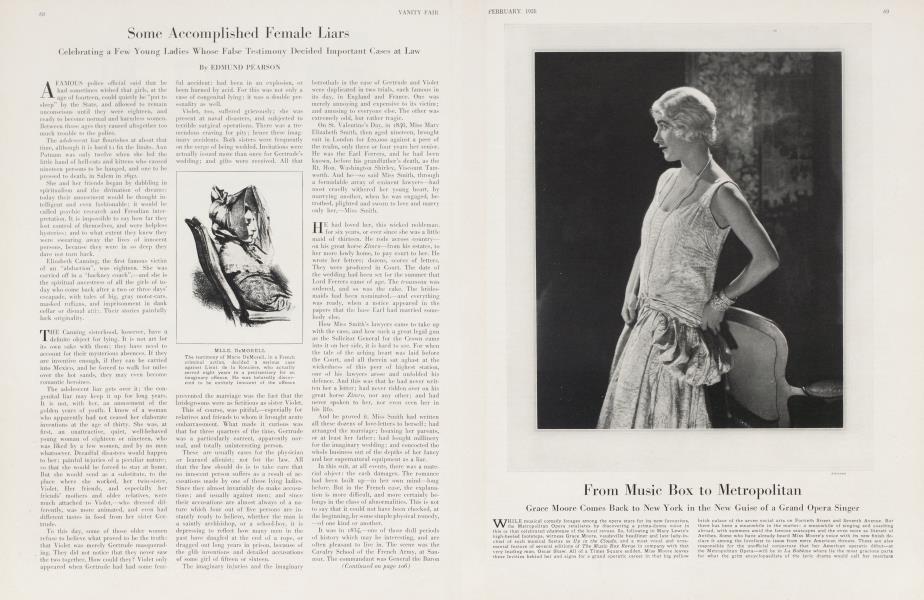
It was in i834,—one of those dull periods of history which may be interesting, and are often pleasant to live in. The scene was the Cavalry School of the French Army, at Saumur. The commandant was General the Baron de Morell, whose family lived in Paris, but came to Saumur in the summer. They were Madame de Morell; a son, aged twelve; and a daughter, named Marie, aged sixteen.
(Continued on page 106)
(Continued from page 68)
The de Morells had been bothered in Paris by anonymous letters, and now, in this summer at Saumur, the plague broke out again. Everyone seemed to get them: the General, his wife, their daughter, and her English governess. Strange incidents began to happen; unknown men pushed notes in at doors, or peered in at windows. No one seemed to notice that only Marie saw these unknown men.
She was insulted one evening, after a dinner party, by Lieutenant de la Ronciere, who compared her beauty most unfavorably with that of her mother. This young subaltern was the son of another titled general,—one of Napoleon's distinguished veterans.
The letters, which now began to come in a flood, were often signed by his initials—E. de la R. Sometimes they were avowals of affection for the mother; more often they were expressions of hatred for Marie. Modern psychology would probably have explained this, quickly and correctly. It is strange that the explanation did not occur to anyone at the time.
Finally, at two o'clock one morning, the privacy of the virginal bed-chamber was invaded by a man in deep disguise. He climbed in at the window, called out that he was bent on revenge; tied and gagged the terrified girl; stabbed her two or three times with a small knife; and bit her right wrist. The governess came, in response to the cries of Marie, and found her lying on the floor in her chemise, a handkerchief around her neck and a cord round her body. But the man had gone; the governess did not see him.
(Continued on page 118)
(Continued from page 106)
Nobody saw him, except the persecuted Mademoiselle de Morell. The glass from the broken window-pane, where the man entered, had fallen outside, instead of in. Mademoiselle told the governess that she thought she recognized M. de la Roncière. Later, she was sure of it.
The anonymous messages continued; the lieutenant was involved in a duel with another officer; and finally, owing to the almost universal opinion of his brother officers that he was the letterwriter, was coerced into signing a partial confession of guilt. He did this, believing the evidence against him was so overwhelming that it was his only hope of escape from a long sentence.
His trial became an enormous political sensation, which divided France into two camps, and was notorious throughout Europe. A number of experts testified that the letters w:ere not in his handwriting, and that they were unmistakably in the hand of Marie. Moreover, the paper on which one of the letters was written was conclusively shown to be of a peculiar kind, matching exactly with some which the girl used.
All this availed nothing against her testimony. By the time the trial came on she was having periodical "attacks" of a nervous character, which occurred at certain precise times each day. The only possible hour for her to testify was at midnight, so she entered the Court at a special midnight session, and was conducted to a large arm-chair. She absolutely identified Lieutenant de la Ronciere as the man who came into her room, and treated her so cruelly.
As a result, he was found guilty of "attempting to commit an outrage", and of having wilfully wounded her. He was sent to prison for ten years. He actually served eight. There was, later, after his release, a legal investigation, which seems to have been equal to a reversal of the sentence. He was made a Commandant in the National Guard, and afterwards held high official appointments, retiring with the Legion of Honor.
A few years after the trial, Marie married a Marquis, and lived in sanctity: a good mother and a gracious and bountiful lady, I wonder if she was ever troubled by thoughts of M. de la Ronciere; his eight years in prison and his disgraced father. Her patient malice is hard to explain or excuse altogether on the ground of abnormality, and, however shocking to psychologists the suggestion may be, it is conceivable that, at the very beginning, the devils could have been cast out by three sound spankings.
Subscribers have complete access to the archive.
Sign In Not a Subscriber?Join Now

