Sign In to Your Account
Subscribers have complete access to the archive.
Sign In Not a Subscriber?Join NowThe Learned Murderer
An American Example of Crime Among the Erudite—Rulloff, the Philologist
EDMUND PEARSON
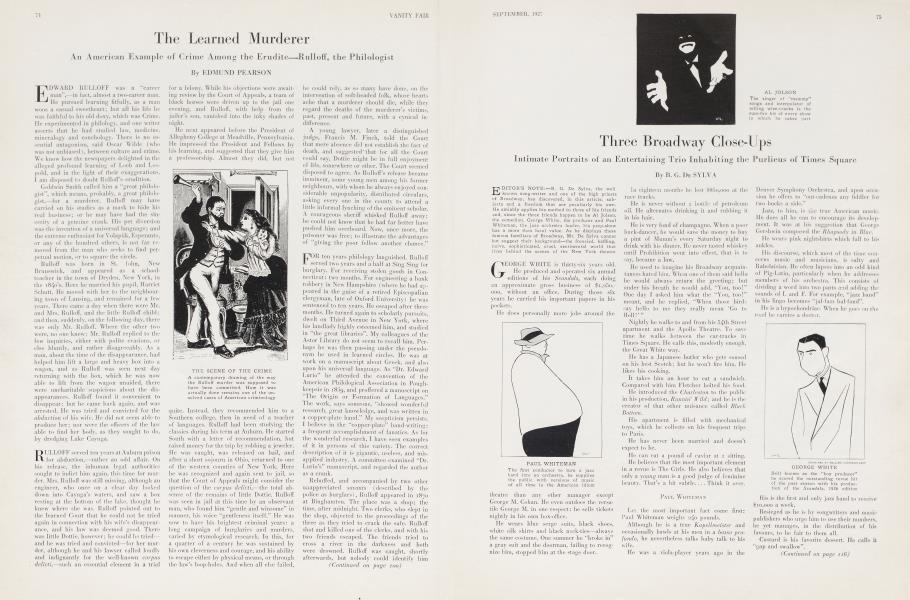
EDWARD RULLOFF was a "career man",—in fact, almost a two-career man. He pursued learning fitfully, as a man woos a casual sweetheart; but all his life he was faithful to his old doxy, which was Crime. He experimented in philology, and one writer asserts that he had studied law, medicine, mineralogy and conchology. There is no essential antagonism, said Oscar Wilde (who was not unbiased), between culture and crime. We know how the newspapers delighted in the alleged profound learning of Loeb and Leopold, and in the light of their exaggerations. I am disposed to doubt Rulloff s erudition.
Goldwin Smith called him a "great philologist", which means, probably, a great philologist,—for a murderer. Rulloff may have carried on his studies as a mask to hide his real business; or he may have had the sincerity of a genuine crank. His pet diversion was the invention of a universal language; and the extreme enthusiast for Volapük, Esperanto, or any of the hundred others, is not far removed from the man who seeks to find perpetual motion, or to square the circle.
Rulloff was horn in St. John, New Brunswick, and appeared as a schoolteacher in the town of Dryden, New York, in the i84o's. Here he married his pupil, Harriet Scluitt. He moved with her to the neighbouring town of Lansing, and remained for a few years. There came a day when there were Mr. and Mrs. Rulloff, and the little Rulloff child; and then, suddenly, on the following day, there was only Mr. Rulloff. Where the other two were, no one knew; Mr. Rulloff replied to the few inquiries, either with polite evasions, or else bluntly, and rather disagreeably. As a man, about the time of the disappearance, had helped him lift a large and heavy box into a wagon, and as Rulloff was seen next day returning with the box, which lie was now able to lift from the wagon unaided, there were uncharitable suspicions about the disappearances. Rulloff found it convenient to disappear; but he came hack again, and was arrested. He was tried and convicted for the abduction of his wife. He did not seem able to produce her; nor were the officers of the law able to find her body, as they sought to do, by dredging Lake Cayuga.
BULLOFF served ten years at.Auburn prison for abduction,—rather an odd affair. On his release, the inhuman legal authorities sought to indict him again, this time for murder. Mrs. Rulloff was still missing, although an engineer, who once on a clear day looked down into Cayuga's waters, and saw a box resting at the bottom of the lake, thought he knew where she was. Rulloff pointed out to the learned Court that he could not he tried again in connection with his wife's disappearance. and his law was deemed good. There was little Dottie. however; he could be tried— and he was tried and convicted—for her murder. although he and his lawyer called loudly and indignantly for the well-known corpus delicti,—such an essential element in a trial for a felony. While his objections were awaiting review by the Court of Appeals, a team of black horses were driven up to the jail one evening, and Rulloff, with help from the jailer's son, vanished into the inky shades of night.
He next appeared before the President of Allegheny College at Meadville, Pennsylvania. He impressed the President and Fellows by his learning, and suggested that they give him a professorship. Almost they did, but not quite. Instead, they recommended him to a Southern college, then in need of a teacher of languages. Rulloff had been studying the classics during his term at Auburn. He started South with a letter of recommendation, but raised money for the trip by robbing a jeweler. He was caught, was released on bail, and after a short sojourn in Ohio, returned to one of the western counties of New York. Here he was recognized and again sent to jail, so that the Court of Appeals might consider the question of the corpus delicti,—the total absence of the remains of little Dottie. Rulloff was seen in jail at this time by an observant man, who found him "gentle and winsome" in manner, his voice "gentleness itself." He was now to have his brightest criminal years: a long campaign of burglaries and murders, varied by etymological research. In this, for a quarter of a century he was sustained by his own cleverness and courage, and his ability to escape either by physical means, or through the law's loop-holes. And when all else failed, he could rely, as so many have done, on the intervention of soft-headed folk, whose hearts ache that a murderer should die, while they regard the deaths of the murderer's victims, past, present and future, with a cynical indifference.
A young lawyer, later a distinguished judge, Francis M. Finch, told the Court that mere absence did not establish the fact of death, and suggested * that for all the Court could say, Dottie might be in full enjoyment of life, somewhere or other. The Court seemed disposed to agree. As Rulloff's release became imminent, some young men among his former neighbours, with whom he always enjoyed considerable unpopularity, distributed circulars, asking every one in the county to attend a little informal lynching of the eminent scholar. A courageous sheriff whisked Rulloff away; he could not know that he had far better have pushed him overboard. Now, once more, the prisoner was free; to illustrate the advantages of 'giving the poor fellow another chance."
FOR ten years philology languished. Rulloff served two years and a half at Sing Sing for burglary. For receiving stolen goods in Connecticut: two months. For engineering a bank robbery in New Hampshire (where he had appeared in the guise of a retired Episcopalian clergyman, late of Oxford University) he was sentenced to ten years. He escaped after three months. He turned again to scholarly pursuits, dwelt on Third Avenue in New York, where his landlady highly esteemed him, and studied in "the great libraries". My colleagues of the Astor Library do not seem to recall him. Perhaps he was then passing under the pseudonym he used in learned circles. He was at work on a manuscript about Greek, and also upon his universal language. As "Dr. Edward Lurio" he attended the convention of the American Philological Association in Poughkeepsie in 1839, and proffered a manuscript on ''The Origin or Formation of Languages." The work, says someone, "showed wonderful research, great knowledge, and was written in a copper-plate hand." My scepticism persists. I believe in tbe "copper-plate" hand-writing: a frequent accomplishment of fanatics. As for the wonderful research, I have seen examples of it in persons of this variety. The correct description of it is gigantic, useless, and misapplied industry. A committee examined "Dr. Lurio's" manuscript, and regarded the author as a crank.
Rebuffed, and accompanied by two other unappreciated savants (described by the police as burglars), Rulloff appeared in 1870 at Binghamton. The place was a shop; the time, after midnight. Two clerks, who slept in the shop, objected to the proceedings of the three as they tried to crack the safe. Rulloff shot and killed one of the clerks, and with his two friends escaped. The friends tried to cross a river in the darkness and both were drowned. Rulloff was caught, shortly afterwards, but nobody could identify him as connected with the burglaries. At all events, a judge who happened to enter the Court where he was being examined recognized him as Rulloff. The scholar-gypsy instantly admitted his identity; said he knew that there had been a burglary and murder, and feared that if he were found in the vicinity he might be unjustly suspected, on account of the ill-feeling which existed in the matter of the accusation regarding his wife and little Dottie. The district attorney apologized. shook hands with him; hoped that Mr. Rulloff would pardon the law's blunder, and once more the persecuted man was free to go whither he listed.
(Continued on page 100)
(Continued from page 74)
He departed, but in a few hours someone recalled that a shoe, found at the scene of the murder, gave unmistakable signs of belonging to a man who had lost a great toe. Such a disaster had happened to Rulloff through frost-bite, during one of his escapes from prison. Again the pursuit began; the shoe fitted; and this tine, when the case came to trial, the corpus delicti was not wanting. The clever Mr. Rulloff had not been able to dispose of it as effectively as he had hidden his wife and child. The dead body of poor Merrick, murdered while trying to defend his employer's property, had been duly seen and recognized.
The other clerk, whose life had been spared, was conscientious. He refused to swear positively that lie had recognized Rulloff. But when that person insisted on cross-examining the witness, and questioned him again and again as to the degree of darkness in the shop, during the burglary, the clerk at last replied:
"Why, you know how dark it was! You were there!"
This led to applause in Court, and was perhaps prejudicial to the prisoner's interests. Few people in the neighbourhood of Binghamton seemed to behove that any injustice was threatened. however, when Rulloff was convicted and condemned to death. He played all his cards; he seized and fondled his precious manuscript in Court, and appealed to it as evidence of his good character. Rulloff, like Eugene Aram, insisted that he did not, himself, actually shoot Merrick. But this was no defence, even if true.
The opponents of capital punishment signed a petition to save his valuable life. They did this on two grounds; first, that he was insane; and second, that his was a matchless intellect, and that if he were hanged, a light of learning would be extinguished. (Another similarity of his case to that of Loeb and Leopold.) It was of no interest to them how many other lives, really valuable, might have been sacrificed if this savage were again spared. The Governor appointed two commissions to inquire into these contentions, and both commissions reported in the negative. Rulloff passed his final days in prison discussing his universal language; relating ribald anecdotes; and interviewing visitors. One of these was an emissary from Horace Greeley. The editor had become interested in the convict, and it happened that the man whom lie sent to the prison carried with him some proofs of Bayard Taylor's translation of Faust. Rulloff looked at these, and delivered a short discourse on the poem, and the merits of this version. Yet the relentless officers of the law stayed not their hands, and Rulloff, shortly afterwards, was duly hanged for the murder of a mere clerk,—just as if he were not the master of four or five languages.
His brain proved to weigh nine or ten ounces more than the average, and he had the forehead which indicates intellect. The width of the head between the ears, however, gave it the appearance of a bull. To-day, he might have been saved from the gallows, but the persons whom he would have killed would have been just as dead as if he had known but one language, and had never studied "law, medicine, mineralogy and conchology."
Subscribers have complete access to the archive.
Sign In Not a Subscriber?Join Now
