Sign In to Your Account
Subscribers have complete access to the archive.
Sign In Not a Subscriber?Join NowAmerica, the Misunderstood
The Contradictory Views of Old and New France in Regard to the United States
PAUL MORAND
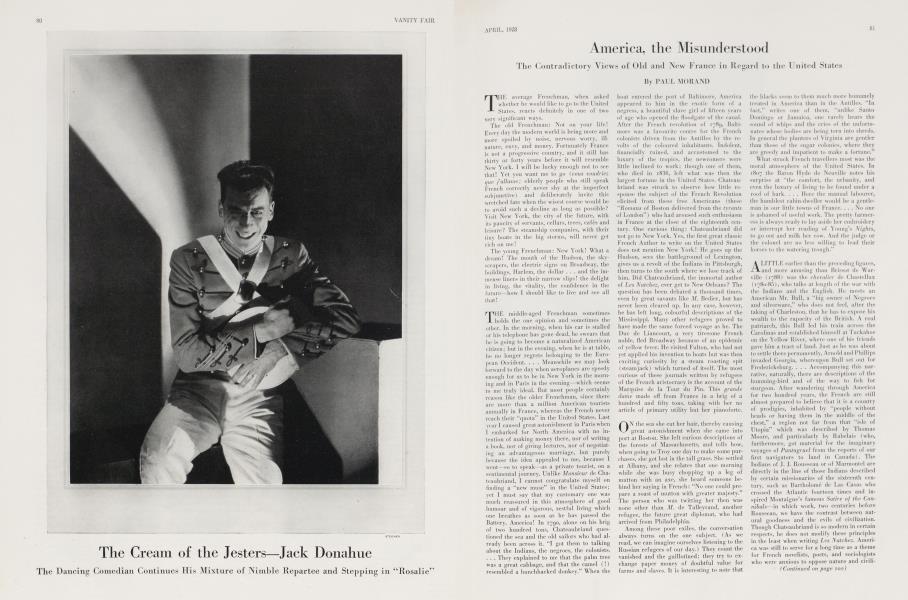
THE average Frenchman, when asked whether he would like to go to the United States, reacts definitely in one of two very significant ways.
The old Frenchman: Not on your life! Every day the modern world is being more and more spoiled by noise, nervous worry, illnature, envy, and money. Fortunately France is not a progressive country, and it still has thirty or forty years before it will resemble New York. I will be lucky enough not to see that! Yet you want me to go (vous voudriez que fallasse; elderly people who still speak French correctly never shy at the imperfect subjunctive) and deliberately invite this wretched fate when the wisest course would be to avoid such a decline as long as possible? Visit New York, the city of the future, with its paucity of servants, cellars, trees, cafes and leisure? The steamship companies, with their tiny boats in the big storms, will never get rich on me!
The young Frenchman: New York! What a dream! The mouth of the Hudson, the skyscrapers, the electric signs on Broadway, the buildings, Harlem, the dollar . . . and the immense liners in their narrow slips! the delight in living, the vitality, the confidence in the future—how I should like to live and see all that!
THE middle-aged Frenchman sometimes holds the one opinion and sometimes the other. In the morning, when his car is stalled or his telephone has gone dead, he swears that he is going to become a naturalized American citizen; but in the evening, when he is at table, he no longer regrets belonging to the European Occident. . . . Meanwhile we may look forward to the day when aeroplanes are speedy enough for us to be in New York in the morning and in Paris in the evening—which seems to me truly ideal. But most people certainly reason like the older Frenchman, since there are more than a million American tourists annually in France, whereas the French never reach their "quota" in the United States. Last year I caused great astonishment in Paris when I embarked for North America with no intention of making money there, nor of writing a book, nor of giving lectures, nor of negotiating an advantageous marriage, but purely because the idea appealed to me, because I went—so to speak—as a private tourist, on a sentimental journey. Unlike Monsieur de Chateaubriand, I cannot congratulate myself on finding a "new muse" in the United States; yet I must say that my customary one was much reassured in this atmosphere of good humour and of vigorous, zestful living which one breathes as soon as he has passed the Battery. America! In 1790, alone on his brig of two hundred tons, Chateaubriand questioned the sea and the old sailors who had already been across it. "I got them to talking about the Indians, the negroes, the colonists. . . . They explained to me that the palm tree was a great cabbage, and that the camel (!) resembled a hunchbacked donkey." When the boat entered the port of Baltimore, America appeared to him in the exotic form of a negress, a beautiful slave girl of fifteen years of age who opened the floodgate of the canal. After the French revolution of 1789, Baltimore was a favourite centre for the French colonists driven from the Antilles by the revolts of the coloured inhabitants. Indolent, financially ruined, and accustomed to the luxury of the tropics, the newcomers were little inclined to work; though one of them, who died in i836, left what was then the largest fortune in the United States. Chateaubriand was struck to observe how little response the subject of the French Revolution elicited from these free Americans (these "Romans of Boston delivered from the tyrants of London") who had aroused such enthusiasm in France at the close of the eighteenth century. One curious thing: Chateaubriand did not go to New York. Yes, the first great classic French Author to write on the United States does not mention New York! He goes up the Hudson, sees the battleground of Lexington, gives us a revolt of the Indians in Pittsburgh, then turns to the south where we lose track of him. Did Chateaubriand, the immortal author of Les Natchez, ever get to New Orleans? The question has been debated a thousand times, even by great savants like M. Bedier, but has never been cleared up. In any case, however, he has left long, colourful descriptions of the Mississippi. Many other refugees proved to have made the same forced voyage as he. The Due de Liancourt, a very tiresome French noble, fled Broadway because of an epidemic of yellow fever. He visited Fulton, who had not yet applied his invention to boats but was then exciting curiosity by a steam roasting spit (steamjack) which turned of itself. The most curious of these journals written by refugees of the French aristocracy is the account of the Marquise de la Tour du Pin. This grande dame made off from France in a brig of a hundred and fifty tons, taking with her no article of primary utility but her pianoforte.
ON the sea she cut her hair, thereby causing great astonishment when she came into port at Boston. She left curious descriptions of the forests of Massachusetts, and tells how, when going to Troy one day to make some purchases, she got lost in the tall grass. She settled at Albany, and she relates that one morning while she was busy chopping up a leg of mutton with an axe, she heard someone behind her saying in French: "No one could prepare a roast of mutton with greater majesty." The person who was twitting her then was none other than M. de Talleyrand, another refugee, the future great diplomat, who had arrived from Philadelphia.
Among these poor exiles, the conversation always turns on the one subject. (As we read, we can imagine ourselves listening to the Russian refugees of our day.) They count the vanished and the guillotined; they try to exchange paper money of doubtful value for farms and slaves. It is interesting to note that the blacks seem to them much more humanely treated in America than in the Antilles. "In fact," writes one of them, "unlike Santo Domingo or Jamaica, one rarely hears the sound of whips and the cries of the unfortunates whose bodies are being torn into shreds. In general the planters of Virginia are gentler than those of the sugar colonies, where they are greedy and impatient to make a fortune."
What struck French travellers most was the moral atmosphere of the United States. In 1807 the Baron Hyde de Neuville notes his surprise at "the comfort, the urbanity, and even the luxury of living to be found under a roof of bark. . . . Here the manual labourer, the humblest cabin-dweller would be a gentleman in our little towns of France. ... No one is ashamed of useful work. The pretty farmeress is always ready to lay aside her embroidery or interrupt her reading of Young's Nights, to go out and milk her cow. And the judge or the colonel are no less willing to lead their horses to the watering trough."
A LITTLE earlier than the preceding figures, and more amusing than Brissot de Warville (1788) was the chevalier de Chastellux (1780-85), who talks at length of the war with the Indians and the English. He meets an American Mr. Bull, a "big owner of Negroes and silverware," who does not feel, after the taking of Charleston, that he has to expose his wealth to the rapacity of the British. A real patriarch, this Bull led his train across the Carolinas and established himself at Tuckahoe on the Yellow River, where one of his friends gave him a tract of land. Just as he was about to settle there permanently, Arnold and Phillips invaded Georgia, whereupon Bull set out for Fredericksburg. . . . Accompanying this narrative, naturally, there are descriptions of the humming-bird and of the way to fish for sturgeon. After wandering through America for two hundred years, the French are still almost prepared to believe that it is a country of prodigies, inhabited by "people without heads or having them in the middle of the chest," a region not far from that "isle of Utopia" which was described by Thomas Moore, and particularly by Rabelais (who, furthermore, got material for the imaginary voyages of Pantagruel from the reports of our first navigators to land in Canada). The Indians of J. J. Rousseau or of Marmontel are directly in the line of those Indians described by certain missionaries of the sixteenth century, such as Bartholome de Las Casas who crossed the Atlantic fourteen times and inspired Montaigne's famous Satire of the Cannibals—in which work, two centuries before Rousseau, we have the contrast between natural goodness and the evils of civilization. Though Chateaubriand is so modern in certain respects, he does not modify these principles in the least when writing Les Natchez. America was still to serve for a long time as a theme for French novelists, poets, and sociologists who were anxious to oppose nature and civilization, the goodness of God and the wickedness of man. Who could have foreseen then that the time would come when exactly the contrary attitude would be held? To-day, when such men as Ghandi and Keyserling want to question our Occidental civilization and oppose it to the immutable wisdom of the Orient, is it not modern America that serves as their text?
Continued on page 102
Continued from page 81
Except for the voyage of a prince of the family of Orleans who came to combat the anti-abolitionists, and some accounts of French evangelists in the West, the period of 1835 to 1870 is quite devoid of documents to do with French travellers in the United States. After 1850, there are some republicans exiled by Napoleon II who left curious records. In 1858, a French author Assolant, who has since been forgotten, made himself famous by his short stories on life in America. He describes here the new California where "since the invention of revolvers, the least dispute ends in gun-fire," and he treats his contemporaries to the spectacle of an America filled with "dishonest judges, journalists with a price, ranting divines who juggle with their sermons like a clown tossing bottles, thefts, massacres, eyes gouged out, and noses eaten away." The French, who are loath to modify their judgments, were to see the whole of America in terms of this "rough life" until the close of the nineteenth century. The first of the modern French travellers to break with this tradition which confused Fifth Avenue with the Far West was the novelist Paul Bourget, who brought back from the United States the two volumes of Outre-Mer, which the New York Herald published in 1896. There are certainly many things in his books which make us smile; especially when he tells us of the "enormous liner of ten thousand tons" which brought him across the Atlantic, and of the skyscrapers "fourteen stories high", but Bourget was the first Frenchman to understand modern America, where he had come to take "an active cure," although the things he saw astonished and overwhelmed the old European in him enough to make him think at one time of calling his book American Shocks. But certain pages, notably those on high society, the upper set of Newport, and on the American woman, where he shows himself the docile disciple of Henry James, contain very subtle distinctions which may still apply today. Disengaging himself from the influ. ences of Fenimore Cooper and the romantic traditions, he discusses with intelligence the greatest of modern countries. And how many of us, since the war, have not observed for ourselves the experience which he describes at the beginning of his book? "After departing from France with a profound disquietude as to the future of society," Bourget writes, "I felt this attitude drop away in the atmosphere of action which prevails from New York to Florida."
Towards ttie close of the sixteenth century, the French Sulpician missionaries who were led by their Indian guides to the falls of Niagara, fell on their knees in admiration and intoned the Magnificat. In our days, it is on their arrival at New York that the voyagers are overwhelmed with admiration. They are no longer affected by the marvels of nature, but by the accomplishments of man. From Paul Bourget to Andre Maurois, in passing through Jules Huret, Chevrillon, or Marcel Prevost, what the travel documents now celebrate are Wall Street, the Equitable Building, or the Brooklyn Bridge. Very few spare us the stock yards of Chicago or the workshops of Detroit. All our early travellers are uniform in their disillusionment at coming to America in search of wealth and failing to find it. In his description of the American coast Jacques Cartier, who discovered Canada, writes in the pungent style of the sixteenth century: "it is full of rocks which are terrible and ill smoothed; neither marvellous animals, nor treasures." The "treasures" of America were not to be uncovered until four centuries later; and in accordance with an eternal and very moral law, man was to owe them to nothing but himself and his own industry.
Subscribers have complete access to the archive.
Sign In Not a Subscriber?Join Now
