
Sign In to Your Account
Subscribers have complete access to the archive.
Sign In Not a Subscriber?Join NowGoing to Jerusalem
PAUL MORAND
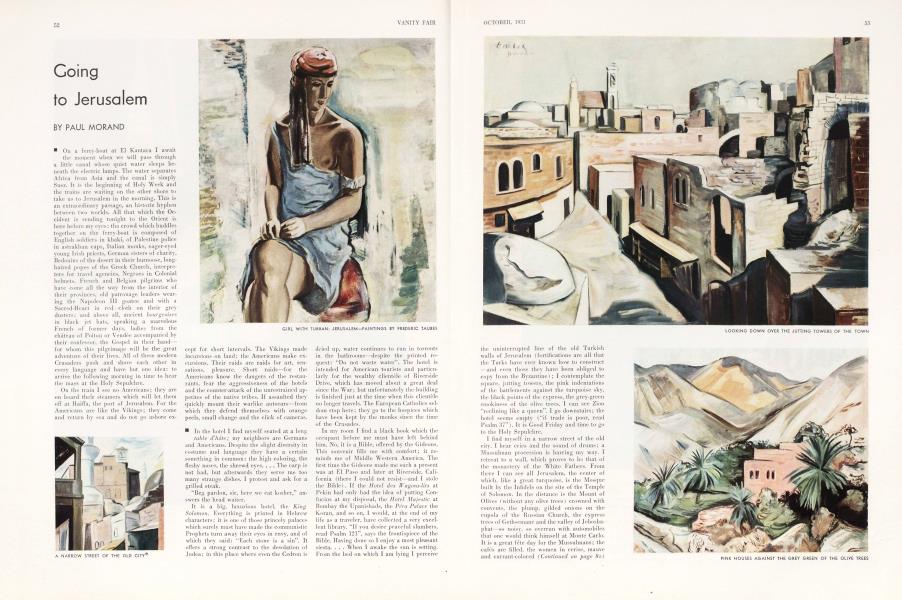
■ On a ferry-boat at El Kantara I await the moment when we will pass through a little canal whose quiet water sleeps beneath the electric lamps. The water separates Africa from Asia and the canal is simply Suez. It is the beginning of Holy Week and the trains are waiting on the other shore to take us to Jerusalem in the morning. This is an extraordinary passage, an historic hyphen between two worlds. All that which the Occident is sending tonight to the Orient is here before my eyes: the crowd which huddles together on the ferry-boat is composed of English soldiers in khaki, of Palestine police in astrakhan caps, Italian monks, eager-eyed young Irish priests, German sisters of charity, Bedouins of the desert in their burnoose, longhaired popes of the Greek Church, interpreters for travel agencies, Negroes in Colonial helmets, French and Belgian pilgrims who have come all the way from the interior of their provinces, old patronage leaders wearing the Napoleon 111 goatee and with a Sacred-Heart in red cloth on their grey dusters; and above all. ancient bourgeoises in black jet hats, speaking a marvelous French of former days, ladies from the chateau of Poitou or Vendee accompanied by their confessor, the Gospel in their hand— for whom this pilgrimage will be the great adventure of their lives. All of these modern Crusaders push and shove each other in every language and have hut one idea: to arrive the following morning in time to hear the mass at the Holy Sepulchre.
On the train I see no Americans; they are on board their steamers which will let them off at Haiffa, the port of Jerusalem. For the Americans are like the Vikings; they come and return by sea and do not go ashore except for short intervals. The Vikings made incursions on land; the Americans make excursions. Their raids are raids for art, sensations, pleasure. Short raids—for the Americans know the dangers of the restaurants. fear the aggressiveness of the hotels and the counter-attack of the unrestrained appetites of the native tribes. If assaulted they quickly mount their warlike autocars—from which they defend themselves with orange peels, small change and the click of cameras.
In the hotel I find myself seated at a long table d'hote; my neighbors are Germans and Americans. Despite the slight diversity in costume and language they have a certain something in common: the high coloring, the fleshy noses, the shrewd eyes. . . . The carp is not bad, but afterwards they serve me too many strange dishes. I protest and ask for a grilled steak.
"Beg pardon, sir, here we eat kosher," answers the head waiter.
It is a big, luxurious hotel, the King Solomon. Everything is printed in Hebrew characters; it is one of those princely palaces which surely must have made the communistic Prophets turn away their eyes in envy, and of which they said: "Each stone is a sin". It offers a strong contrast to the desolation of Judea; in this place where even the Cedron is dried up, water continues to run in torrents in the bathrooms—despite the printed request: "Do not waste water". The hotel is intended for American tourists and particularly for the wealthy clientele of Riverside Drive, which has moved about a great deal since the War; but unfortunately the building is finished just at the time when this clientele no longer travels. The European Catholics seldom stop here; they go to the hospices which have been kept by the monks since the time of the Crusades.
In my room 1 find a black book which the occupant before me must have left behind him. No, it is a Bible, offered by the Gideons. This souvenir fills me with comfort; it reminds me of Middle Western America. The first time the Gideons made me such a present was at El Paso and later at Riverside, California (there I could not resist—and I stole the Bible). If the Hotel des Wagons-lits at Pekin had only had the idea of putting Confucius at my disposal, the Hotel Majestic at Bombay the Upanishads, the Peru Palace the Koran, and so on, I would, at the end of my life as a traveler, have collected a very excellent library. "If you desire peaceful slumbers, read Psalm 121", says the frontispiece of the Bible. Having done so I enjoy a most pleasant siesta. . . . When I awake the sun is setting. From the bed on which I am lying I perceive the uninterrupted line of the old Turkish walls of Jerusalem (fortifications are all that the Turks have ever known how to construct —and even those they have been obliged to copy from the Byzantine) ; I contemplate the square, jutting towers, the pink indentations of the battlements against the turquoise sky, the black points of the cypress, the grey-green smokiness of the olive trees. I can see Zion "reclining like a queen". 1 go downstairs; the hotel seems empty ("if trade is poor, read Psalm 37"). It is Good Friday and time to go to the Holy Sepulchre.
I find myself in a narrow street of the old city. I hear cries and the sound of drums; a Mussulman procession is barring my way. I retreat to a wall, which proves to be that of the monastery of the White Fathers. From there I can see all Jerusalem, the center of which, like a great turquoise, is the Mosque built by the Infidels on the site of the Temple of Solomon. In the distance is the Mount of Olives (without any olive trees) crowned with convents, the plump, gilded onions on the cupola of the Russian Church, the cypress trees of Gethsemane and the valley of Jehoshaphat—so noisy, so overrun with automobiles that one would think himself at Monte Carlo. It is a great fete day for the Mussulmans; the cafes are filled, the women in cerise, mauve and currant-colored neckerchiefs are crowded together on the battlements.
(Continued on page 82)
(Continued from page 53)
"This Mussulman fete," a White Father tells me, "is only a recent thing. As the Arabs were not at all pleased to see only Christianity rejoicing on the occasion of Easter they pretended that they, too, had a procession and that they must make a pilgrimage to the tomb of Moses (who is also a Mussulman saint). Do you hear those tom-toms? Their idea is to make as much noise as possible, in order to drown out the music of our hymns."
"The English police," explains the White Father (a portly Dutchman with a red beard), "forbid the circulation of processions of two different religions in our streets at the same time, in order to do away with rioting. Therefore the Catholics have to await their turn to visit the different stations on the Way of the Cross. It is to annoy them and make it necessary for them to march in the dark and cold that the Mussulmans try to have their procession last as long as possible. ..."
Delightful waggishness of Jerusalem. Saintly controversies! Secular rivalries in the Holy Land. If music sooths the savage beasts certainly the same cannot he said for religions. Not only does the struggle between Jesus and Mohammed continue to take place here, hut it is even fiercer between the Coptic Church and the Abyssinian or Armenian Church—and above all. between the Roman Catholics and the Orthodox.
It is at the Holy Sepulchre that these internal quarrels attain their maximum. This church, built as fancy dictated, gaping with holes, where all civilizations have been crowded together, where different styles of architecture overlap each other promiscuously, is none the less the most touching monument in the universe. The Greeks call it the Center of the World and they are quite right. One should go at evening when the nightlamps are burning in the shadows like rubies, when one's feet slip over the worn cobblestones, when the mystic glow of a thousand changing lamps of gold and silver encircles the divine Tomb, bristling with candles; one hears all languages spoken; one sees all races pass. Shadows dance on the walls; faces lighted by the tapers stand out against the darkness. Here are a thousand kinds of architecture; it is a sort of prehistoric grotto, this sainted Sepulchre, where immobile, undefinalde beings pray or weep in the shadow. Certain priests receive their followers here, like actresses in their dressing-rooms; before the candelabra at Calvary an English official has, since the War, replaced the Turkish Janizary. ... On the roof of the Holy Sepulchre live the Abyssinians. These good Christian Negroes, the last to arrive, have been installed there for want of other room. . . . They form a veritable Little Africa on the cupolas; they are not looking for trouble with anyone; they are the meek of the Scriptures and they will perhaps he the only ones to inherit the Kingdom of Heaven.
The atmosphere of Jerusalem is the most ethnically active that I have ever known. Every house in the European quarter is the seat of an institution; German Protestant^ schools, JewishAmerican hospitals, Calvinist libraries, Roman dispensaries, Anglican kindergartens, Italian seminaries, convents for Russian nuns (where a woman says mass) ; there are more institutions than inhabitants; all opinions, all beliefs are mingled together—one would believe himself in Geneva. . . . This Good Friday I am enjoying the sunset in the lower city when, turning into a narrow lane, I hear the monotonous sound of praying; 1 have come upon the Wailing Wall. On the great antique stones from the base of the Temple of Solomon the English police have hung a telephone; if there is a disturbance between Arabs and Jews relief is sent immediately. From across the lane the tourists watch the Jews on the other side who, one hand touching the stone and one holding the prayer-book open, chant their psalms as they sway to and fro. There are wealthy Jews in "touloupe" of blue velvet, in grey silk levites, in coats lined with polecat and fur bonnets—as one sees them nowhere else hut in the Polish ghetto, behind the citadel of Cracow. There are the poor old men in torn and shiny overcoats; there are the young Zionists in knickerbockers; there is the impassioned, revolutionary Jew in a black frock coat, with red heard and green face. How far away we are here from the bar of the Hotel King Solomon; we are descending to the very depths of the ages. . . .
Has the Wandering Jew at last reached his goal? Today I asked myself this question while going from Judea to Galilee, across the Asiatic Far-West of the Zionist colonies. I thought of the Israelites who were finding here for the first time in many centuries a hospitable land when suddenly, last year, the quarrel with the Arabs threw everything once more into confusion. As to whether these Polaks are happier in the perfumed orange-groves which are being exploited due to the generosity of Baron Edmond tie Rothschild, in these plains of Balfouria and Tel Aviv, than in the evil-smelling ghettoes of Warsaw or Cernauti—one has only to look at them to find out. Among the herds of fine Dutch cattle young Zionists in elephant-leg trousers—very Broadway —intellectuals in horn-rimmed spectacles, pretty peasant women, all are prospering at last.
The English, pulled between the Jewish financiers of the Foundation in London and Mussulman India, tear their hair:—the Roman procurator of Judea had at least recourse to washing his hands of the affair. . . . Here the centuries pass and conquerors are replaced by other conquerors. One learns in Palestine as in Rome, as in Egypt, as in all lands steeped in eternity, not to take time into account.
"We have only been here seven hundred years," a White Father told me, in speaking of his monastery and, when I admired one of the walls encircling Zion, he said with some disdain: "It is new; it only dates from the time of Herod!" In Jerusalem centuries are but minutes.
Subscribers have complete access to the archive.
Sign In Not a Subscriber?Join Now

