Sign In to Your Account
Subscribers have complete access to the archive.
Sign In Not a Subscriber?Join NowThe girl who looked like Garbo
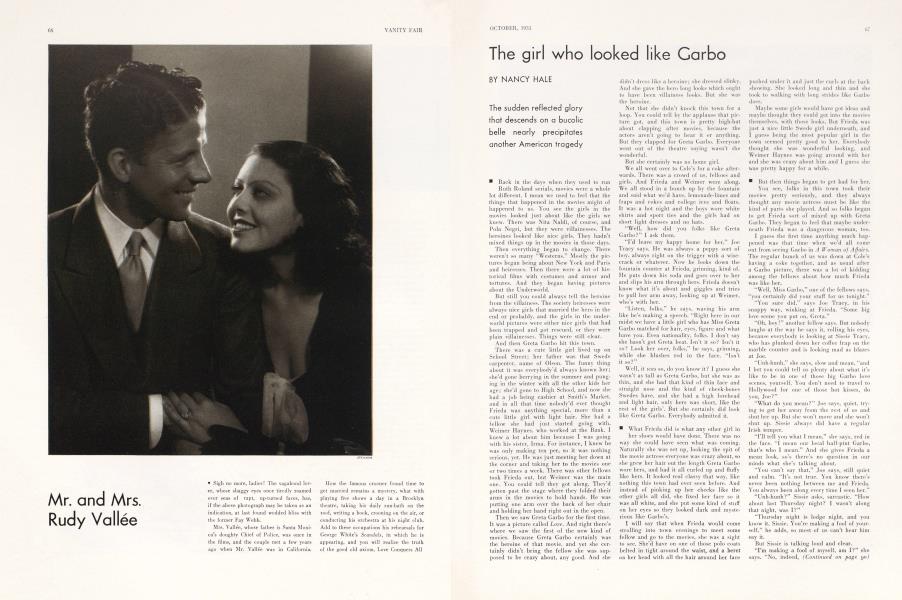
NANCY HALE
The sudden reflected glory that descends on a bucolic belle nearly precipitates another American tragedy
• Back in the days when they used to run Ruth Roland serials, movies were a whole lot different. I mean we used to feel that the things that happened in the movies might of happened to us. You see the girls in the movies looked just about like the girls we knew. There was Nita Naldi, of course, and Pola Negri, but they were villainesses. Tbe heroines looked like nice girls. They hadn't mixed things up in the movies in those days.
Then everything began to change. There weren't so many "Westerns." Mostly the pictures began being about New York and Paris and heiresses. Then there were a lot of historical films with costumes and armor and tortures. And they began having pictures about the Underworld.
But still you could always tell the heroine from the villainess. The society heiresses were always nice girls that married the hero in the end or probably, and the girls in the underworld pictures were either nice girls that had been trapped and got rescued, or they were plain villainesses. Things were still clear.
And then Greta Garbo hit this town.
There was a cute little girl lived up on School Street; her father was that Swede carpenter, name of Olson. The funny thing about it was everybody'd always known her; she'd gone berrying in the summer and punging in the winter with all the other kids her age; she'd gone to High School, and now she had a job being cashier at Smith's Market, and in all that time nobody'd ever thought Frieda was anything special, more than a cute little girl with light hair. She had a fellow she had just started going with, Weimer Haynes, who worked at the Bank. I knew a lot about him because I was going with his sister, Irma. For instance, I knew he was only making ten per, so it was nothing serious, yet. He was just meeting her down at the corner and taking her to the movies one or two times a week. There was other fellows took Frieda out, but Weimer was the main one. You could tell they got along. They'd gotten past the stage where they folded their arms in the movies to hold hands. He was putting one arm over the back of her chair and holding her hand right out in the open.
Then we saw Greta Garbo for the first time. It was a picture called Love. And right there's where we saw the first of the new kind of movies. Because Greta Garbo certainly wras tbe heroine of that movie, and yet she certainly didn't bring tbe fellow sbe was supposed to be crazy about, any good. And she didn't dress like a heroine; she dressed slinky. And she gave the hero long looks which ought to have been villainess looks. But she was the heroine.
Not that she didn't knock this town for a loop. You could tell by the applause that picture got, and this town is pretty high-hat about clapping after movies, because the actors aren't going to hear it or anything. But they clapped for Greta Garbo. Everyone went out of the theatre saying wasn't she wonderful.
But she certainly was no home girl.
We all went over to Cole's for a coke afterwards. There was a crowd of us, fellows and girls. And Frieda and Weimer were along. We all stood in a bunch up by the fountain and said what we'd have, lemonade-limes and fraps and cokes and college ices and floats. It was a hot night and the boys wore white shirts and sport ties and the girls had on short light dresses and no hats.
"Well, how did you folks like Greta Garbo?" I ask them.
"I'd leave my happy home for her," Joe Tracy says. He was always a peppy sort of boy, always right on the trigger with a wisecrack or whatever. Now he looks down the fountain counter at Frieda, grinning, kind of. He puts down his soda and goes over to her and slips his arm through hers. Frieda doesn't know what it's about and giggles and tries to pull her arm away, looking up at Weimer, who's with her.
"Listen, folks," he says, waving his arm like he's making a speech. "Right here in our midst we have a little girl who has Miss Greta Garbo matched for hair, eyes, figure and what have you. Even nationality, folks. I don't say she hasn't got Greta beat. Isn't it so? Isn't it so? Look her over, folks," he says, grinning, while she blushes red in the face. "Isn't it so?"
Well, it was so, do you know it? 1 guess she wasn't as tall as Greta Garbo, but she was as thin, and she had that kind of thin face and straight nose and the kind of cheek-bones Swedes have, and she had a high forehead and light hair, only hers was short, like the rest of the girls'. But she certainly did look like Greta Garbo. Everybody admitted it.
■ What Frieda did is what any other girl in her shoes would have done. There was no way she could have seen what was coming. Naturally she was set up, looking the spit of the movie actress everyone was crazy about, so she grew her hair out the length Greta Garbo wore hers, and had it all curled up and fluffy like hers. It looked real classy that way, like nothing this town had ever seen before. And instead of pinking up her cheeks like the other girls all did, she fixed her face so it was all white, and she put some kind of stuff on her eyes so they looked dark and mysterious like Garbo's.
I will say that when Frieda would come strolling into town evenings to meet some fellow and go to the movies, she was a sight to see. She'd have on one of those polo coats belted in tight around the waist, and a beret on her head with all the hair around her face pushed under it and just the curls at the back showing. She looked long and thin and she took to walking with long strides like Garbo does.
Maybe some girls would have got ideas and maybe thought they could get into the movies themselves, with those looks. But Frieda was just a nice little Swede girl underneath, and I guess being the most popular girl in the town seemed pretty good to her. Everybody thought she was wonderful looking, and Weimer Haynes was going around with her and she was crazy about him and l guess she was pretty happy for a while.
■ But then things began to get bad for her. You see, folks in this town took their movies pretty seriously, and they always thought any movie actress must be like the kind of parts she played. And so folks began to get Frieda sort of mixed up with Greta Garbo. They began to feel that maybe underneath Frieda was a dangerous woman, too.
I guess the first time anything much happened was that time when we'd all come out from seeing Garbo in A Woman of Affairs. The regular bunch of us was down at Cole's having a coke together, and as usual after a Garbo picture, there was a lot of kidding among the fellows about how much Frieda was like her.
"Well, Miss Garbo," one of the fellows says, "you certainly did your stuff for us tonight."
"You sure did," says Joe Tracy, in his snappy way, winking at Frieda. "Some big love scene you put on, Greta."
"Oh, boy!" another fellow says. But nobody laughs at the way he says it, rolling his eyes, because everybody is looking at Sissie Tracy, who has plunked down her coffee frap on the marble counter and is looking mad as blazes at Joe.
"Unh-hunb," she says, slow and mean, "and I bet you could tell us plenty about what it's like to be in one of those big Garbo love scenes, yourself. You don't need to travel to Hollywood for one of those hot kisses, do you, Joe?"
"What do you mean?" Joe says, quiet, trying to get her away from the rest of us and shut her up. But she won't move and she won't shut up. Sissie always did have a regular Irish temper.
"I'll tell you what I mean." she says, red in the face. "I mean our local half-pint Garbo, that's who I mean." And she gives Frieda a mean look, so's there's no question in our minds what she's talking about.
"You can't say that," Joe says, still quiet and calm. "It's not true. You know there's never been nothing between me and Frieda. You always been along every time I seen her."
"Unh-hunh?" Sissie asks, sarcastic. "How about last Thursday night? I wasn't along that night, was I?"
"Thursday night is lodge night, and you know it, Sissie. You're making a fool of yourself," he adds, so most of us can't hear him say it.
But Sissie is talking loud and clear.
"I'm making a fool of myself, am I?" she says. "No, indeed, Mr. Joseph Tracy, it's you that's making a fool of me, with that dirty little Swede there. Lodge night, huh? Lodging night's more like it. Why don't you tell us where you was lodging last Thursday night, Mr. Joseph Tracy?"
(Continued on page 90)
(Continued from page 67)
That was had. It made a had impression. Even if we knew it wasn't true, it kind of confirmed the feeling that had been going around that Frieda was a dangerous woman. Because it was hard to believe that anyone who looked as much like Garbo as Frieda did wasn't like her, too, I mean like the parts she played in the pictures. So it was had for Frieda. Folks who hadn't been in Cole's that night but who heard about it got the impression that maybe Joe was crazy about Frieda, although nobody did think that there had been anything between them there oughtn't to been.
So from then on Frieda really was a dangerous woman, people felt. The girls didn't seem too friendly with her, and the boys made a big thing out of taking her to the movies, kind of winking as they waited on the corner in the Center, and saying, "Oh, boy, guess who I'm stepping out with tonight," and things like that.
She was still dating with Weimer Haynes, but she wasn't dating any oftener than she had been for a year, now, and he'd had a raise at the bank and so they should have been going steady, if things had been right.
I felt real sorry for Frieda. By this time she was doing everything she could think of to stop looking like Greta Garbo. She cut her hair off short in a boyish bob, and she put stuff on her cheeks to make them pink, and she didn't put anything on her lips at all. She did everything she could to look like the other girls, and the fact was with her hair cut off she didn't look any more like Garbo than any other little Swede girl you might pick out. She didn't look a half as good-looking, neither.
Of course things blew over some after a while. 1 guess people still remembered about the row Sissie had made and the rest of it, but it was pretty stale gossip and they had other things to talk about.
Irma Haynes and me were going steady by that time, and evenings, sitting on the old black sofa up to her house holding hands, we often talked about Weimer and Frieda. Irma and I had worried about Frieda a lot and finally we got together and decided that we ought to talk to him about her. Well, anyway, we called Weimer into the parlor one night when we were sitting there and we heard him going out somewhere.
"Hey, Weim, where you going?" Irma says.
"1 got a date," he says, saying hello to me and giving me a Lucky.
"With Frieda?"
"You know she's the only girl I go out with," Weimer says.
"About time you and she were getting married, isn't it?" Irma says. "You and she've been going together two years or more. And you're making good pay at the bank now, so there's no reason I can see why you don't get married."
"Well!" says Weimer. I knew what he meant. He meant it was his business what he did. I knew how he felt but Irma was only doing it for his good.
"What reason is there?" Irma asks
him.
"No reason."
"I bet I know the reason," Irma says. "It's because of how folks said she was just like Greta Garbo, isn't it?" "No."
"It is so. Well, you listen to me;, Weimer Haynes, you're my brother and I wouldn't give you advice unle;ss I knew it was good advice. You're an awful fool if you don't marry Frieda Olson. She's as good a housekeeper as any girl in town and a lot better than some that do most of the talking. She'd make you a fine wife. And she's crazy about you. She never makes dates with any other fellows, does she?"
"No."
"Well then. I think it's a shame the way that poor little kid don't go out with any other fellows but you, and you won't ask her to marry you. Don't you love her?"
"Sure, I do," Weimer says. "If you hadn't been talking so hard I would of told you before that I was going to propose to her tonight."
"IJnh-hunh?" Irma says, kind of sisterly. "I know you, Weim Haynes. You say that because you don't like to let on anything I could say could make you do anything you weren't going to do anyway."
So he grins and goes out and next day we hear that they're engaged sure enough. And just like Irma said, the engagement seemed to blow over the last of the old gossip. Nobody said anything mean, and Frieda cheered up and looked so cute and excited when you saw her coming in evenings to the movies with Weimer, with her pink cheeks and her boyish bob. But the thing that happened about a week after they got engaged just began life over for Frieda, I guess. The way it happened was real comical. Irma and I just howled.
Wednesday nights the picture changes down at the movie house, and the new picture up on the bills was called Morocco, with a new star called Marlene Dietrich, who none of us had seen before. Well, the picture went over bigger in this town than anything we had seen for some time. There was clapping at the end of the picture, and that is a sure sign, as I said before. Afterwards, we all went down to Cole's for a coke, a big crowd of us, fellows and girls. Frieda and Weimer was along, drinking their fraps down at the end of the counter like a regular pair of love-birds.
There was plenty talk about Marlene Dietrich. The fellows were all for her. They thought she was the best thing they'd seen in years.
"She can pack her clothes in my trunk any time," one of the fellows says, rolling his eyes.
"Oh, boy!" says another.
"Marlene sure is some baby," says Joe Tracy. That fellow is always right on The trigger with some wise-crack. "She sure makes Greta Garbo look like just a home girl," he says now.
You should of seen Frieda's face.
Subscribers have complete access to the archive.
Sign In Not a Subscriber?Join Now
