Sign In to Your Account
Subscribers have complete access to the archive.
Sign In Not a Subscriber?Join NowA Machine Age Theatre
A Proposal That Modern Drama Follow an Ancient Greek Example and Justify Something
JOHN DOS PASSOS
§1
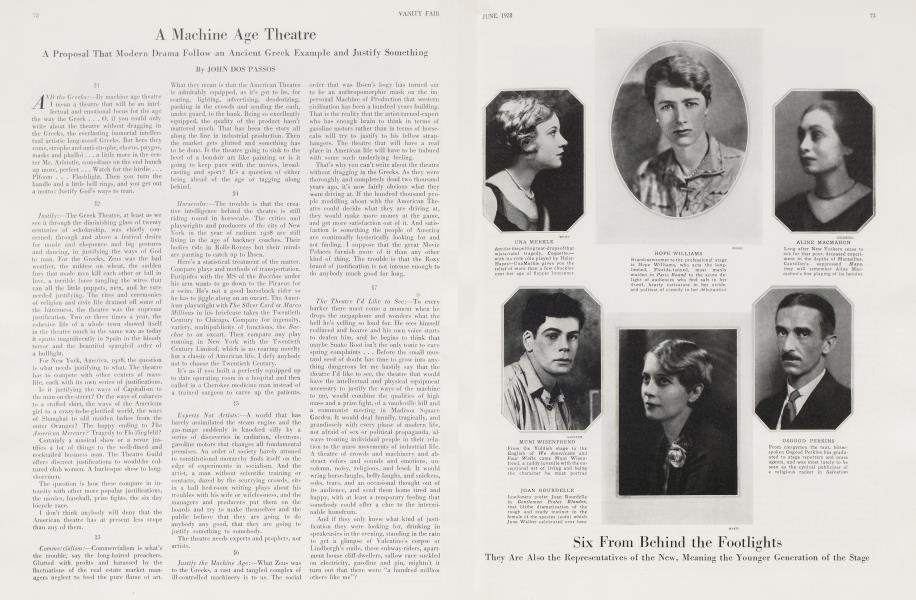
AND the Greeks:—By machine age theatre I mean a theatre that will be an intellectual and emotional focus for the age the way the Greek ... O, if you could only write about the theatre without dragging in the Greeks, the everlasting immortal intellectual artistic long-nosed Greeks. But here they come, strophe and anti-strophe, chorus, pnygos, masks and phalloi ... a little more in the center Mr. Aristotle, comedians on the end bunch up more, perfect. . . Watch for the birdie .. . Plfoom . . . Flashlight. Then you turn the handle and a little bell rings, and you get out a motto: Justify God's ways to man.
§2
Justify:—The Greek Theatre, at least as we see it through the diminishing glass of twenty centuries of scholarship, was chiefly concerned, through and above a festival desire for music and eloquence and big gestures and dancing, in justifying the ways of God to man. For the Greeks, Zeus was the bad weather, the mildew on wheat, the sudden fury that made men kill each other or fall in love, a terrible force tangling the wires that ran all the little puppets, men, and he sure needed justifying. The rites and ceremonies of religion and civic life drained off some of the bitterness, the theatre was the supreme justification. Two or three times a year, the cohesive life of a whole town showed itself in the theatre much in the same way as today it spurts magnificently in Spain in the bloody terror and the beautiful spangled order of a bullfight.
For New York, America, 1928, the question is what needs justifying to what. The theatre has to compete with other centers of masslife, each with its own series of justifications.
Is it justifying the ways of Capitalism to the man-on-the-street? Or the ways of cabarets to a stuffed shirt, the ways of the American girl to a crazy-to-be-glorified world, the ways of Shanghai to old maiden ladies from the outer Oranges? The happy ending to The American Mercury? Tragedy to Flo Ziegfeld?
Certainly a musical show or a revue justifies a lot of things to the well-dined and cocktailed business man. The Theatre Guild offers discreet justifications to would-be cultured club women. A burlesque show to longshoremen.
The question is how these compare in intensity with other more popular justifications, the movies, baseball, prize fights, the six day bicycle race.
I don't think anybody will deny that the American theatre has at present less scope than any of them.
§3
Commercialism:—Commercialism is what's the trouble, say the long-haired preachers. Glutted with profits and harassed by the fluctuations of the real estate market managers neglect to feed the pure flame of art. What they mean is that the American Theatre is admirably equipped, as it's got to be, for seating, lighting, advertising, deodorizing, packing in the crowds and sending the cash, under guard, to the bank. Being so excellently equipped, the quality of the product hasn't mattered much. That has been the story all along the line in industrial production. Then the market gets glutted and something has to be done. Is the theatre going to sink to the level of a boudoir art like painting or is it going to keep pace with the movies, broadcasting and sport? It's a question of either being ahead of the age or tagging along behind.
§4
Horsecabs:—The trouble is that the creative intelligence behind the theatre is still riding round in horsecabs. The critics and playwrights and producers of the city of New York in the year of radium 1928 are still living in the age of hackney coaches. Their bodies ride in Rolls-Royces but their minds are panting to catch up to Ibsen.
Here's a statistical treatment of the matter. Compare plays and methods of transportation. Euripides with the MS of the Bacchae under his arm wants to go down to the Piraeus for a swim. He's not a good horseback rider so he has to jiggle along on an oxcart. The American playwright with The Silver Cord or Marco Millions in his briefcase takes the Twentieth Century to Chicago. Compare for ingenuity, variety, multipublicity of functions, the Bacchae to an oxcart. Then compare any play running in New York with the Twentieth Century Limited, which is no roaring novelty but a classic of American life. I defy anybody not to choose the Twentieth Century.
It's as if you built a perfectly equipped up to date operating room in a hospital and then called in a Cherokee medicine man instead of a trained surgeon to carve up the patients.
§5
Experts Not Artists:—A world that has barely assimilated the steam engine and the gas-range suddenly is knocked silly by a series of discoveries in radiation, electrons, gasoline motors that changes all fundamental premises. An order of society barely attuned to constitutional monarchy finds itself on the edge of experiments in socialism. And the artist, a man without scientific training or contacts, dazed by the scurrying crowds, sits in a hall bed-room writing plays about his troubles with his wife or wifelessness, and the managers and producers put them on the boards and try to make themselves and the public believe that they are going to do anybody any good, that they are going to justify something to somebody.
The theatre needs experts and prophets, not artists.
§6
Justify the Machine Age:—What Zeus was to the Greeks, a vast and tangled complex of ill-controlled machinery is to us. The social order that was Ibsen's bogy has turned out to be an anthropomorphic mask on the impersonal Machine of Production that western civilization has been a hundred years building. That is the reality that the artist-turned-expert who has enough brain to think in terms of gasoline motors rather than in terms of horsecabs will try to justify to his fellow straphangers. The theatre that will have a real place in American life will have to be imbued with some such underlying feeling.
That's why you can't write about the theatre without dragging in the Greeks. As they were thoroughly and completely dead two thousand years ago, it's now fairly obvious what they were driving at. If the hundred thousand people muddling about with the American Theatre could decide what they are driving at, they would make more money at the game, and get more satisfaction out of it. And satisfaction is something the people of America are continually hysterically looking for and not finding. I suppose that the great Movie Palaces furnish more of it than any other kind of thing. The trouble is that the Roxy brand of justification is not intense enough to do anybody much good for long.
§7
The Theatre I'd Like to See:—To every barker there must come a moment when he drops the megaphone and wonders what the hell he's yelling so loud for. He sees himself redfaced and hoarse and his own voice starts to deafen him, and he begins to think that maybe Snake Root isn't the only tonic to cure spring complaints . . . Before the small mustard seed of doubt has time to grow into anything dangerous let me hastily say that the theatre I'd like to see, the theatre that would have the intellectual and physical equipment necessary to justify the ways of the machine to me, would combine the qualities of high mass and a prize fight, of a vaudeville bill and a communist meeting in Madison Square Garden. It would deal funnily, tragically, and grandiosely with every phase of modern life, not afraid of sex or political propaganda, always treating individual people in their relation to the mass movements of industrial life. A theatre of crowds and machinery and abstract colors and sounds and emotions, unsolemn, noisy, religious, and lewd. It would wring horse-laughs, belly-laughs, and snickers, sobs, tears, and an occasional thought out of its audience, and send them home tired and happy, with at least a temporary feeling that somebody could offer a clue to the interminable humdrum.
And if they only knew what kind of justification they were looking for, drinking in speakeasies in the evening, standing in the rain to get a glimpse of Valentino's corpse or Lindbergh's smile, these subway-riders, apartment house cliff-dwellers, sallow race suckled on electricity, gasoline and gin, mightn't it turn out that there were "a hundred million others like me"?
Subscribers have complete access to the archive.
Sign In Not a Subscriber?Join Now