Sign In to Your Account
Subscribers have complete access to the archive.
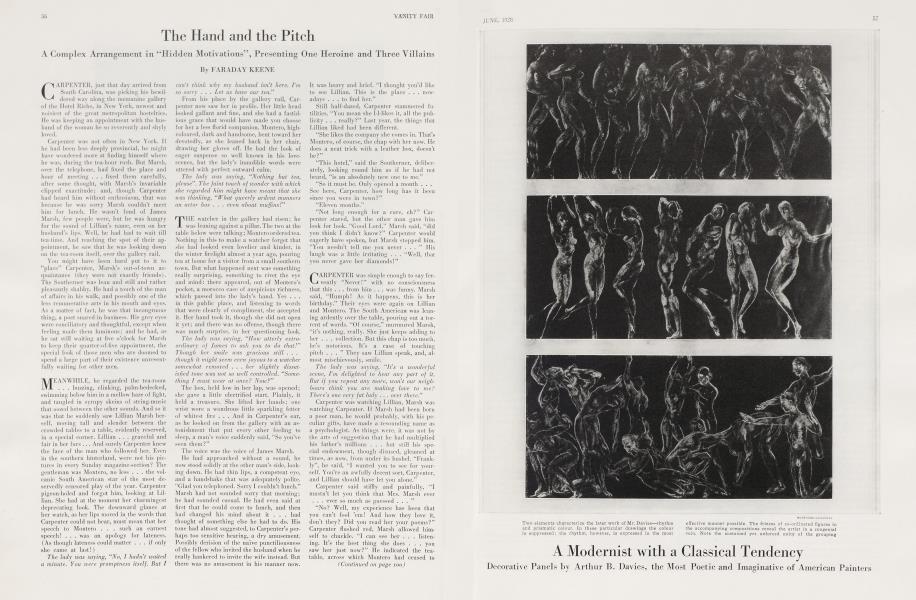
Sign In Not a Subscriber?Join NowThe Hand and the Pitch
A Complex Arrangement in "Hidden Motivations", Presenting One Heroine and Three Villains
FARADAY KEENE
CARPENTER, just that day arrived from South Carolina, was picking his bewildered way along the mezzanine gallery of the Hotel Riche, in New York, newest and noisiest of the great metropolitan hostelries. He was keeping an appointment with the husband of the woman he so reverently and shyly loved.
Carpenter was not often in New York. If he had been less deeply provincial, he might have wondered more at finding himself where he was, during the tea-hour rush. But Marsh, over the telephone, had fixed the place and hour of meeting . . . fixed them carefully, after some thought, with Marsh's invariable clipped exactitude; and, though Carpenter had heard him without enthusiasm, that was because he was sorry Marsh couldn't meet him for lunch. He wasn't fond of James Marsh, few people were, but he was hungry for the sound of Lillian's name, even on her husband's lips. Well, he had had to wait till tea-time. And reaching the spot of their appointment, he saw that he was looking down on the tea-room itself, over the gallery rail.
You might have been hard put to it to "place" Carpenter, Marsh's out-of-town acquaintance (they were not exactly friends). The Southerner was lean and still and rather pleasantly shabby. He had a touch of the man of affairs in his walk, and possibly one of the less remunerative arts in his mouth and eyes. As a matter of fact, he was that incongruous thing, a poet snared in business. His grey eyes were conciliatory and thoughtful, except when feeling made them luminous; and he had, as he sat still waiting at five o'clock for Marsh to keep their quarter-of-five appointment, the special look of those men who are doomed to spend a large part of their existence unresentfully waiting for other men.
MEANWHILE, he regarded the tea-room . . . buzzing, clinking, palm-bedecked, swimming below him in a mellow haze of light, and tangled in syrupy skeins of string-music that oozed between the other sounds. And so it was that he suddenly saw Lillian Marsh herself, moving tall and slender between the crowded tables to a table, evidently reserved, in a special corner. Lillian . . . graceful and fair in her furs ... And surely Carpenter knew the face of the man who followed her. Even in the southern hinterland, were not his pictures in every Sunday magazine-section? The gentleman was Montero, no less . . . the volcanic South American star of the most deservedly censored play of the year. Carpenter pigeon-holed and forgot him, looking at Lillian. She had at the moment her charmingest deprecating look. The downward glance at her watch, as her lips moved in the words that Carpenter could not hear, must mean that her speech to Montero . . . such an earnest speech! . . . was an apology for lateness. (As though lateness could matter ... if only she came at last!)
The lady was saying, "No, I hadn't waited a minute. You were promptness itself. But I can't think why my husband isn't here. I'm so sorry . . . Let us have our tea."
From his place by the gallery rail, Carpenter now saw her in profile. Her little head looked gallant and fine, and she had a fastidious grace that would have made you choose for her a less florid companion. Montero, highcoloured, dark and handsome, bent toward her devotedly, as she leaned back in her chair, drawing her gloves off. He had the look of eager suspense so well known in his lovescenes, but the lady's inaudible words were uttered with perfect outward calm.
The lady was saying, "Nothing but tea, please". The faint touch of wonder with which she regarded him might have meant that she was thinking, "What queerly ardent manners an actor has . . . even about muffins!"
THE watcher in the gallery had risen; he was leaning against a pillar. The two at the table below were talking; Montero ordered tea. Nothing in this to make a watcher forget that she had looked even lovelier and kinder, in the winter firelight almost a year ago, pouring tea at home for a visitor from a small southern town. But what happened next was something really surprising, something to rivet the eye and mind: there appeared, out of Montero's pocket, a morocco case of auspicious richness, which passed into the lady's hand. Yes . . . in this public place, and listening to words that were clearly of compliment, she accepted it. Her hand took it, though she did not open it yet; and there was no offense, though there was much surprise, in her questioning look.
The lady was saying, "How utterly extraordinary of James to ask you to do that!" Though her smile was gracious still . . . though it might seem even joyous to a watcher somewhat removed . . . her slightly dissatisfied tone was not so well controlled. "Something I must wear at once? Now?"
The box, held low in her lap, was opened; she gave a little electrified start. Plainly, it held a treasure. She lifted her hands; one wrist wore a wondrous little sparkling fetter of whitest fire . . . And in Carpenter's ear, as he looked on from the gallery with an astonishment that put every other feeling to sleep, a man's voice suddenly said, "So you've seen them?"
The voice was the voice of James Marsh. He had approached without a sound, he now stood solidly at the other man's side, looking down. He had thin lips, a competent eye, and a handshake that was adequately polite. "Glad you telephoned. Sorry I couldn't lunch." Marsh had not sounded sorry that morning; he had sounded casual. He had even said at first that he could come to lunch, and then had changed his mind about it . . . had thought of something else he had to do. His tone had almost suggested, to Carpenter's perhaps too sensitive hearing, a dry amusement. Possibly derision of the naive punctiliousness of the fellow who invited the husband when he really hankered to invite the wife instead. But there was no amusement in his manner now.
It was heavy and brief. "I thought you'd like to see Lillian. This is the place . . . nowadays ... to find her."
Still half-dazed, Carpenter stammered futilities. "You mean she l-l-likes it, all the publicity . . . really?" Last year, the things that Lillian liked had been different.
"She likes the company she comes in. That's Montero, of course, the chap with her now. He does a neat trick with a leather box, doesn't he?"
"This hotel," said the Southerner, deliberately, looking round him as if he had not heard, "is an absolutely new one to me."
"So it must be. Only opened a month . . . See here, Carpenter, how long has it been since you were in town?"
"Eleven months."
"Not long enough for a cure, eh?" Carpenter stared, but the other man gave him look for look. "Good Lord," Marsh said, "did you think I didn't know?" Carpenter would eagerly have spoken, but Marsh stopped him. "You needn't tell me you never ..." His laugh was a little irritating . . . "Well, that you never gave her diamonds!"
CARPENTER was simple enough to say fervently "Never!" with no consciousness that this . . . from him . . . was funny. Marsh said, "Humph! As it happens, this is her birthday." Their eyes were again on Lillian and Montero. The South American was leaning ardently over the table, pouring out a torrent of words. "Of course," murmured Marsh, "it's nothing, really. She just keeps adding to her . . . collection. But this chap is too much, he's notorious. It's a case of touching pitch ..." They saw Lillian speak, and, almost mischievously, smile.
The lady was saying, "It's a wonderful scene, I'm delighted to hear any part of it. But if you repeat any more, won't our neighbours think you are making love to me? There's one very fat lady . . . over there."
Carpenter was watching Lillian, Marsh was Avatching Carpenter. If Marsh had been born a poor man, he would probably, with his peculiar gifts, have made a resounding name as a psychologist. As things were, it was not by the arts of suggestion that he had multiplied his father's millions . . . but still his special endowment, though disused, gleamed at times, as now, from under its bushel. "Frankly", he said, "I wanted you to see for yourself. You're an awfully decent sort, Carpenter, and Lillian should have let you alone."
Carpenter said stiffly and painfully, "I mustn't let you think that Mrs. Marsh ever . . . ever so much as guessed . . . "
"No? Well, my experience has been that you can't fool 'em! And how they love it, don't they? Did you read her your poems?" Carpenter flushed red, Marsh allowed himself to chuckle. "I can see her . . . listening. It's the best thing she does . . . you saw her just now?" He indicated the teatable, across which Montero had ceased to lean. "I take it," he went on, "that you don't care to interrupt them at their parting?" Marsh was encouraging. "You can probably catch the scene if you hurry."
(Continued on page 100)
(Continued, from, page 56)
Downstairs at last, at the table whose third chair had stood empty, Marsh was making peace with his wife.
"But your message to me said five o'clock," she reminded him, "so precisely! To Mr. Montero, you said the same. And it's fortunate he is so easy to recognize; for how was he to know me? . . . You'll need a very good excuse indeed!"
"I was busy with something unexexpected," said Marsh, "that had come up this morning. I've had a lot to do ... . And I did make sure that one thing was on time: your birthday present. Much obliged to you, Montero, for stopping for it ... I see," he went on to his wife, "that you've humoured my wish to see it first on your wrist."
"It's a glorious thing. Though I nearly refused to put it on, because," she told him with frank amusement, "Mr. Montero was getting the credit of the gift from most of the neighbouring tables! But I saw one virtuous lady, so ready to be shocked, and I couldn't resist ... I shocked her."
"I'm glad you did," said Marsh truthfully. "Do 'em good .... Has Montero told you the news: that . . . since lunch-time . . . I'm backing his new play?"
"He even," she said, in the tone that suggests it is time to be going, "recited one scene of it to me. Most poetic."
"Speaking of poetry," said Marsh, as they rose, "I ran into Carpenter outside . . . Queer fish," he explained to Montero, "a poet manque, who runs a cotton-duck factory in South Carolina. He comes to town now and then, and maybe turns up at the house, if he can remember it. Reads his stuff to Lillian. I tried to drag him in, but he said he was off to his train. . . . Lillian, he sent you his regards."
She was very pale. "Had . . . Mr. Carpenter been long in New York?"
"I don't think so. He's never here more than a week or two," Marsh told her. "Montero, I've made out that memorandum for you; it's in this envelope. We'll have a conference later."
Only a man would have been sure, from the quality of the gesture, that the envelope had a check in it; only a woman would have noticed, without knowing why, that the famous South American star had suddenly about him, in bowing, something resembling that nice head-waiter at Biarritz.
But not more than a small and dim corner of Lillian Marsh's mind could have harboured that flitting impression. Her eyes were heroically blank, the eyes of a woman who, like Mr. Montero, was conscious of having received something that was not to be looked at until one was alone. . . . Her mind closing over it like a closed hand . . . Marsh was bidding their guest goodbye. "You'll be great in that part, Montero. Though always in any part you're good."
Montero's first response was not so much a smile as a grimace. But the appropriate words, almost simultaneous, were not lacking. "It's a privilege to work with you, Mr. Marsh ... at anything," said the pitch to the hand that had touched it.
Subscribers have complete access to the archive.
Sign In Not a Subscriber?Join Now
