

Sign In to Your Account
Subscribers have complete access to the archive.
Sign In Not a Subscriber?Join Nowinseparable
HENRI DUVERNOIS
the fable of the perfect friendship, showing that an entente of embonpoint requires parity in tonnage
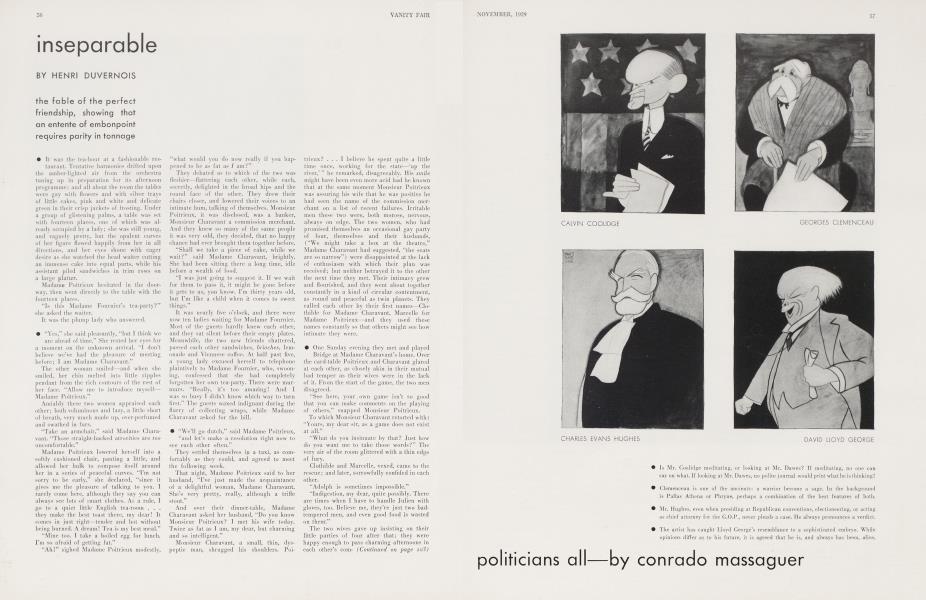
It was the tea-hour at a fashionable restaurant. Tentative harmonies drifted upon the amber-lighted air from the orchestra tuning up in preparation for its afternoon programme; and all about the room the tables were gay with flowers and with silver trays of little cakes, pink and white and delicate green in their crisp jackets of frosting. Under a group of glistening palms, a table was set with fourteen places, one of which was already occupied by a lady; she was still young, and vaguely pretty, but the opulent curves of her figure flowed happily from her in all directions, and her eyes shone with eager desire as she watched the head waiter cutting an immense cake into equal parts, while his assistant piled sandwiches in trim rows on a large platter.
Madame Poitrieux hesitated in the doorway, then went directly to the table with the fourteen places.
"Is this Madame Fournier's tea-party?" she asked the waiter.
It was the plump lady who answered.
"Yes," she said pleasantly, "but I think we are ahead of time." She rested her eyes for a moment on the unknown arrival. "I don't believe we've had the pleasure of meeting before; I am Madame Charavant."
The other woman smiled—and when she smiled, her chin melted into little ripples pendant from the rich contours of the rest of her face. "Allow me to introduce myself— Madame Poitrieux."
Amiably these two women appraised each other; both voluminous and lazy, a little short of breath, very much made up, over-perfumed and swathed in furs.
"Take an armchair," said Madame Charavant. "Those straight-backed atrocities are too uncomfortable."
Madame Poitrieux lowered herself into a softly cushioned chair, panting a little, and allowed her bulk to compose itself around her in a series of peaceful curves. "I'm not sorry to be early," she declared, "since it gives me the pleasure of talking to you. I rarely come here, although they say you can always see lots of smart clothes. As a rule, I go to a quiet little English tea-room . . . they make the best toast there, my dear! It comes in just right—tender and hot without being burned. A dream! Tea is my best meal."
"Mine too. I take a boiled egg for lunch. I'm so afraid of getting fat."
"Ah!" sighed Madame Poitrieux modestly, "what would you do now really if you happened to be as fat as I am?"
They debated as to which of the two was fleshier—flattering each other, while each, secretly, delighted in the broad hips and the round face of the other. They drew their chairs closer, and lowered their voices to an intimate hum, talking of themselves. Monsieur Poitrieux, it was disclosed, was a banker, Monsieur Charavant a commission merchant. And they knew so many of the same people it was very odd, they decided, that no happy chance had ever brought them together before.
"Shall we take a piece of cake, while we wait?" said Madame Charavant, brightly. She had been sitting there a long time, idle before a wealth of food.
"I was just going to suggest it. If we wait for them to pass it, it might be gone before it gets to us, you know. I'm thirty years old, but I'm like a child when it comes to sweet things."
It was nearly five o'clock, and there were now ten ladies waiting for Madame Fournier. Most of the guests hardly knew each other, and they sat silent before their empty plates. Meanwhile, the two new friends chattered, passed each other sandwiches, brioches, lemonade and Viennese coffee. At half past five, a young lady excused herself to telephone plaintively to Madame Fournier, who, swooning, confessed that she had completely forgotten her own tea-party. There were murmurs. "Really, it's too amazing! And I was so busy I didn't know which way to turn first." The guests waxed indignant during the flurry of collecting wraps, while Madame Charavant asked for the bill.
"We'll go dutch," said Madame Poitrieux, "and let's make a resolution right now to see each other often."
They settled themselves in a taxi, as comfortably as they could, and agreed to meet the following week.
That night, Madame Poitrieux said to her husband, "I've just made the acquaintance of a delightful woman, Madame Charavant. She's very pretty, really, although a trifle stout."
And over their dinner-table, Madame Charavant asked her husband, "Do you know Monsieur Poitrieux? I met his wife today. Twice as fat as I am, my dear, but charming and so intelligent."
Monsieur Charavant, a small, thin, dyspeptic man, shrugged his shoulders. Poitrieux? ... I believe he spent quite a little time once, working for the state—'up the river,'" he remarked, disagreeably. His smile might have been even more acid had he known that at the same moment Monsieur Poitrieux was assuring his wife that he was positive he had seen the name of the commission merchant on a list of recent failures. Irritable men these two were, both morose, nervous, always on edge. The two women, who had promised themselves an occasional gay party of four, themselves and their husbands, ("We might take a box at the theatre," Madame Charavant had suggested, "the seats are so narrow") were disappointed at the lack of enthusiasm with which their plan was received; but neither betrayed it to the other the next time they met. Their intimacy grew and flourished, and they went about together constantly in a kind of circular contentment, as round and peaceful as twin planets. They called each other by their first names—Clothilde for Madame Charavant, Marcelle for Madame Poitrieux—and they used these names constantly so that others might see how intimate they were.
One Sunday evening they met and played Bridge at Madame Charavant's home. Over the card-table Poitrieux and Charavant glared at each other, as closely akin in their mutual bad temper as their wives were in the lack of it. From the start of the game, the two men disagreed.
"See here, your. own game isn't so good that you can make comments on the playing of others," snapped Monsieur Poitrieux.
To which Monsieur Charavant retorted with: "Yours, my dear sir, as a game does not exist at all."
"What do you insinuate by that? Just how do you want me to take those words?" The very air of the room glittered with a thin edge of fury.
Clothilde and Marcelle, vexed, came to the rescue; and later, sorrowfully confided in each other.
"Adolph is sometimes impossible."
"Indigestion, my dear, quite possibly. There are times when I have to handle Julien with gloves, too. Believe me, they're just two badtempered men, and even good food is wasted on them."
The two wives gave up insisting on their little parties of four after that; they were happy enough to pass charming afternoons in each other's company. They met at four o'clock, and ate their cakes in the comfortable twilight of some favourite tea-room, letting the sweet morsels melt deliciously upon their tongues as they listened to the faint throbbing of the violins in the orchestra. After tea, they strolled only far enough to reach a taxi; and if, in the street, an urchin sometimes turned to stare at them and to comment impudently upon their size, they didn't mind—for each one thought that he meant the other. Together, they hunted up and found a dressmaker who swore that he could make them look like sylphs, who assured them lavishly of his vast success with the "full figures" of other women. They were contented. They had the same absence of opinion about everything; the same placid agreement with everything; a smiling fatalism, a passivity which even the snarlings of their husbands failed to disturb. The antipathy which the two men manifested toward each other only served to bind the women more closely together, to encompass and hold them secure in a kind of brave glow of defiance.
(Continued on page 123)
(Continued from page 56)
One day, Madame Charavant did not find her friend at their customary meeting-place. She rushed to Marcelle's home.
"Madame is very ill," the maid told her. "The doctor says it's fever. Would you like to come in?"
Madame Charavant declined; she was afraid of contagion. But every day for two months, she called to make inquiries. Then she received a telegram: "I shall be able to go out this afternoon, at last. Call for me here. Have no fear, the apartment has been disinfected."
An hour later, Madame Charavant stood dumbfounded before her friend; an unfamiliar Marcelle whose happy curves had dissolved into an incredible slimness, whose shoulders were thin beneath her dress and whose face was entirely, amazingly oval.
(Continued on page 138)
(Continued from page 123)
"I've melted away," said Marcelle, complacently. "I only weigh a hundred and twenty-five pounds."
"It's a matter of time," stammered Clothilde. "In a few months you will have picke4 up—"
"Indeed, I hope not."
A silence fell, an unhappy, bewildered silence for Clothilde.
"You'll have to think of ordering some new gowns, soon," she murmured desperately. "You haven't any that will fit you now." Her face brightened, and she went on bravely: "we'll go to oilr dressmaker—"
"Oh, I shan't use him any more!" Marcelle's words were significant. "You see, now that I have a figure. . .
They had suddenly become strangers to each other. They both realized at that moment that something had broken between them—that friendships that endure are founded primarily on weaknesses and mutual disadvantages. Tea was a failure. Madame Poitrieux, proud of her newly acquired slimness, would not succumb to sweet cakes or to savoury chocolate with whipped cream. But she no longer feared the summer heat which a warm Spring was already threatening; to her friend's dismay, she talked briskly of taking long walks. They sat miserably throughout the meal, and said goodbye coldly.
When Monsieur Charavant returned home, that evening, he found his wife sitting in a thoughtful silence, in her room.
"You have seen the inseparable one again?" he inquired, ironically.
"Yes."
"She is quite well now?"
"Yes."
"Why the monosyllables? You are in a bad humour. Perhaps all is not well between you and your little friend?"
Clothilde sighed. "I found her changed," she said, dryly, "and not for the better."
Subscribers have complete access to the archive.
Sign In Not a Subscriber?Join Now

