Sign In to Your Account
Subscribers have complete access to the archive.
Sign In Not a Subscriber?Join NowThe Critic in the Crib
Demonstrating That to the Puerile All Things Are Pure and Sometimes Vice Versa
ALDOUS HUXLEY
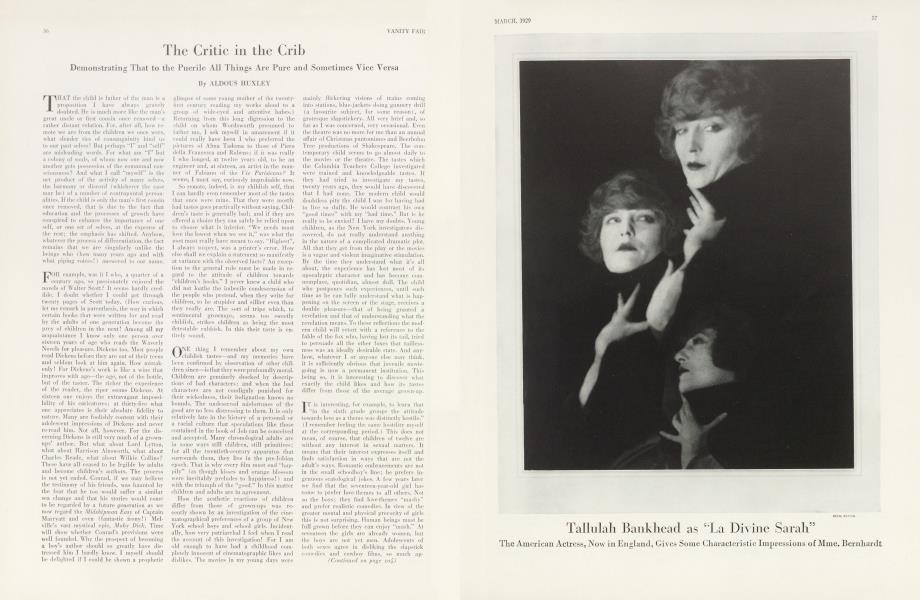
THAT the child is father of the man is a proposition 1 have always gravely doubted. He is much more like the man's great uncle or first cousin once removed—a rather distant relation. For, after all, how remote we are from the children we once were, what slender ties of consanguinity bind us to our past selves! But perhaps "I" and "self" are misleading words. For what am "1" but a colony of souls, of whom now one and now another gets possession of the communal consciousness? And what I call "myself" is the net product of the activity of many selves, the harmony or discord (whichever the case may be) of a number of contrapuntal personalities. If the child is only the man's first cousin once removed, that is due to the fact that education and the processes of growth have conspired to enhance the importance of one self, or one set of selves, at the expense of the rest; the emphasis has shifted. Anyhow, whatever the process of differentiation, the fact remains that we are singularly unlike the beings who (how many years ago and with what piping voices!) answered to our name.
FOR example, was it I who, a quarter of a century ago, so passionately enjoyed the novels of Walter Scott? It seems hardly credible. I doubt whether I could get through twenty pages of Scott today. (How curious, let me remark in parenthesis, the way in which certain books that were written for and read by the adults of one generation become the prey of children in the next! Among all my acquaintance I know only one person over sixteen years of age who reads the Waverly Novels for pleasure. Dickens too. Most people read Dickens before they are out of their teens and seldom look at him again. How mistakenly! For Dickens's work is like a wine that improves with age—the age, not of the bottle, but of the taster. The richer the experience of the reader, the riper seems Dickens. At sixteen one enjoys the extravagant impossibility of his caricatures; at thirty-five what one appreciates is their absolute fidelity to nature. Many are foolishly content with their adolescent impressions of Dickens and never re-read him. Not all, however. For the discerning Dickens is still very much of a grownups' author. But what about Lord Lytton, what about Harrison Ainsworth, what about Charles Reade, what about Wilkie Collins? These have all ceased to be legible by adults and become children's authors. The process is not yet ended. Conrad, if we may believe the testimony of his friends, "was haunted by the fear that he too would suffer a similar sea change and that his stories would come to be regarded by a future generation as we now regard the Midshipman Easy of Captain Marryatt and even (fantastic irony!) Melville's vast mystical epic, Moby Dick. Time will show whether Conrad s previsions were well founded. Why the prospect of becoming a boy's author should so greatly have distressed him I hardly know. I myself should be delighted if I could be shown a prophetic glimpse of some young mother of the twentyfirst century reading my works aloud to a group of wide-eyed and attentive babes.) Returning from this long digression to the child on whom Wordsworth presumed to father me, I ask myself in amazement if it could really have been I who preferred the pictures of Alma Tadema to those of Piero della Francesca and Rubens; if it was really I who longed, at twelve years old, to be an engineer and, at sixteen, an artist in the manner of Fabiano of the Vie Parisienne? It seems, I must say, curiously improbable now.
So remote, indeed, is my childish self, that I can hardly even remember most of the tastes that once were mine. That they were mostly bad tastes goes practically without saying. Children's taste is generally bad; and if they are offered a choice they can safely be relied upon to choose what is inferior. "We needs must love the lowest when we see it," was what the poet must really have meant to say. "Highest", 1 always suspect, was a printer's error. How else shall we explain a statement so manifestly at variance with the observed facts? An exception to the general rule must be made in regard to the attitude of children towards "children's books." I never knew a child who did not loathe the imbecile condescension of the people who pretend, when they write for children, to be stupider and sillier even than they really are. The sort of tripe which, to sentimental grownups, seems too sweetly childish, strikes children as being the most detestable rubbish. In this their taste is entirely sound.
ONE thing I remember about my own childish tastes—and my memories have been confirmed by observation of other children since—is that they were profoundly moral. Children are genuinely shocked by descriptions of bad characters; and when the bad characters are not condignly punished for their wickedness, their indignation knows no bounds. The undeserved misfortunes of the good are no less distressing to them. It is only relatively late in the history of a personal or a racial culture that speculations like those contained in the book of Job can be conceived and accepted. Many chronological adults are in some ways still children, still primitives; for all the twentieth-century apparatus that surrounds them, they live in the pre-Jobian epoch. That is why every film must end "happily" (as though kisses and orange blossom were inevitably preludes to happiness!) and with the triumph of the "good." In this matter children and adults are in agreement.
How the aesthetic reactions of children differ from those of grown-ups was recently shown by an investigation of the cinematographical preferences of a group of New York school boys and school girls. Incidentally, how very patriarchal I feel when I read the account of this investigation! For I am old enough to have had a childhood completely innocent of cinematographic likes and dislikes. The movies in my young days were mainly flickering visions of trains coming into stations, blue-jackets doing gunnery drill (a favourite subject, for some reason), of grotesque slapstickery. All very brief and, so far as I was concerned, very occasional. Even the theatre was no more for me than an annual affair of Christmas pantomimes and Beerbolnn Tree productions of Shakespeare. The contemporary child seems to go almost daily to the movies or the theatre. The tastes which the Columbia Teachers College investigated were trained and knowledgeable tastes. If they had tried to investigate my tastes, twenty years ago, they would have discovered that I had none. The modern child would doubtless pity the child I was for having had to live so dully. He would contrast his own "good times" with my "bad time." But is he really to be envied? I have my doubts. Young children, as the New York investigators discovered, do not really understand anything in the nature of a complicated dramatic plot. All that they get from the play or the movies is a vague and violent imaginative stimulation. By the time they understand what it's all about, the experience has lost most of its apocalyptic character and has become commonplace, quotidian, almost dull. The child who postpones such experiences, until such time as he can fully understand what is happening on the screen or the stage, receives a double pleasure—that of being granted a revelation and that of understanding what the revelation means. To these reflections the modern child will retort with a reference to the fable of the fox who, having lost its tail, tried to persuade all the other foxes that taillessness was an ideally desirable state. And anyhow, whatever I or anyone else may think, it is sufficiently obvious that juvenile moviegoing is now a permanent institution. This being so, it is interesting to discover what exactly the child likes and how its tastes differ from those of the average grown-up.
IT is interesting, for example, to learn that "in the sixth grade groups the attitude towards love as a theme was distinctly hostile." (I remember feeling the same hostility myself at the corresponding period.) This does not mean, of course, that children of twelve are without any interest in sexual matters. It means that their interest expresses itself and finds satisfaction in ways that are not the adult's ways. Romantic embracements are not in the small schoolboy's line; he prefers ingenuous scatological jokes. A few years later we find that the seventeen-year-old girl has come to prefer love-themes to all others. Not so the boys; they find love-themes "mushy" and prefer realistic comedies. In view of the greater mental and physical precocity of girls this is not surprising. Human beings must be full grown before they can enjoy "mush." At seventeen the girls are already women, but the boys are not yet men. Adolescents of both sexes agree in disliking the slapstick comedies and cowboy films, so much appredated in earlier years. Adolescence is the most priggish period of human life—the period during which even those "with foreheads villainous low" come near to being high-brow. One must have had a certain experience of life and, still more, of the things of the mind (the newly intellectual are as snobbish and arrogant in their way as the newly rich) before one can return with a good conscience to the simple amusements of childhood. While approving the rather pathetic, the charmingly ridiculous earnestness of the adolescent, I must admit that my own favourite fdms are precisely the extravagant farces and the lurid adventure stories which they despise. Not that I don't enjoy more serious films when they are good. But the trouble is that they are so seldom good. It is easier to achieve excellence in slapstickery and the Wild West than in high tragedy or the comedy of manners. Another class of film, of which I personally am very fond, is the documentary film which shows me places I have never visited, strange animals, odd people, queer trades. I was surprised to learn from the Teachers College report that "at no age did students like such semi-educational productions as Nanook, Grass, Moana, and Chang." This is the more to be wondered at, when we hear from two other investigators, Drs. Wood and Freeman, that experiments with many thousands of schoolchildren show that "class-room films can raise pupils' marks by an average of twentyfour per cent" and that the majority of teachers believe that such films are very effective "in arousing and sustaining the children's interest, in improving the quantity and quality of their reading and in aiding them to correlate features of their lessons with personal experiences and community conditions." The apparent contradictions contained in the two reports can be reconciled, if we reflect that the same educational fihn may appear wildly exciting when compared with lessons, but wildly dull when compared with play. And, anyhow1, the documentary film appears less interestingly novel to the child than to the adult for the good reason that the child has not had time to form a conception of everyday ordinariness, in comparison with which novelty can be assessed. To a child everything is equally queer, or equally obvious—it comes to the same thing. There is nothing in his eyes intrinsically odder about an Eskimo or a lion than about a horse or clergyman. It is only for the grown-up, long familiar with horses and clergymen, that there is anything remarkable about lions and Eskimos. Only the unfamiliar is odd. To the profoundly philosophical eyes of the child, clergymen are just as queer as lions. Moreover, in comparison with childish fancies (nourished from earliest years with fairy tales, Bible stories and the like), lions and Eskimos are tame and unsurprising creatures; the tropical jungle is not nearly so interesting as the landscape of the Arabian Nights; by comparison with fairy-land or the Garden of Eden, the South Sea Islands are dim and ordinary. Nanook and Chang and Moana are delightful imaginative liberations for those who have undergone long slavery in the world of adult interests. To the child, on the contrary, they seem merely a rather poor substitute for his fancies; they represent merely another aspect of that dull and heavy reality which clogs the too often sternly restricted freedom of his imagination.
Continued on page 104
Continued from page 56
Subscribers have complete access to the archive.
Sign In Not a Subscriber?Join Now
